Solar in Dubai vs Solar in the UK: Why the Maths Is Completely Different
Date Posted:Wed, 16th Sep 2026

Your summer DEWA bill has landed, and it wasn't pretty. If you've ever wondered whether solar panels make sense here and then dismissed the idea based on what you remember from the UK it's worth a second look. Almost every assumption in the British mental model of solar is wrong in Dubai. Some of it is wrong in your favour. Some of it isn't. Here's how the maths actually compares.
The sunshine gap is bigger than you think
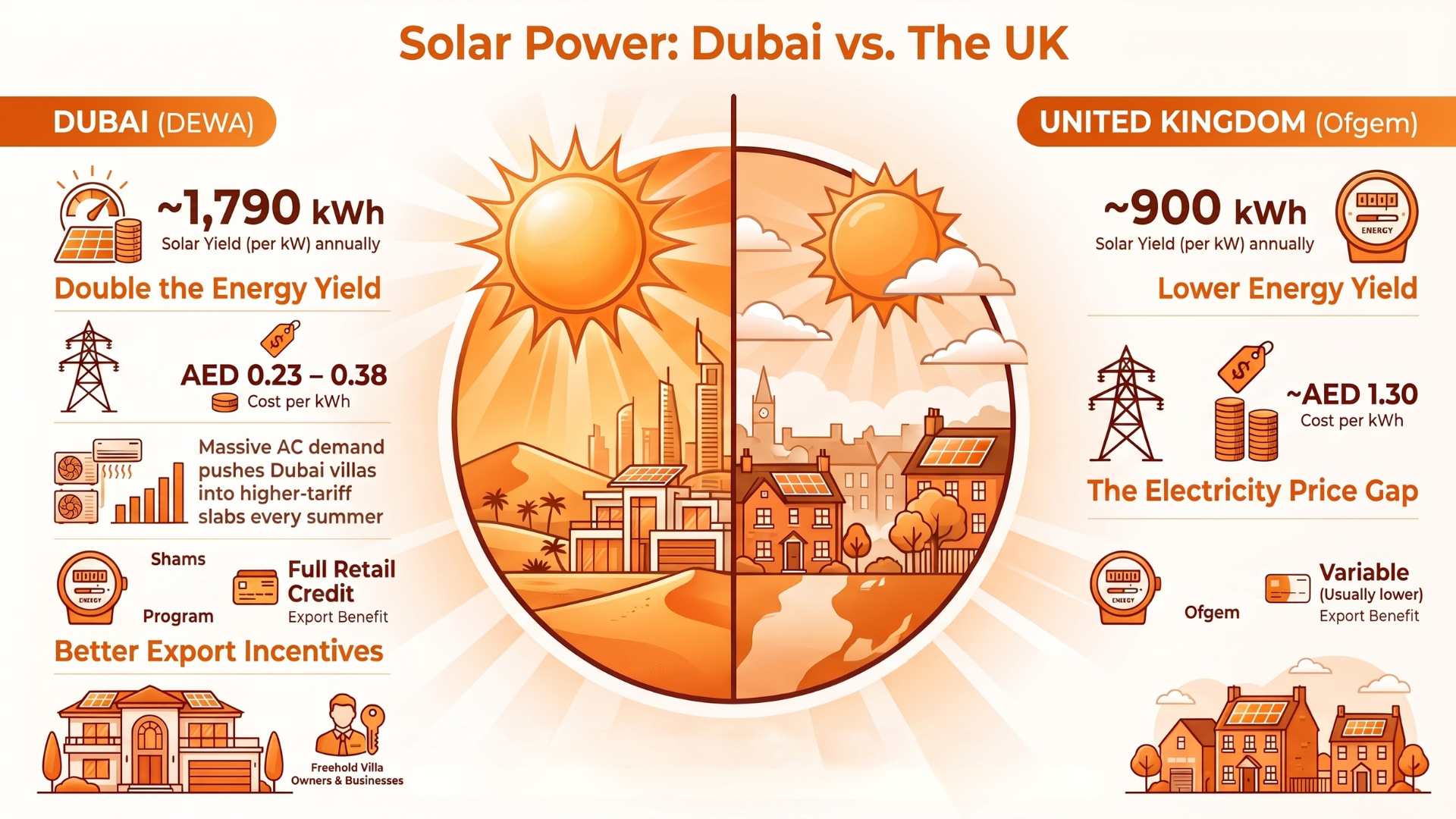
A solar panel's output depends on where it sits. According to the Global Solar Atlas, a well-installed system in Dubai produces around 1,790 kWh per year for every kilowatt of panel capacity. In the UK, the equivalent figure is typically in the region of 850–950 kWh. The same panels, on a Dubai roof, generate roughly double what they would in Surrey and they do it most reliably in exactly the months your air conditioning is working hardest.
But electricity here is far cheaper and that cuts the other way
Here's the part that surprises people. Under the Ofgem price cap for July–September 2026, UK households on a standard variable tariff pay 26.11p per kWh roughly AED 1.25–1.30 at recent exchange rates plus a daily standing charge of 57.19p.
Dubai residential electricity is billed on DEWA's slab tariff: rates start at 23 fils per kWh for the first 2,000 kWh each month and rise through 28 and 32 fils to 38 fils above 6,000 kWh, with a fuel surcharge (currently 6 fils per kWh) and 5% VAT on top. Even at the top "red" slab, you're paying well under half closer to a third of the UK unit rate.
So in the UK, expensive electricity makes even weak sunshine worth harvesting. In Dubai, cheap electricity means the sunshine has to do more of the work. What tips the balance back is volume: air conditioning drives villa consumption to levels no UK household ever approaches, pushing many homes deep into the higher slabs every summer month. Whether solar pays off for you depends almost entirely on where your consumption sits which is why generic answers are useless and quotes based on your actual bills matter.
The scheme is different too and in one way, better
British homeowners will remember the Feed-in Tariff, and its replacement, the Smart Export Guarantee, under which suppliers set their own export rates most fixed tariffs pay noticeably less per exported unit than you pay to import one.
Dubai runs a cleaner mechanism. Under Shams Dubai, DEWA's net metering programme running since 2015, your system first powers your property directly; any surplus is exported through a DEWA-installed bidirectional meter and credited against your bill at the full retail rate, with credits rolling over to future months. There's no cash payout credits only offset consumption but there's also no gap between what you're paid and what you'd otherwise pay. Excess generated in the milder months offsets the brutal August bill. One catch: installation must be carried out by a contractor enrolled with DEWA, and the system requires DEWA approval and inspection before connection.
The real qualifying question: do you control a roof?
This is where the honest filter comes in, and it applies whether you're thinking about home or work.
At home. If you own a freehold villa in e.g. Arabian Ranches, The Springs, Jumeirah Park, Dubai Hills and the like you're the ideal candidate. If you rent, you'll need your landlord's consent. Apartment residents are generally out, as the roof belongs to the building.
At work. The same logic, with better economics. If your business owns its premises a warehouse, industrial unit or standalone office the case is often stronger than residential, for two reasons. First, commercial DEWA accounts pay a flat 38 fils per kWh from the very first unit, so every kWh solar displaces is a top-rate kWh. Second, businesses consume electricity precisely when the sun is producing it: your operating hours and peak solar output overlap almost perfectly, whereas a villa's demand peaks in the evening. If you lease your premises, the landlord-consent hurdle applies though owner-managers on long leases with cooperative landlords do make it work. And if you happen to be a commercial landlord, a solar-equipped building is an increasingly marketable asset.
What does it cost?
Installer-published pricing in Dubai varies with system size, equipment tier and site conditions turnkey residential figures commonly quoted in the market range from roughly AED 1.8 to AED 4.5 per watt installed, meaning a typical villa system can run from the low tens of thousands of dirhams upwards. Treat any single number with suspicion; roof condition, shading, panel choice and consumption profile move the figure materially. For a fuller breakdown of current UAE pricing, see our 2026 cost guide.
The sensible first step
In the UK you'd never sign with the first double-glazing salesman at your door, and the same discipline applies here: get multiple itemised quotes and compare expected annual yield, equipment warranties and price not just the headline figure.
That's exactly what SolarQuote.ae exists to do. Submit one request with your details, and up to three DEWA-enrolled solar installers respond with quotes directly. It's free for homeowners and businesses, there's no markup quotes come straight from the installers and it works for a villa roof or a warehouse roof alike. If you control (or get a NOC letter from your landlord) a roof in Dubai, five minutes with your last few DEWA bills is all it takes to find out what the maths says for you: request your quotes here.
Figures cited are drawn from Ofgem, DEWA and Global Solar Atlas as of August 2026 and may change; exchange-rate conversions are approximate. Always verify current tariffs with the relevant utility.

Events Calendar
Upcoming Events

BCCD Business Advance Members Speed Networking Sponsored by Barclays International Banking
Wed, 7th Oct 2026
The Black Sheep
Building on the success of the BCCD Speed Networking series, we recently started hosting n... Read more

Battle of the Business Councils Golf Day
Thu, 8th Oct 2026
Dubai Creek Golf Club
BCCD invites you to our Battle of the Business Councils Golf Day & Dinner on Thursday 8th ... Read more

Battle of the Business Councils Golf Day - Dinner Only Registration
Thu, 8th Oct 2026
Lakeview, Dubai Creek Golf Club
Post-golf dinner and tournament prize presentation at Lakeview terrace... Read more


