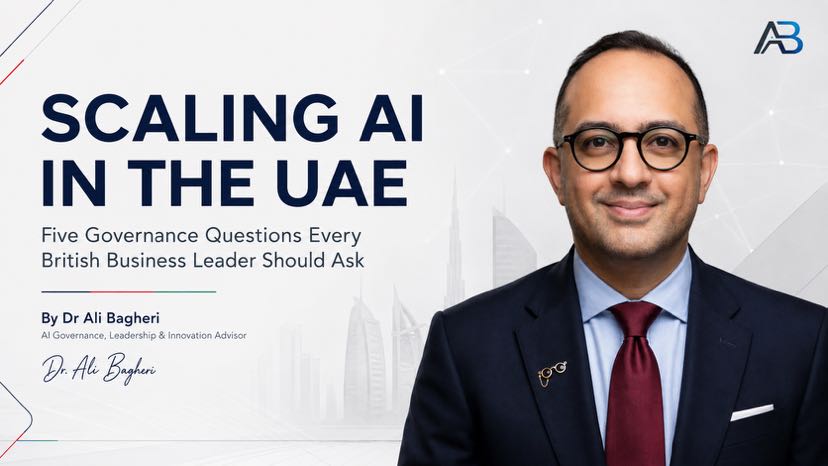
Scaling AI in the UAE: Five Governance Questions Every British Business Leader Should Ask
Date Posted:Thu, 20th Aug 2026

The leadership challenge: capture the UAE's AI opportunity without allowing speed to outrun accountability.
The UAE's AI advantage will depend on governance
The United Arab Emirates does not face a choice between moving fast with artificial intelligence and governing it well. Its real competitive advantage will come from doing both. The country's direction is unambiguous. The UAE Strategy for Artificial Intelligence 2031 places AI at the centre of economic, government and capability development. Dubai's Universal Blueprint for Artificial Intelligence is accelerating adoption across sectors, attracting specialist companies and strengthening the emirate's position in AI governance and legislation. Dubai Chambers has also documented a marked rise in business AI adoption, from 7 per cent in Q4 2022 to 21 per cent in Q4 2024.
For British companies operating in the UAE, this creates a significant opportunity. But adopting more tools is not the same as becoming AI-ready. The critical question is whether leadership structures, decision rights and controls are developing as quickly as the technology itself.
Governance is not a brake on innovation. It is the operating system that allows an organisation to innovate repeatedly, responsibly and at scale.
The following five questions offer a practical starting point for boards, executive teams and business owners.
What decisions is AI actually influencing?
Many organisations begin with a list of tools: copilots, chatbots, recommendation engines or automated screening systems. Governance should begin somewhere else - with the decisions those systems influence.
An AI assistant drafting an internal email does not carry the same exposure as a system recommending who receives credit, employment, healthcare or insurance. Leaders should map AI uses according to the significance of the decision, the people affected and the consequences of error. This shifts the conversation from technology inventory to business accountability.
Who owns the outcome - not merely the system?
The most common governance weakness is an ownership gap. Technology teams may manage the platform, vendors may supply the model and business units may use the output, yet no executive clearly owns the resulting decision.
Every consequential AI use should therefore have a named business owner with authority to approve its purpose, accept its risks and stop its use when necessary. This is particularly relevant in the UAE's fast-moving environment, where pilots can move into daily operations before accountability has been formalised.
What data is entering the system, and where is it going?
Generative AI has made experimentation easy. It has also made it easy for employees to place customer information, commercial material or internal documents into tools without understanding how that data may be stored, processed or reused.
British businesses must adapt their familiar privacy and assurance disciplines to the UAE's multi-layered environment. The federal Personal Data Protection Law establishes national requirements, while financial free zones maintain their own regimes. Within the DIFC, Data Protection Regulation 10 directly addresses systems that process personal data and clarifies accountability for deployers and operators. The practical response is not a blanket ban. It is clear data classification, approved tools, supplier due diligence and role-based guidance for employees.
What data is entering the system, and where is it going?
Generative AI has made experimentation easy. It has also made it easy for employees to place customer information, commercial material or internal documents into tools without understanding how that data may be stored, processed or reused.
British businesses must adapt their familiar privacy and assurance disciplines to the UAE's multi-layered environment. The federal Personal Data Protection Law establishes national requirements, while financial free zones maintain their own regimes. Within the DIFC, Data Protection Regulation 10 directly addresses systems that process personal data and clarifies accountability for deployers and operators. The practical response is not a blanket ban. It is clear data classification, approved tools, supplier due diligence and role-based guidance for employees.
Where must a human intervene?
Human oversight is often promised but rarely designed. A person cannot provide meaningful oversight if they lack the information, authority or time to challenge an AI recommendation.
For each material use case, leaders should define when human review is mandatory, what evidence the reviewer receives and who can override or suspend the system. They should also specify an escalation route for unusual, high-impact or contested outcomes. Human involvement must be an operational control, not a sentence in a policy.
How will we measure value, detect harm and reverse a decision?
A successful pilot can still become an operational liability if performance deteriorates, user behaviour changes or the underlying business context shifts. AI governance must therefore continue after launch.
Management should monitor business value alongside accuracy, complaints, exceptions, bias indicators and security events. Equally important is reversibility: can the organisation pause the system, reconstruct what happened, correct an outcome and return safely to a human or previous process? In high-impact settings, the ability to reverse may be as important as the ability to automate.
From policy to operating capability
The right response is not to begin with a hundred-page AI policy. It is to build a lightweight governance system around real business decisions. A practical first cycle can include:
- Select one meaningful use case - where AI is already being used or is close to deployment.
- Assign an accountable executive - who owns the business outcome and can approve, pause or redesign the use.
- Classify the exposure - across decision impact, data sensitivity, legal obligations and reputational risk.
- Define the controls - including approved data, human review, escalation, monitoring and rollback.
- Prepare the workforce - so leaders and employees understand not only how to use AI, but when not to rely on it.
This approach aligns well with the UAE's broader direction. The Dubai AI Seal, for example, is designed to strengthen trust in AI providers and create responsible business opportunities. The signal is important: in the UAE market, credibility will increasingly depend not only on having AI capability, but on demonstrating that the capability can be trusted.
A UK-UAE opportunity
British businesses bring valuable experience in corporate governance, professional standards, risk management and data responsibility. The UAE brings ambition, implementation speed, public-private collaboration and a strong appetite for new business models. The opportunity is not to export one governance model unchanged. It is to combine these strengths into an approach suited to the region.
The organisations that lead will not necessarily be those using the greatest number of AI tools. They will be those that can answer, clearly and consistently: what is the system allowed to do, who is accountable, how do we know it is working, and what happens when it is wrong?
The next phase of AI leadership in the UAE is not adoption alone. It is accountable adoption - converting ambition into trusted, repeatable business value.
An invitation to collaborate
As a Dubai-based AI Governance, Leadership & Innovation Advisor, I welcome conversations with BCCD members seeking to assess their AI readiness, strengthen executive accountability or develop practical governance capabilities. I would also be pleased to contribute to a BCCD member roundtable, executive briefing or collaborative learning initiative focused on responsible AI adoption in the UAE.
About the author
Dr Ali Bagheri is a Dubai-based AI Governance, Leadership & Innovation Advisor, executive trainer and consultant with more than 20 years of experience in technology, innovation and organisational transformation. He holds a PhD in Technology and Innovation Management and a DBA in Digital Transformation. His work helps leaders translate AI ambition into clear governance, leadership readiness and measurable business value across the UAE and GCC.
An invitation to collaborate
As a Dubai-based AI Governance, Leadership & Innovation Advisor, I welcome conversations with BCCD members seeking to assess their AI readiness, strengthen executive accountability or develop practical governance capabilities. I would also be pleased to contribute to a BCCD member roundtable, executive briefing or collaborative learning initiative focused on responsible AI adoption in the UAE.
About the author
Dr Ali Bagheri is a Dubai-based AI Governance, Leadership & Innovation Advisor, executive trainer and consultant with more than 20 years of experience in technology, innovation and organisational transformation. He holds a PhD in Technology and Innovation Management and a DBA in Digital Transformation. His work helps leaders translate AI ambition into clear governance, leadership readiness and measurable business value across the UAE and GCC.
Selected official sources
- UAE Government - AI resources and UAE Strategy for Artificial Intelligence 2031
- UAE Government - Data protection laws
- Dubai Government - Dubai Universal Blueprint for Artificial Intelligence
- Dubai Government - Dubai AI Seal
- DIFC - Data Protection Regulation 10
- Dubai Chambers - Assessing Business Confidence Report 2025
Events Calendar
Upcoming Events

BCCD Business Briefing: The Financial Landscape - Trust, Regulations and the Road Ahead, Sponsored by Canaccord Wealth
Tue, 13th Oct 2026
voco Dubai
As the wealth and investment landscape evolves, so does the expectation around regulation ... Read more

BCCD Masterclass - Clarity in Chaos: Navigating Leadership Decisions
Wed, 14th Oct 2026
Hotel Indigo Dubai Downtown
Join us for “Clarity in Chaos: Navigating Leadership Decisions”, an immersive, high-st... Read more

BCCD Breakfast Networking
Wed, 21st Oct 2026
Reform Social & Grill
Kickstart your morning with valuable connections & conversations. This casual yet engaging... Read more


