Immigration and Other Developments in the MENA Region
Date Posted:Fri, 17th Jul 2026

.
United Arab Emirates
Sharjah Introduces Additional Temporary Business Support Measures
6 July 2026
Sharjah has introduced a three-month package of fee reductions, exemptions and other incentives to reduce operating costs and support businesses across the Emirate.
A closer look
Sharjah has announced a temporary package of business support measures designed to reduce operating costs and improve the ease of doing business across the Emirate. The package includes:
- 50% reductions in fees for renewing commercial security permits, security system subscriptions and fines imposed on economic establishments.
- A 20% reduction in fees for mandatory corporate training programmes, including occupational health and safety courses.
- Fee exemptions and operational facilitations for businesses operating in the transport sector.
- Additional operational relief, including measures relating to traffic fines, vehicle registration and heavy vehicle operations.
The measures will remain in effect for three months from the date of implementation.
Impact
Businesses operating in Sharjah, particularly those in the commercial, transport and logistics sectors, should assess whether they are eligible for the available incentives. The measures may reduce operating costs and ease compliance with certain regulatory requirements during the three-month implementation period.
Background
These measures form part of Sharjah's broader efforts to support the business community through targeted financial incentives and regulatory relief. For further information on previously announced business support measures, please refer to Fragomen News Flash 088.26.
If you have any questions or require assistance, please do not hesitate to contact Fragomen at [email protected].
Emiratization Requirements in the Private Health Care Sector Revised
6 July 2026
Private healthcare facilities with 50 or more employees must now allocate their mandatory annual 2% Emiratization target equally between specialised healthcare professions and other skilled positions within the facility. Previously, employers could meet the target across skilled positions without being required to allocate it equally between these two categories.
A closer look
The Ministry of Human Resources and Emiratisation (MOHRE), in coordination with the Ministry of Health and Prevention, has revised the Emiratization requirements applicable to private healthcare facilities employing 50 or more workers.
While the existing 2% annual Emiratization target remains unchanged, employers must now allocate the required annual increase equally between specialised healthcare professions, such as physicians, nurses and pharmacists, and other skilled positions within the facility. Previously, employers could satisfy the annual target across skilled positions without a prescribed allocation between these two categories.
The implementation timeline remains unchanged – employers must continue to achieve 1% Emiratization growth during the first half of the year and the remaining 1% during the second half. Healthcare facilities that have already met the first-half requirement should ensure recruitment during the second half of 2026 complies with the revised allocation. MOHRE will begin assessing compliance with the revised requirement in 2027.
Employers may also use the Nafis platform to source qualified Emirati candidates for specialised healthcare professions and other skilled positions.
Impact
Affected private healthcare facilities should review their recruitment plans to ensure the required allocation between specialised healthcare professions and other skilled positions is achieved. Compliance with the revised requirement will be assessed from 2027, and non-compliant employers may be subject to financial contributions.
If you have any questions or require assistance, please do not hesitate to contact Fragomen at [email protected].
Authorities Conducting Verification of Educational Certificates for Work Permit Issuance
2 July 2026
Immigration practitioners have observed that the Ministry of Human Resources and Emiratisation in Abu Dhabi is assessing with significantly increased diligence the adequacy of education certificates submitted with work permit applications.
A closer look
Work permit applications have been returned with requests for corrected education certificate documentation. Furthermore, even current work permit holders have been asked to resubmit corrected education certificate documentation. Instances where authorities are flagging inadequate education certification include the following:
- Education certificates containing additional stickers, stamps, or markings that are not part of the official verification process;
- The equivalency process is incomplete;
- Uploaded document images are unclear or low quality;
- There is a mismatch between the name on the educational certificate and the passport;
- The education certificates have been issued by unrecognised universities; and
- The education certificates have not been recently legalised.
This verification process is currently only being implemented in Abu Dhabi. It may be extended to other emirates.
Impact
Affected individuals should ensure that education certificates submitted for work permit issuance are clear, high-quality scans of the original documents and do not contain any additional stickers, stamps, or markings that are not part of the official verification process. Certificates should also meet all required criteria, including completed equivalency (where applicable), consistency between the name on the certificate and the passport, issuance by a recognised university, and valid recent legalisation.
If you have any questions or require assistance, please do not hesitate to contact Fragomen at [email protected].
Visa-on-Arrival Expanded for Select Nationals
29 June 2026
Nationals of Indonesia, Kenya, the Philippines, South Africa, Thailand, and Vietnam holding residence permits from select countries are now eligible for a visa on arrival in the United Arab Emirates for tourism or business stays of up to 60 days.
A closer look
To be eligible, affected individuals must hold a residence permit from Australia, Canada, any country in the European Union, Japan, New Zealand, Singapore, South Korea, the United Kingdom, or the United States.
Previously, affected individuals were required to obtain a visa prior to arrival.
Eligible travelers must also meet the following requirements:
- Have a passport with a minimum of six months validity from the intended date of entry;
- Have valid health insurance;
- Have a return or onward ticket; and
- Pay the applicable visa fee upon arrival.
The permitted duration of stay is either 14 days or 60 days.
The 14-day visa may be extended once while the holder is in the United Arab Emirates. By contrast, the 60-day visa is issued as a single-entry visa and cannot be extended. Visa holders must depart the United Arab Emirates before the expiry of their authorized stay. Individuals who overstay their visa will be subject to a fine of AED 50 for each day of overstay.
Individuals travelling for other purposes (including study or work) must continue to obtain a visa prior to arriving in the country.
Impact
This latest expansion builds on the existing visa-on-arrival policy and aligns with the country’s broader visa reforms, which aim to boost tourism and facilitate smoother travel for foreign nationals.
If you have any questions or require assistance, please do not hesitate to contact Fragomen at [email protected].
Dubai Introduces Flexible Rental Payment Schemes
26 June 2026
Effective immediately, the Dubai Land Department has launched the Flexi Rent scheme to reduce financial pressure on tenants by offering flexible rental payment options. Tenants can now pay monthly, quarterly, or annually instead of relying on the traditional large upfront or limited cheque payments.
The scheme is currently implemented by 11 real estate and property management companies and applies to both new and existing tenants, with more companies expected to join.
A closer look
Under Flexi Rent, participating landlords may offer tenants monthly, quarterly, or annual payment options on a voluntary, case-by-case basis, with additional benefits such as grace periods, revised payment schedules, promotional offers or rent freezes. Payments can be made via credit card, debit card, or cheque, and tenants previously on four-cheque plans will have standard administrative fees waived.
The pilot phase involves 11 real estate and property management companies - Wasl Properties, Deyaar Property Management, Dubai World Real Estate, Dubai Investment Real Estate, Modern Real Estate, SBK Real Estate, Rocky Real Estate, SRG Properties, Harbor Real Estate, Driven Properties, and Al Showaib Real Estate - with further companies expected to join. The initiative will be evaluated using key performance indicators such as the number of units enrolled, tenancy contracts under Flexi Rent, occupancy levels, payment compliance, and tenant feedback.
The scheme applies to both new and existing tenants, who must request changes directly from landlords or property managers, as participation is not automatic.
Impact
Flexi Rent helps Dubai-based residents better align rent payments with salary cycles. For new arrivals, the scheme provides immediate payment flexibility and potential access to more favourable terms in some cases.
Mobility teams managing housing allowances or relocation packages may benefit from greater predictability in payment scheduling, while also using the scheme to support negotiations for more favourable terms at renewal or when relocating within the emirate.
Background
The scheme builds on earlier Dubai government initiatives supporting the real estate sector, including the first-time homebuyer programme, the 2025 smart rental index, and updated visa rules aimed at attracting overseas residents and investors.
If you have any questions or require assistance, please do not hesitate to contact Fragomen at [email protected].
Sharjah Government Announces Business Support Package
26 June 2026
Effective immediately, the Emirate of Sharjah has announced a three-month package of business support measures, including fee discounts, exemptions, and payment deferrals. The initiative is designed to help companies manage operating costs and maintain business continuity.
A closer look
A range of corporate incentives have been introduced to improve cash flow and liquidity for businesses and reduce financial pressure. These include:
- Exemption from late payment penalties for micro-licences, covering e-commerce and Eitimad domestic licences
- 50% discount on issuance and renewal fees for micro-licences for three months
- 50% discount on industrial licence fees for targeted sectors, including food and pharmaceutical industries
- 25% reduction on promotional campaign permit fees
- 25% reduction on issuance and renewal fees for nursery licences
Impact
These measures are intended to support business continuity, ease financial pressure on companies, and enhance liquidity, thereby contributing to sustained growth across Sharjah.
Background
Earlier, the Emirate of Dubai announced a business support package worth AED 1 billion, to be implemented over three to six months starting 1 April 2026. The package is aimed at supporting businesses and enhancing economic agility. This was later followed by an additional AED 1.5 billion in economic incentives, bringing the total value of support measures to AED 2.5 billion.
If you have any questions or require assistance, please do not hesitate to contact Fragomen at [email protected].
Grace Period Announced for Foreign Nationals in Irregular Status
22 June 2026
From now until July 9, 2026, eligible foreign nationals who were affected by travel disruptions from February 28, 2026 until March 31, 2026 are subject to a grace period during which they may either regularize their immigration status or depart the United Arab Emirates without incurring penalties.
To be eligible, the foreign national must hold a UAE visit visa, an exit permit, or a resident permit (which they cancelled in preparation for departure in the relevant period).
Impact
This grace period provides relief to affected individuals by allowing them to regularize their status or depart without penalties.
Employers may wish to review the status of impacted employees and plan accordingly within the validity period of the grace period.
Background
In March 2026, immigration authorities introduced flexibility measures for holders of visit visas, exit permits, and residents who cancelled their UAE residency in preparation for departure but were affected by the travel disruptions.
If you have any questions or require assistance, please do not hesitate to contact Fragomen at [email protected].
Saudi Arabia
Clarification on Permitted Business Activities under Saudi Arabia – Russia Visa Waiver Agreement
13 July 2026
Saudi authorities have clarified that Russian nationals travelling under the Saudi Arabia–Russia visa waiver agreement may undertake limited business activities, including attending business meetings and exploring business or investment opportunities. Other business-related activities may require a business visit visa.
A closer look
Following the implementation of the visa waiver agreement between Russia and Saudi Arabia, Fragomen has sought clarification from the Saudi authorities regarding the scope of business activities permitted for individuals travelling under the agreement.
Based on information obtained from the relevant authorities, affected individuals may undertake limited business activities, including attending business meetings and exploring business or investment opportunities. Individuals intending to engage in other business-related activities may be required to obtain a business visit visa before travel.
As detailed guidance on the full scope of permitted business activities under the agreement is not available, employers should assess the intended purpose of travel on a case-by-case basis to ensure compliance with applicable entry requirements.
By way of background, Russian nationals may enter Saudi Arabia visa-free for up to 90 days per calendar year, whether on a continuous or cumulative basis, for tourism, business, or visits to family and friends. The agreement does not cover employment, study, residence, or Hajj-related travel, for which the appropriate visa must be obtained in advance.
If you have any questions or require assistance, please do not hesitate to contact Fragomen at [email protected].
Grace Period Extended for Foreign Workers in Irregular Status
10 July 2026
Saudi Arabia has extended the grace period to regularise the status of foreign workers whose work permits expired more than 12 months ago or who were not issued a work permit within six months of commencing employment. The new deadline is December 31, 2026.
A closer look
Saudi Arabia has extended until December 31, 2026, the grace period for employers to regularise the status of foreign workers whose work permits expired more than 12 months ago or who were not issued a work permit within six months of joining an establishment.
Previously, the deadline was June 30, 2026, after which foreign workers whose work permits had been expired for more than three months were scheduled to be automatically removed from their employers’ records in the Qiwa portal.
Impact
Employers are advised to review the status of their foreign workforce and, where necessary, renew or obtain work permits before the revised deadline of December 31, 2026. Failure to regularise workers' status by the deadline may result in financial penalties and other compliance consequences.
If you have any questions or require assistance, please do not hesitate to contact Fragomen at [email protected].
Reminder: Increased Saudization Requirements for Engineering Sector
25 June 2026
As a reminder, updated Saudization requirements now apply to certain roles in Saudi Arabia’s engineering sector.
A closer look
As a reminder, the Ministry of Human Resources and Social Development (MHRSD) has increased Saudization requirements for private-sector entities employing five or more accredited engineers across 46 engineering professions, including oil and gas engineer, mechanical engineer, chemical engineer, electrical engineer, and civil engineer. Affected employers must ensure that 30% of such roles (up from the current 25%) are filled by Saudi nationals by June 30, 2026.
The MHRSD also announced that the minimum monthly salary for Saudi engineers will increase from SAR 7,000 to SAR 8,000.
As was the case previously, all engineers regardless of nationality, must be accredited by the Saudi Council of Engineers, as only accredited engineers will count toward the company’s Saudization percentage. In addition, the engineer’s monthly salary must be registered with the General Organization for Social Insurance. Saudi engineers earning less than SAR 8,000 per month are excluded from this calculation.
Impact
Affected employers should review the composition of their workforce so that it is aligned with the newly announced Saudization rates. This may include reviewing staffing structures, increasing the recruitment and retention of Saudi nationals, and leveraging available government support programs to meet compliance requirements.
Employers that fail to comply may face penalties, including the suspension of MHRSD services, such as employee transfer services and work permit renewals.
Background
In February 2024, it was announced that the Saudization targets for private-sector businesses employing five or more accredited engineers were set to increase to 25 percent, up from 20 percent by July 2024.
The implementation of these new Saudization requirements follows a broader trend across a number of industries. For example, in December 2025, Saudi Arabia announced new Saudization requirements for the sports sector and housing supervisors. This followed the introduction of Saudization requirements for several roles in the tourism sector in April 2025 and earlier, in February 2025, the authorities announced increases to Saudization rates for private sector roles in the accounting, dentistry, engineering and pharmacy industries.
If you have any questions or require assistance, please do not hesitate to contact Fragomen at [email protected].
Premium Residency Holders Now Require Work Permits
24 June 2026
Premium Residency holders must now obtain a separate work permit before commencing employment. Previously, Premium Residency holders were eligible to work without a separate work permit.
A closer look
Premium Residency holders must now obtain a separate work permit before commencing employment. Previously, Premium Residency holders were eligible to work without a separate work permit.
Work permit applications are made through the Qiwa platform. As was the case previously, Premium Residency holders must continue to have their employment contract registered on Qiwa and be registered with General Organisation for Social Insurance. The situation for existing Premium Residency holders remains unclear including whether they must obtain a work permit and, if so, the deadline by which such permit must be obtained.
The validity period of the work permit has not been officially confirmed; however, work authorisations are generally aligned with annual employment cycles and may therefore be expected to require renewal on a yearly basis.
Impact
Employers will need to update onboarding processes to ensure that any employees who are Premium Residency holders remain compliant with work permit rules.
Background
Saudi Arabia’s Premium Residency, introduced in 2019, allows eligible foreign nationals to live, work, and own businesses and property without a local sponsor. It includes both permanent and renewable options, and is available under categories such as investors, property owners, and talented or exceptional individuals.
Qiwa, the Ministry of Human Resources and Social Development’s digital platform, manages labour market processes including employment contracts, work permits, and Saudization compliance.
If you have any questions or require assistance, please do not hesitate to contact Fragomen at [email protected].
Reminder: Social Security Contribution Rate Increased
22 June 2026
As a reminder, the General Organization for Social Insurance introduced amendments to the Social Insurance Law affecting Saudi nationals registered under the new social insurance system. From July 1, 2026, the second phase of the scheduled increase in contribution rates will take effect for eligible employees and employers.
A closer look
Under the amended regulations, Saudi nationals are categorised into two groups for pension contribution purposes:
Employees registered before July 3, 2024
Saudi nationals who were registered with the General Organization for Social Insurance (GOSI) prior to July 3, 2024, remain subject to the existing social insurance framework. Their pension contribution rates are unchanged at 18%, with a total contribution of 18%, split equally between employer and employee (9% each). No phased increases apply to this group.
Employees registered on or after July 3, 2024
Saudi nationals registered for the first time under the new Social Insurance Law are subject to a phased increase in pension contribution rates. This increase is being implemented annually, starting 12 months after the issuance of the regulations, with contributions rising by 0.5% per year for both employer and employee until reaching the full rate in July 2028.
The applicable contribution schedule is as follows:
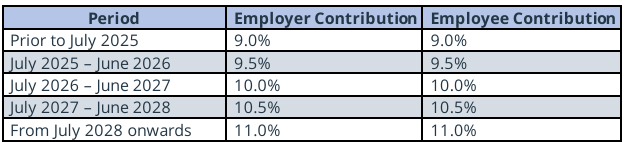
This represents a total increase of 2% for each party, resulting in a final pension contribution rate of 11% for employers and 11% for employees.
Impact
Employers should identify Saudi national employees who were first registered with GOSI on or after July 3, 2024, and ensure that payroll and HR systems are updated to reflect the increased contribution rate effective July 1, 2026. They should also review employment cost projections and budgets to account for the increase in employer contributions and communicate the upcoming change to affected employees while addressing any questions relating to payroll deductions.
If you have any questions or require assistance, please do not hesitate to contact Fragomen at [email protected].
Qatar
Freehold Real Estate Ownership Zones Expanded for Non-Qatari Real Estate Ownership
9 July 2026
Qatar has expanded the designated freehold real estate ownership zones where non-Qataris are permitted to own real estate by adding the Simaisma Beach and Resort Project.
A closer look
The Simaisma Beach and Resort Project has been added to the list of designated freehold real estate areas where non-Qataris may own real estate.
Previously, non-Qataris were permitted to own property only in the following designated areas:
- West Bay (Legtaifiya)
- The Pearl
- Al Khor Resort
- Al Dafna (administrative area)
- Onaiza (administrative area)
- Lusail
- Al Kharayej
- Jabal Thuaileb
Impact
The inclusion of the Simaisma Beach and Resort Project provides additional investment opportunities for non-Qataris seeking to purchase real estate in Qatar.
If you have any questions or require assistance, please do not hesitate to contact Fragomen at [email protected].
Employers Encouraged to Update Entity Contact Information
8 July 2026
The General Retirement and Social Insurance Authority (GRSIA) in Qatar is encouraging all registered companies to update their entity contact information via the Government-to Business (G2B) portal.
This request forms part of a broader compliance initiative recently undertaken by GRSIA, which has intensified its awareness efforts and conducted a series of inspection visits to employers' offices across Qatar. These visits are aimed at strengthening employer compliance with social insurance regulations and reinforcing awareness of statutory obligations under Qatari law. In this context, ensuring that entity contact information is accurate and current on the G2B portal should be regarded as a priority action, as it directly supports employers' ability to receive and respond to regulatory communications in a timely manner, and may also reduce exposure during future compliance reviews or inspections.
Impact
Employers are encouraged to ensure that their designated points of contact are accurate and up to date on the G2B portal, as GRSIA relies on this information to issue official notifications, including those relating to inspection visits and compliance requirements.
Failure to maintain accurate contact details may result in missed or delayed notifications from GRSIA, which could affect employers' ability to respond in a timely manner to regulatory updates or upcoming inspection visits, potentially leaving them less prepared and increasing their exposure during compliance reviews.
If you have any questions or require assistance, please do not hesitate to contact Fragomen at [email protected].
Amendments to the Labor Law Introduced
2 July 2026
Qatar has amended its Labor Law, including broader exclusions from labour law coverage, mandatory training and certification requirements, stricter post-termination non-compete provisions, revised thresholds for joint committees, and new financial penalties. While most of the changes relate specifically to employment regulations, some of the amendments will affect immigration processes.
A closer look
The amendments to the labor law introduce key changes, including the following:
- Mandatory training requirement. Workers in certain professions must obtain training and certification from Ministry-accredited centres before commencing employment. A list of professions required to complete the training, and certification is expected to be published on the Ministry of Labour’s website. This may result in delayed start dates for affected employees, as individuals will likely need to complete the required training and obtain certification before being permitted to begin work.
- Expansion of categories of workers excluded from Labor Law coverage. The Labor Law expands the categories of workers excluded from the scope of the Labor Law to include part-time and freelance workers and employees of companies operating in the petroleum industry (including the marketing and sale of petroleum and petroleum products). Despite this change, the Council of Ministers may, on the recommendation of the Minister of Labour, apply certain Labour Law provisions to these workers or introduce a separate regulatory framework. This change expressly recognizes part-time and freelance arrangements through their exclusion from the scope of the Labor Law.
- Amendments to post-termination non-compete clauses. The maximum duration of a post-termination non-compete clause – which allows employers to restrict former employees from working for competing businesses – has been increased to two years (up from the previous one year). Additionally, such clauses no longer apply where employment is terminated during the probationary period.
- Revised threshold for mandatory joint committees. Every establishment employing 100 or more workers (previously 30 or more) must form a joint committee comprising equal representatives of the employer and workers.
- Suspension of Ministry of Labour services for repeat violations. Repeated labor law violations by the same establishment within the same year, including wage disputes, may lead to the suspension of all or part of the employer’s applications and transactions submitted to the Ministry including those of establishments affiliated with the offending employer. Suspension of Ministry of Labour services is common practice, but the extension of such practice to affiliated entities is a new development.
- Public listing of violating establishments. Repeated labor law violations, including violations involving recruitment of workers from abroad, employees performing work other than agreed, wage non-compliance, and work injuries, may result in the offending establishment being listed on the Ministry of Labour’s website. This introduces a form of public disclosure as a compliance tool. The impact is reputational, as public listing may affect how employers are perceived by clients and prospective employees, thereby encouraging stronger compliance.
- New penalties for joint committees. A fine ranging from QAR 2,000 to QAR 5,000 has been introduced for breaches of the mandatory joint committee requirement.
- New penalties for wage non-compliance. A fine ranging from QAR 2,000 to QAR 10,000 and or imprisonment for up to one year has been introduced for wage non-compliance.
The Ministry of Labour is expected to issue implementing regulations that will provide further details of the amendments. It is not clear when these regulations will be available.
Impact
The amendments introduce updated employer compliance requirements, including mandatory training and stricter penalties.
At the same time, the changes also provide greater flexibility for part-time and freelance arrangements, reflecting a more adaptable approach to non-traditional forms of work.
Employers will need to strengthen internal compliance processes to align with the updated framework and are encouraged to review the new requirements to ensure full compliance.
If you have any questions or require assistance, please do not hesitate to contact Fragomen at [email protected].
Kuwait
Eligibility Criteria Announced for 15-Year Investor Residency Permit
7 July 2026
Kuwait has issued the executive regulations for obtaining a 15-year Investor Residency Permit. The regulations set out the categories for eligible applicants, the minimum investment thresholds, and the criteria applicable to qualifying entities.
A closer look
The regulation establishes eligibility for the 15-year Investor Residency Permit for investors, partners, directors and senior management and their family members, including spouse, children and parents, subject to approval by the Kuwait Direct Investment Promotion Authority (KDIPA) and the Ministry of Interior.
To qualify, the value of the investment must be worth at least KWD 5,000,000, with the applicant depositing an additional paid-up capital of at least KWD 1,000,000 into the investment entity’s bank account. The investment entity must hold a valid investment license issued by KDIPA to conduct business activities from within Kuwait and must comply with the required Kuwaitization quotas.
Applicants must have a passport validity of at least 6 months and a clear criminal record to apply.
Impact
The Investor Residency Permit is expected to enhance Kuwait's attractiveness as an investment destination by providing eligible foreign investors with up to 15 years of long-term residency.
Background
As part of Kuwait's immigration reforms introduced in January 2026, the maximum validity of investor residency permits was extended to 15 years for eligible investors, with the implementing regulations and eligibility criteria now announced.
If you have any questions or require assistance, please do not hesitate to contact Fragomen at [email protected].
Relaxed Employer Transfer Rules in Limited Circumstances
26 June 2026
Foreign workers may now transfer to a new employer before completing one year of employment where employers are in breach of certain contractual or regulatory obligations. Previously, this was only possible after one year of employment, regardless the conduct of the employer.
A closer look
Foreign workers may transfer to a new employer before completing one year of employment in the following circumstances:
- The employer fails to secure a work or residence permit for the foreign worker including because they fail to complete necessary elements of the application process.
- The employer’s file – a profile registered with authorities that contains a company’s labor records – has been suspended or restricted by the authorities.
- The employer fails to pay a foreign worker’s salary in accordance with official procedures.
- Where the employer’s conduct grants an employee the right to terminate their employment contract without prior written notice while retaining full end-of-service benefits and rights. The circumstances in which such a right emerges are set out under Kuwait employment law.
- Where an absconding report (an official complaint filed by an employer against a foreign worker who is alleged to have ceased working without permission or is no longer reporting to work) is found to be malicious, incorrect, or intended to harm the worker, to prevent them from claiming their rights, or to obstruct the transfer of their work permit.
Previously, foreign workers could transfer to a new employer only after completing one year of employment and with the employer’s consent, regardless of any conduct by the employer.
Impact
The amendments increase flexibility for foreign workers in cases of employer non-compliance or disputes, while increasing the incentive for employers to adhere to obligations around residency and salary payments.
If you have any questions or require assistance, please do not hesitate to contact Fragomen at [email protected].
Oman
Increased Employer Social Protection Fund Contributions Forthcoming
2 July 2026
Effective July 19, 2026, employer contributions to Oman’s Social Protection Fund will increase by 1% for Omani and non-Omani employees based in Oman.
A closer look
The employer contribution rate to Oman’s Social Protection Fund (SPF) will increase by 1% for employees in Oman, as follows:
- For Omani employees, the total contribution will rise from 21.5% to 22.5%, with the employer bearing the additional 1%, bringing the employer share to 14.5%.
- For non-Omani employees, the total contribution will rise from 1% to 2%, with the employer bearing the additional 1%, bringing the employer share to 2%.
Impact
This change will increase employment costs from July 2026 and may require adjustments to payroll systems and budgeting processes.
Employers should also ensure ongoing compliance with SPF reporting and payment requirements.
If you have any questions or require assistance, please do not hesitate to contact Fragomen at [email protected].
Middle East
Travel and Mobility Considerations: Situation in the Middle East
15 July 2026
Travel and mobility conditions across the Middle East continue to evolve as regional tensions persist. While immigration processes remain largely unaffected, employers should expect continued disruption to air travel, maritime transport and selected consular services.
A closer look
Most immigration systems across the region continue to operate normally. However, travel conditions remain fluid as airlines adjust schedules, governments update travel advisories and transport routes experience occasional disruption.
The Strait of Hormuz remains a key area to monitor. Maritime traffic continues to face disruption following renewed military activity, with reduced vessel movements, heightened security measures and ongoing operational uncertainty.
Mobility Access
Airspace and Flights
Most Gulf airports remain operational, although airlines continue to adjust schedules and routings in response to the evolving security situation. Flights to Abha International Airport in southwestern Saudi Arabia have been affected following renewed attacks on airport infrastructure, including some services from the UAE.
The United Kingdom and several European governments have strengthened travel advice for parts of the Middle East. Airlines and travellers should continue to expect changes to schedules and routings at short notice.
Maritime Transportation
Maritime transportation through the Strait of Hormuz remains subject to disruption. While vessel movements continue, heightened security measures, reduced traffic volumes and operational uncertainty may affect shipping schedules and cargo movements.
Land Borders
Land border crossings across the region generally remain open. However, damage to border infrastructure at the Kuwait-Iraq border has disrupted movements and may result in delays.
Processing Status
Immigration processing continues largely as normal across the GCC and wider Middle East. However, some diplomatic missions have temporarily adjusted their operations. For example, the U.S. Embassy in Abu Dhabi and the U.S. Consulate General in Dubai have suspended routine visa and consular appointments until further notice.
Impact
Organizations should continue to monitor developments, maintain flexibility in travel planning and review contingency arrangements for employees travelling to or within the region. Particular attention should be given to travel through major Gulf transit hubs and supply chains that depend on transit through the Strait of Hormuz.
This News Flash complements Fragomen’s Travel and Mobility Considerations microsite.
If you have any questions or require assistance, please do not hesitate to contact Fragomen at [email protected].
Update on Temporary Ebola-Related Restrictions in the Middle East
26 June 2026
As a response to an Ebola outbreak reported in parts of Africa, several countries across the region have introduced various restrictions for entry and immigration processing.
A closer look
In addition to the measures previously introduced by Bahrain, Jordan, Kuwait, Lebanon, Pakistan and the United Arab Emirates, further measures have been introduced:
Saudi Arabia
Saudi Arabia has suspended travel by its nationals to the Democratic Republic of the Congo (DRC), Uganda, and South Sudan. It has also suspended the issuance of all visa categories, as well as the entry for travelers arriving from these countries or travellers arriving via third countries who have stayed in any of the affected countries within 21 days before entering Saudi Arabia.
In addition, travellers arriving from countries bordering the outbreak areas, namely Rwanda, Burundi, Tanzania, and the Republic of Congo (Brazzaville), will be subject to enhanced health screening measures upon arrival in Saudi Arabia.
Oman
Oman is currently requiring nationals of the DRC and Uganda, as well as passengers arriving from or who have been present in either country within the past 21 days, to complete an Electronic Health Self-Declaration Form prior to or upon arrival in Oman.
Impact
Employers may experience disruptions to travel and mobility arrangements for affected individuals, including delays or inability to travel due to visa suspensions, increased health screening measures, and evolving entry requirements as authorities continue to monitor the Ebola outbreak.
If you have any questions or require assistance, please do not hesitate to contact Fragomen at [email protected].
Social Protection Fund: Temporary Portal Feature for Retroactive Salary Updates
25 June 2026
The Social Protection Fund in Oman has introduced a temporary feature on its electronic portal enabling employers to retroactively update salary data for Omani employees registered under the GCC Unified Insurance Protection Extension scheme.
A closer look
Employers operating across Gulf Cooperation Council countries with Omani employees registered under the unified protection extension system are required to review and update salary records for both active and inactive employees. The adjustments must be applied retroactively from the start date of the protection extension scheme to the present.
The purpose of this feature is to ensure the accurate calculation of contributions and the reconciliation of any outstanding differences or dues.
The duration for which the temporary feature will remain available on the electronic portal is currently unclear, and no timeframe has been provided for the retroactive adjustments.
Impact
Employers are required to complete the necessary salary data updates for Omani employees as non-compliance may result in the imposition of financial penalties.
If you have any questions or require assistance, please do not hesitate to contact Fragomen at [email protected].
Update on Temporary Ebola-Related Restrictions in the Middle East
22 June 2026
As a response to an Ebola outbreak reported in parts of Africa, several countries across the region have introduced various restrictions for entry and immigration processing.
A closer look
In addition to the measures previously introduced by Bahrain, Jordan, Kuwait, Lebanon and the United Arab Emirates, further measures have been introduced or updated:
Bahrain (update)
Until further notice, Bahrain is banning travelers of any nationality who arrive directly from South Sudan, Democratic Republic of Congo (DRC) or Uganda, or who have traveled in South Sudan, DRC or Uganda in the 30 days prior to arrival in Bahrain. As an exception to both policies, Bahraini nationals can enter Bahrain but will be subject to quarantine.
Jordan (update)
Until further notice, Jordan is banning entry for travelers of any nationality (apart from Jordanian nationals) who are either a) arriving directly from the DRC or Uganda, b) or have been in any of those countries in the 21 days preceding their arrival in Jordan. Jordanian nationals currently in the DRC or Uganda will be allowed to return to Jordan but will be required to undergo a 21-day quarantine (the quarantine may take place in designated facilities or at home).
Pakistan
Pakistan is currently requiring all passengers and airline crew arriving from, or who have transited through, the DRC, South Sudan, or Uganda to undergo mandatory screening upon arrival at Karachi Jinnah International Airport.
Impact
Employers may experience disruptions to travel and mobility arrangements for affected individuals, including delays or inability to travel due to visa suspensions, increased health screening measures, and evolving entry requirements as authorities continue to monitor the Ebola outbreak.
If you have any questions or require assistance, please do not hesitate to contact Fragomen at [email protected].
Events Calendar
Upcoming Events

BCCD Business Advance Members Speed Networking Sponsored by Barclays International Banking
Wed, 7th Oct 2026
The Black Sheep
Building on the success of the BCCD Speed Networking series, we recently started hosting n... Read more

Battle of the Business Councils Golf Day
Thu, 8th Oct 2026
Dubai Creek Golf Club
BCCD invites you to our Battle of the Business Councils Golf Day & Dinner on Thursday 8th ... Read more

Battle of the Business Councils Golf Day - Dinner Only Registration
Thu, 8th Oct 2026
Lakeview, Dubai Creek Golf Club
Post-golf dinner and tournament prize presentation at Lakeview terrace... Read more


