Dubai Real Estate Market Overview for UK Investors Insights
Date Posted:Fri, 19th Jun 2026

UK property has historically been viewed as a stable long-term investment. However, the environment investors now face is increasingly restrictive, capital-intensive and less forgiving than it was even a few years ago.
The current reality for UK property investors
High entry prices, muted growth, elevated borrowing costs and affordability pressures mean that deploying new capital into UK property today requires accepting tighter margins and greater complexity than in the past.
Key facts on the UK’s property cost pressures
- Extremely high house prices
London’s average house price is £553,258, with the South East at £381,369, forcing investors to deploy large capital sums before tax, fees or leverage constraints.
- Weak growth in expensive markets
UK prices rose 2.5% YoY to Nov 2025, but London fell -1.2%, undermining the growth case in the country’s highest-cost market.
- Prices far outpacing income
In England, the median home costs 7.7x median earnings, constraining long-term growth and increasing exposure to rates and policy risk.
- High rents, but capped upside
Average UK rent reached £1,366/month (+4.4% YoY), but affordability ceilings increasingly limit how much further rents can rise.
- Rent affordability under strain
In London, private rent absorbs 41.6% of median household income, heightening tenant stress and raising the risk of rent controls and policy intervention.
With prices high, growth subdued and affordability stretched, deploying new capital into UK property now requires accepting tighter conditions, higher friction and greater uncertainty than in the past.
What’s changed for UK property investors?
- Higher stamp duty for landlords
Since 31 Oct 2024, buying an additional property triggers an extra 5% SDLT surcharge (up from 3%), pushing up the upfront cost before you’ve earned any rent.
- Interest is no longer fully deductible
Mortgage interest for individual landlords is restricted to a 20% tax credit, rather than being deducted from rental income, reducing after-tax returns for higher-rate taxpayers.
- Selling still comes with a tax bill
Residential property gains are taxed at up to 24% CGT for higher-rate taxpayers, increasing exit friction and reducing what you keep when you sell.
- Rental income tax is set to rise
From April 2027, the budget introduces separate property income tax rates of 22% / 42% / 47%, tightening net returns for many landlords.
- No-fault evictions are being removed
From 1 May 2026, Section 21 is abolished and landlords must rely on specific grounds to regain possession, changing the risk profile of tenancies.
- Rent increases are more constrained
From 1 May 2026, rent rises are limited to once per year and must follow a formal notice process with at least 2 months’ notice.
- Tighter rules on tenant selection and letting
From 1 May 2026, new rules restrict how tenancies are advertised and allocated, including bans on rental bidding and tighter controls on upfront rent requests.
- More oversight, fees and enforcement
A mandatory PRS database (with an annual fee) and a Landlord Ombudsman are being introduced from 2026 onward, alongside stronger council enforcement powers.
With higher taxes, reduced control and a steady stream of rule changes, the UK property system now demands more effort and capital for less certainty of outcome.

Dubai’s role as a global property market
Dubai has become one of the world’s most active and liquid real estate markets, attracting global capital across residential, commercial and mixed-use property.
Key stats from 2025
- AED 686.8b total real estate sales value - highest on record, up 31% YoY
- 215,736 total property transactions in 2025 - transaction volume up 18.7% YoY
- +6.7% average transaction price growth - prices rising across key segments
- 7% average rental yields - one of strongest yield ranges globally
- Global capital participation
Dubai property attracts buyers and investors from across Europe, Asia, the Middle East and Australia.
- Active, liquid market
High transaction volumes support regular buying, selling and price discovery across cycles.
- Income and growth combined
The market offers a rare mix of rental income and ongoing capital growth across multiple segments.
- Clear long-term direction
Development and infrastructure follow defined growth plans, giving visibility beyond short-term cycles.
Dubai’s property market combines scale, liquidity and income in a way few global cities can match.
How the UK and Dubai property markets differ
UK
A housing-led, compliance-heavy system
The UK’s property market prioritises housing over capital attraction.
Affordability pressures and political scrutiny shape property policy, tying investment property closely to tax, tenancy law and regulation, with frequent rule changes that have steadily shifted the system away from capital efficiency and toward control and compliance.
This creates a market that is:
- Tenant-first and politically sensitive
- Tax-heavy at purchase, income and exit
- Increasingly complex to operate at scale
Dubai
A growth-led, capital-attractive system
Dubai’s property market is designed as a growth platform.
Real estate plays a clear role in economic expansion, population growth and international capital attraction. Planning, policy and infrastructure are aligned to encourage investment, development and global participation.
This creates a market that is:
- Built for international participation
- Centrally coordinated
- Designed to support investment
The UK’s property system prioritises housing control and compliance, while Dubai’s is intentionally structured to attract capital and support growth.
Comparing property investment fundamentals between Dubai and the UK
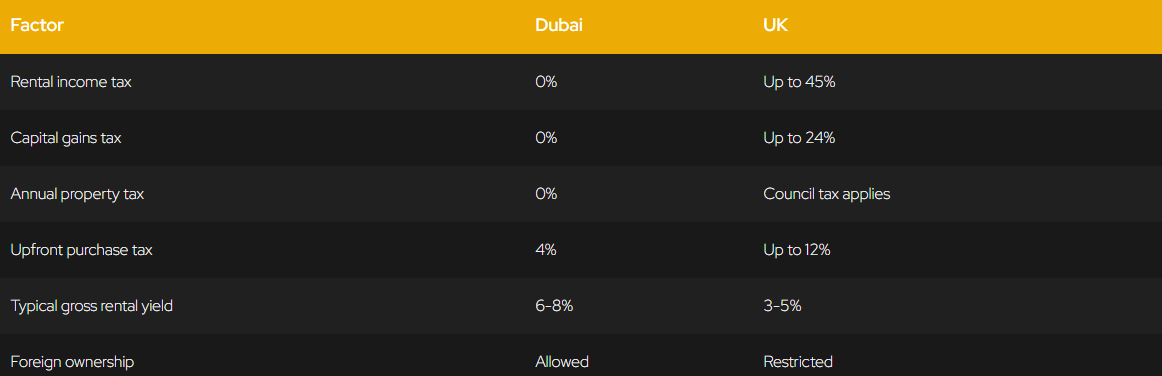
A side-by-side view of the core financial factors that matter most to property investors.
Dubai vs UK
Dubai vs major UK cities
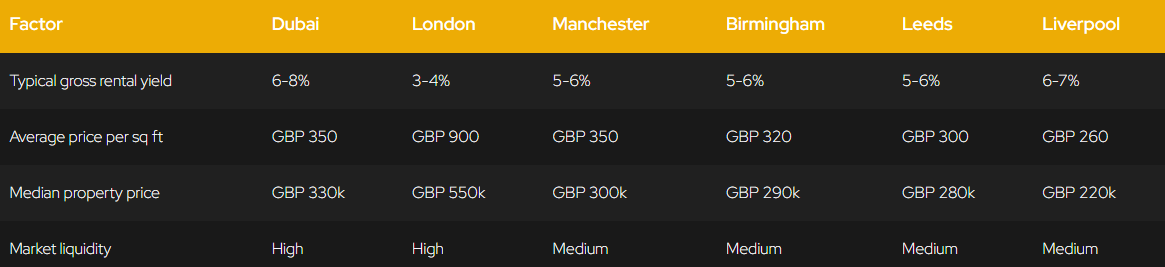
Side by side, Dubai offers higher income, lower tax and lower entry costs than UK property markets.
Britons are already part of Dubai’s property market
Dubai is not an unfamiliar or fringe market for UK investors. The UK has one of the largest, longest-standing and most economically integrated expat and investor footprints in Dubai.
- Britons living in Dubai
An estimated 30,000-40,000 British nationals live in the UAE, with Dubai the primary base, making the UK one of the largest Western resident groups.
- UK travellers to Dubai
The UK is consistently Dubai’s #1 European source market, with around 1.1 million UK visitors annually, placing it among Dubai’s top global inbound markets.
- Direct UK-Dubai connectivity
Dubai has one of its strongest global flight networks with the UK, including multiple daily direct flights from London (several airports), Manchester, Birmingham and Glasgow.
- Britons buying Dubai property
British buyers are consistently ranked among the top Western nationalities purchasing Dubai real estate, particularly in freehold residential markets.
- UK investor presence
UK investors form a core segment of Dubai’s international buyer base, spanning owner-occupiers, buy-to-let investors and second-home purchasers.
- Where Britons buy
British buyers are most active in Dubai Marina, Downtown Dubai, Business Bay, Palm Jumeirah and JVC, locations that account for a large share of Dubai’s transaction volume.
- Established British business networks
Dubai hosts hundreds of UK-linked firms, supported by organisations such as the British Business Group Dubai, alongside long-established professional and commercial networks.
- UK-UAE economic relationship
The UAE is one of the UK’s largest trade and investment partners in the Middle East, with bilateral trade measured in the tens of billions of pounds annually across finance, real estate, infrastructure and services.
- Britons working in key sectors
British professionals are heavily represented across finance, legal services, real estate, aviation, consulting and regional HQ roles, reflecting Dubai’s role as a Middle East business hub.
These trends reflect a mature progression from British presence in Dubai to sustained and growing UK property investment.

Why global capital is concentrating in Dubai
Dubai has become a focal point for international capital, driven by policy alignment, mobility, connectivity and long-term economic positioning.
- Wealth migration
Dubai consistently ranks as one of the world’s leading destinations for high-net-worth individuals relocating capital and residency.
- Investor relocation
Entrepreneurs, business owners and professionals are choosing Dubai as a long-term base for wealth, work and investment.
- Sustained capital inflows
International capital continues to flow into Dubai across property, business and infrastructure at scale.
- Tax efficiency
No personal income tax and no capital gains tax allow capital to compound with minimal friction.
- Pro-investment environment
Policy, regulation and planning are aligned to attract global capital rather than restrict it.
- Residency through investment
Long-term residency options, including the Golden Visa, support permanent relocation and capital deployment.
- Global connectivity
Dubai sits at the centre of Europe, Asia and Africa, with direct access to the world’s major markets.
- Stability and quality of life
Safety, infrastructure, education and lifestyle support long-term family and investor decisions.
What this means for UK investors
As the UK property system becomes more constrained by tax, regulation and policy intervention, capital naturally looks for environments that offer greater efficiency, clarity and control.
Higher income tax on rent, rising compliance, restricted leverage and increasing political involvement have materially changed the risk-reward profile of domestic property investment.
Dubai represents a clear structural alternative. One where tax efficiency, investor mobility and policy intent are aligned, allowing capital to be deployed with fewer layers of friction and greater visibility over long-term outcomes.
For UK investors, this helps explain why an increasing share of capital is being allocated to Dubai rather than reinvested at home.
Ready to explore Dubai property with confidence?
Resura works with UK investors to navigate Dubai’s property market with clarity and precision. We provide straight-talk advice on locations, pricing, payment structures and developer quality – aligned to your goals, not sales targets. Whether you’re investing offshore for the first time or reallocating existing capital, we help you make informed decisions in a market that rewards preparation. Get direct guidance from someone who understands both the UK and Dubai property markets – and can bridge the two effectively.
For further information, contact Muhammad Rahman, Founder and CEO at [email protected] / +971 56 157 7707
Click here to read the original article.
Events Calendar
Upcoming Events

BCCD Business Advance Members Speed Networking Sponsored by Barclays International Banking
Wed, 7th Oct 2026
The Black Sheep
Building on the success of the BCCD Speed Networking series, we recently started hosting n... Read more

Battle of the Business Councils Golf Day
Thu, 8th Oct 2026
Dubai Creek Golf Club
BCCD invites you to our Battle of the Business Councils Golf Day & Dinner on Thursday 8th ... Read more

Battle of the Business Councils Golf Day - Dinner Only Registration
Thu, 8th Oct 2026
Lakeview, Dubai Creek Golf Club
Post-golf dinner and tournament prize presentation at Lakeview terrace... Read more


