Fragomen Monthly MENA Newsletter: Insights on Immigration, Corporate, Social Security and Destination Services in the MENA Region
Date Posted:Mon, 18th May 2026

This newsletter provides timely insights across immigration, corporate, social security, payroll and destination services, helping organizations stay informed and adapt to evolving regulatory and operational changes
UNITED ARAB EMIRATES
8 May 2026 – Reminder of Upcoming Deadline for Mainland Private Sector Employers to Increase Emiratization Rate
Private sector mainland companies in the United Arab Emirates with 50 or more employees are reminded that, per existing rules, they must increase their current Emiratization rate by an additional 1% by June 30, 2026.
Under this policy, by June 30, 2026, all eligible companies must have an Emiratization percentage of at least 9%. Companies which have a higher Emiratization rate must still increase their percentage by 1% by June 30, 2026.
The Ministry of Human Resources and Emiratisation (MoHRE) has also emphasized the effectiveness of its monitoring system, now enhanced with advanced artificial intelligence tools, in detecting violations such as ‘Fake Emiratisation’ schemes and attempts to circumvent Emiratisation targets. MoHRE warned that non-compliant companies will face legal consequences, including downgraded classification within the Ministry’s system and being required to correct their status.
A fine of AED 10,000 per month will apply from July 1, 2026 for each position filled by a foreign national when it should be filled by an Emirati per the Emiratization rules. Businesses may also be blocked from using government portals, affecting the recruitment of employees.
8 May 2026 – Dubai Relaxes Eligibility Criteria for Two-Year Property Investor Residence Visa
Dubai authorities have relaxed the eligibility criteria for the two-year property investor residence visa, removing the minimum property value requirement for sole property owners and relaxing conditions for jointly owned properties.
Under the revised framework, the previous minimum property value requirement of AED 750,000 (approximately USD 204,220) for sole property owners has been removed, allowing applicants to qualify regardless of the property value, provided they are the sole owner.
For jointly owned properties, each co-owner must hold a share worth at least AED 400,000 (approximately USD 108,918) to be eligible to apply for the residence visa, even if ownership is split equally. Previously there was no explicit caveat, with each owner required to meet the AED 750,000 threshold.
As was the case previously, where the property is mortgaged or purchased under an instalment plan, applicants must provide a no-objection certificate (NOC) from the bank, or, in the case of developer-financed properties, a payment statement from the developer confirming the total amount paid, the outstanding balance, and formal mortgage statement.
4 May 2026 – Travel Ban for UAE Nationals Travelling to Iran, Iraq and Lebanon
The Ministry of Foreign Affairs has announced a travel ban on UAE nationals traveling to Iran, Iraq and Lebanon due to ongoing regional security challenges. The duration of the ban has not been specified.
The Ministryhas also urged UAE nationals currently in any of these countries to arrange their immediate return to the United Arab Emirates and to contact the Ministry through its dedicated emergency hotline at +971 800 44444.
SAUDI ARABIA
13 May 2026 - Reminder: Implementation Deadlines for Employment Contract Reforms
As a reminder, in 2025, Saudi Arabia introduced significant reforms to its employment contract framework as part of its Vision 2030 program, including mandatory contract registration with the Ministry of Justice and enhanced employee enforcement rights, implemented on a phased basis.
The first stage came into effect on October 6, 2025, applying the new requirements to newly issued employment contracts and updates to existing ones. The second stage, effective March 6, 2026, extended these requirements to fixed-term contracts upon renewal or extension. The next implementation date is August 6, 2026, when the reforms will also apply to unlimited-term employment contracts.
Key features of the initiative include:
1. Requirements
- Employment contracts must be documented on the Qiwa platform using the Executive Employment contract template.
- Each employment contract must include an Execution Number issued by the Ministry of Justice Documentation Center.
2. Mandatory Employment Contract Information
New employment contracts must also include the following details, in addition to the previously required information:
- Registered national address for both the company and foreign national.
- Company mobile and landline contact numbers.
- Employment contract type (fixed-term or non-fixed-term) (nonfixed-term employment contracts are for Saudi employees only).
- Duration and renewal terms, if applicable, for fixed-term employment contracts.
- Exact salary due date.
3. Employee Enforcement Rights
- Enforcement action may now be initiated if wages are not paid within 30 days of the due date. Previously, employees could only submit a complaint after two months of non-payment.
- If partial payment is made, enforcement may now be initiated 90 days after the due date.
- Employers have a right to object to enforcement requests through the Najiz platform within 5 days or settle the outstanding payment during the same period.
Additionally, to strengthen the quality of contractual relationships and safeguard the rights of all parties, the Ministry of Human Resources and Social Development has increased the required compliance thresholds for employment contract authentication through the Qiwa platform, representing an increase from the previous authentication threshold of 50%:
- First phase: Employers must ensure that at least 85% of employment contracts are authenticated.
- Second phase: Employers must ensure that at least 90% of employment contracts are authenticated by the end of the second quarter of 2026.
29 April 2026 - Qiwa Updates May Impact Saudization, Nitaqat and Quota Accuracy
The Qiwa platform is currently being updated following recent changes to the Nitaqat program, effective April 26, 2026. As a result, Saudization percentages, Nitaqat ratings, and quota figures displayed on the platform may not accurately reflect an employer's current compliance status. This also affects the Nitaqat calculator, which may not reflect the updated methodology for determining current or projected classification based on workforce composition. Although authorities have not confirmed a timeline for completion, the updates are expected to be finalized in the coming weeks.
QATAR
5 May 2026 - Business Support Measures Announced
Qatar has announced business support measures through its foreign direct investment ecosystem, aimed at providing immediate financial, regulatory, and operational relief to support businesses operating in the country in response to the ongoing regional conflict. These measures are temporary and intended to mitigate short-term economic disruption. The support package includes a range of targeted measures aimed at easing business pressures and ensuring continuity, including:
Financial support
- Financial relief is provided through Invest Qatar’s ongoing support for investors, including up to 40% support on eligible local expenses through the National Incentives Programme
Regulatory Flexibility
- Qatar Financial Centre and Qatar Financial Zones Authority shall provide rent waivers, payment deferrals, and lease extensions for affected tenants
- Qatar Financial Centre shall provide extensions for filing audited financial statements and case-by-case adjustments to tax filing deadlines
Operational support
- The Ministry of Commerce and Industry supports business continuity through over 500 digital e-services, alongside strengthened consumer protection oversight
- Invest Qatar ensures ongoing investor engagement through advisory support, weekly seminars and a 24/7 hotline
- The Qatar Financial Zones Authority enhances investor confidence through dedicated investor channels, logistics facilitation and crisis preparedness across free zones
These measures are currently in effect and will be continuously reviewed to ensure they continue to meet the evolving needs of the private sector.
BAHRAIN
30 April 2026 - Changes to Driving License Validity for Foreign Nationals Forthcoming
Bahrain’s parliament has approved two new amendments to the traffic law for the Expert Driving License linking the validity to the duration of the residence permit and granting regulatory discretion in setting requirements and conditions before issuing driving licences to foreign nationals in the future. The amendments must still be reviewed and approved by the Shura Council before they come into effect.
If approved by the Shura Council and implemented, foreign nationals’ driving licenses in Bahrain will be tied to the validity of their residence permits and will automatically expire when the residence permit expires. Currently, the Expat Driving License is valid for five years and having a valid residence permit is a prerequisite.
In addition, the Ministry of Interior has also been granted authority to introduce additional licensing requirements for foreign national applicants, which may include criteria such as income thresholds or employment category requirements.
24 April 2026 - Appointment of a Wage Responsible Person for WPS Required to Avoid Violations
The Labour Market Regulatory Authority in Bahrain has startedthe enforcement phase of the enhanced Wage Protection System, and administrative violations are being issued to companies that fail to appoint a Wage Responsible Person within the Expatriate Management System.
As the Wage Protection System (WPS) enters its final phase, private sector companies are encouraged to ensure full compliance with the regulations set out by the Labour Market Regulatory Authority (LMRA), including the appointment of a Wage Responsible Person (WRP).
The WRP is responsible for:
- Reviewing, and ensuring the accuracy of, payroll data;
- Ensuring that salary disbursements comply with contractual terms and applicable regulations; and
- Managing the registration of authorized personnel in the Expat Management System, including defining and maintaining “maker” and “checker” roles to ensure proper segregation of duties.
Establishments that fail to appoint a WRP will be unable to proceed with payroll submissions or demonstrate compliance with wage protection regulations. We are also observing that violations are resulting in the suspension of the LMRA portal, which can significantly impact a company’s ability to carry out any immigration-related transactions.
Several financial institutions are currently eligible to process wage transfers through the WPS, with additional institutions expected to be approved by the Central Bank of Bahrain. If your bank is not yet eligible, registration of your company and WRP can still be completed.
In addition, the government has approved salary support from the unemployment insurance fund for Bahraini nationals working in the private sector for April 2026. Further details, including the payment mechanism, have yet to be announced; however, it is expected that payments will be made through the WPS. This further underscores the importance of companies registering with the system.
IRAQ
4 May 2026 - New Digital Platform for Company Registration Launched
Effective immediately, the Iraqi Companies Registration Department has launched a new electronic platform to streamline company registration procedures and post-incorporation services for limited liability companies and individuals.
Limited liability companies and individuals are now required to submit applications and access relevant services exclusively through the new electronic platform. The system will serve as the sole channel for processing transactions, with the aim of expediting procedures.
Services available through the platform include, among others, opening an alternative file for limited liability companies, issuing endorsements, and processing the closure of company branches.
It is no longer possible to submit applications via the UR platform/gate (e-government) system. Applications submitted prior to April 23, 2026, will continue to be processed.
To use the new platform, companies must create an account and submit a registration request, including uploading all required documentation. Following submission, procedures revert to standard manual processing. Currently, access to the platform is limited to registered attorneys.
MIDDLE EAST
15 May 2026 - Unemployment Insurance Contribution Requirements for Bahraini Employees in GCC Countries Forthcoming
The Bahrain Shura Council has approved amendments to the GCC Unified Insurance System that will extend unemployment insurance coverage to Bahraini nationals employed across other GCC countries.
Under the revised framework, Bahraini employees working in GCC countries outside Bahrain will be required to contribute 1% of their insured wage towards unemployment insurance, with employers contributing a matching 1%, which will be directed to Bahrain's Unemployment Insurance Account.
Currently, this applies only to Bahraini nationals employed within Bahrain.
The implementation date, along with detailed procedural guidance, has not yet been announced. Further clarification is expected from the Social Insurance Organisation.
14 May 2026 - Update on Government Closures During Eid-al-Adha Holiday
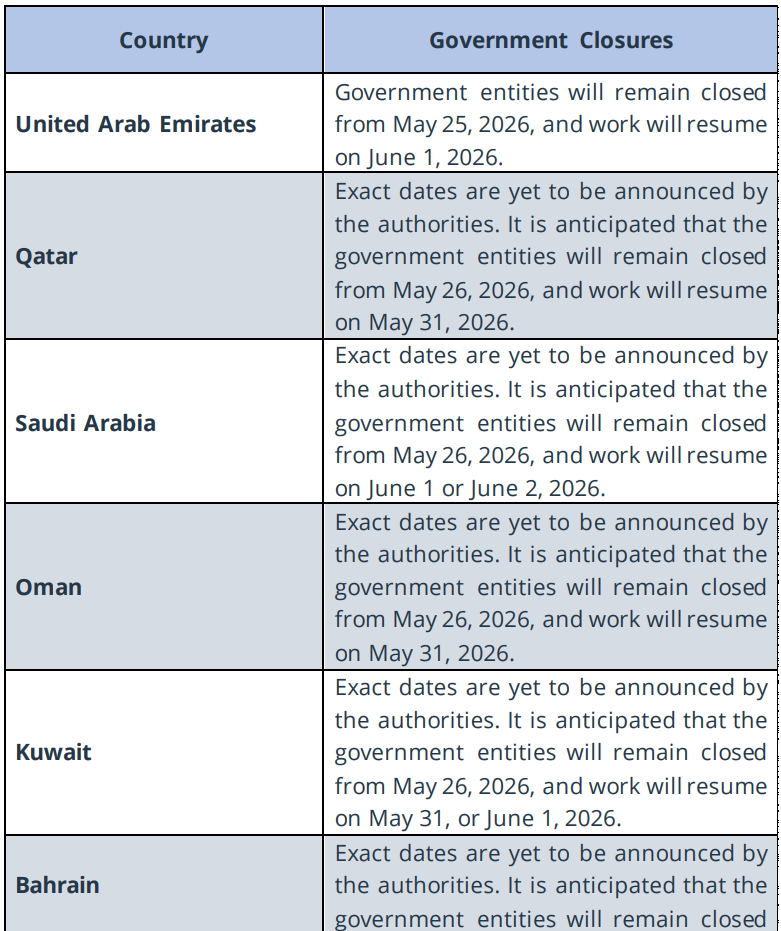
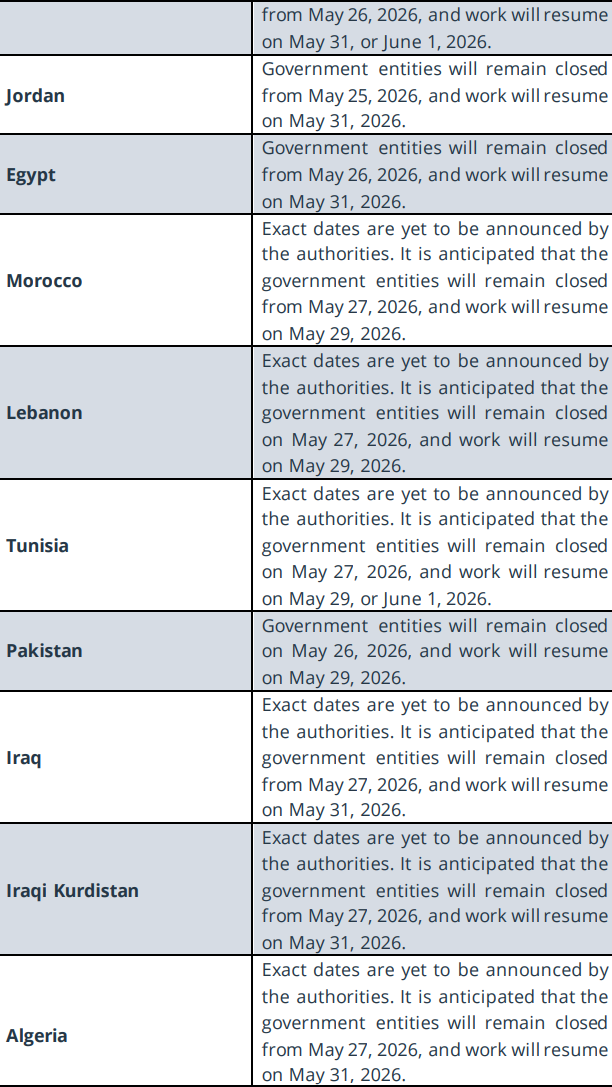
Government offices across the Middle East, North Africa and parts of Asia will close during the upcoming Eid al-Adha holiday, which may impact processing times for immigration applications. Employers and foreign nationals should anticipate delays both during and after the holiday period.
Government closures during the Eid-al-Adha holiday are expected to be as follows:
11 May 2026 - Travel and Mobility Considerations: Situation in the Middle East
As the regional situation has stabilised and is no longer evolving rapidly, enhanced situational reporting is no longer required.
We have therefore discontinued Situation Reports and reverted to our weekly News Flash format. Should conditions change, Situation Reports will be reactivated.
Overview
The ceasefire remains fragile, while progress on ongoing US-Iran negotiations under the proposed 14-point framework continues at a slow pace. Regional tensions remain elevated but broadly contained following recent attacks targeting the UAE and a US strike on an Iranian-linked oil tanker.
The security situation in the Strait of Hormuz remains a key concern, as the pause in escort operations and the risk of further attacks continue to create uncertainty for commercial shipping and energy flows.
In Lebanon, intermittent strikes and evacuation measures underscore a volatile environment with potential for wider regional spillover.
Mobility Access
Airspace and Flights Status
Airspace conditions across the region have stabilized to an extent, with most regional airspaces open and airports operational. However, not all international airlines have resumed services, and flight schedules remain uneven. Stability remains contingent on the current ceasefire, and conditions may change at short notice.
Travelers should monitor updates from airlines and relevant authorities and allow for flexibility when planning travel.
Land Borders
Land border crossings across the region generally remain open. However, operations may be restricted (e.g. reduced hours, directional controls, enhanced screening).
Processing Status
Immigration processes are largely continuing without significant disruption; however, the security situation continues to impact consular services in parts of the region, which may be reduced, temporarily suspended, or limited to emergency cases.
Several governments across the region have implemented temporary immigration and business support measures in response to travel disruptions and economic uncertainty, offering concessions and relief to foreign nationals and businesses. Many of these measures are now nearing expiry or are expected to lapse in the coming weeks, while others have already been withdrawn.
Impact
For organisations, key risks include maritime disruption, renewed violence in Lebanon, and the potential for short-notice precautionary measures in the UAE, reinforcing the need for ongoing monitoring and regularly updated contingency plans. While operations can continue, organizations should ensure immigration applications remain complete and compliant with current and jurisdiction-specific requirements.
Travellers should monitor updates from airlines and relevant authorities, allow for flexibility in travel planning, and not assume that any extensions or waivers apply unless formally confirmed by the relevant authority.
This News Flash complements Fragomen’s Travel and Mobility Considerations microsite.
6 May 2026 - Government Closures During Eid al-Adha Holiday
Government offices across the Middle East, North Africa and parts of Asia will close during the upcoming Eid al-Adha holiday, which may impact processing times for immigration applications. Employers and foreign nationals should anticipate delays both during and after the holiday period.
Eid al-Adha is expected to begin in most countries on May 27 or 28 and continue until May 30, or 31, 2026. Exact dates will vary by country based on lunar sightings and will be announced for each country separately.
What this means for employers and foreign nationals
- Expect longer processing times for immigration applications submitted before and during the holiday period.
- Anticipate continued delays in the weeks following Eid due to post-holiday backlogs.
- Plan filings and travel timelines accordingly to mitigate disruption
ABOUT FRAGOMEN
Fragomen is a leading firm dedicated to immigration services worldwide. The firm has nearly 5,500 professionals and staff in 62 offices located in the Americas, Asia Pacific and EMEA. Overall, Fragomen offers support in more than 170 countries.
We are structured to support all aspects of global immigration, including strategic planning, efficiency, quality management, compliance, government relations, reporting, and case management and processing. These capabilities allow us to represent a broad range of companies, organizations and individuals, working in partnership with clients to facilitate the transfer of employees worldwide.
Our Middle East and North Africa (MENA) practice also provides corporate services, including social security assistance, end-to-end corporate setup, corporate secretarial services, corporate amendments, restructuring activities and more. Our corporate services and immigration professionals have extensive experience working with multinational businesses, conglomerates, local employers, start-ups and individual investors. We have a deep understanding of the MENA region and maintain strong professional relationships with relevant authorities.
To learn more about how we can assist you, please visit our website at www.fragomen.com or contact us at [email protected]
Events Calendar
Upcoming Events

BCCD Business Advance Members Speed Networking Sponsored by Barclays International Banking
Wed, 7th Oct 2026
The Black Sheep
Building on the success of the BCCD Speed Networking series, we recently started hosting n... Read more

Battle of the Business Councils Golf Day
Thu, 8th Oct 2026
Dubai Creek Golf Club
BCCD invites you to our Battle of the Business Councils Golf Day & Dinner on Thursday 8th ... Read more

Battle of the Business Councils Golf Day - Dinner Only Registration
Thu, 8th Oct 2026
Lakeview, Dubai Creek Golf Club
Post-golf dinner and tournament prize presentation at Lakeview terrace... Read more


