Fragomen Monthly MENA Newsletter: Insights on Immigration, Corporate, Social Security and Destination Services in the MENA Region
Date Posted:Mon, 20th Apr 2026

This newsletter provides timely insights across immigration, corporate, social security, payroll and destination services, helping organizations stay informed and adapt to evolving regulatory and operational changes.
UNITED ARAB EMIRATES
17 April 2026 –Additional Business Support Packages in Select Free Zones Announced
Effective immediately, the below free zones have announced targeted measures designed to support companies operating within their jurisdictions:
Dubai International Financial Centre (DIFC):
- Businesses can pay license renewal fees in instalments; while businesses in the commercial and retail sectors will be able to use flexible payment plans.
- Selected administrative payments (including fees related to lease contracts, the registrar of companies, the data protection department and the registration of employees under the DIFC Employee Workplace Savings plan) are deferred for a temporary period of time
Dubai Airport Freezone Authority (DAFZA), Dubai Silicon Oasis (DSO), and Dubai CommerCity under Dubai Integrated Economic Zones Authority (DIEZ):
- Option to pay rent in monthly instalments, with a waiver of instalment-related fees.
- Three-month deferral of shareholder amendment fees, with waiver for fees associated with company restructuring and authorized capital amendments.
- Three-month deferral of fees related to license activity amendments.
Dubai Healthcare City Authority (DHCA):
- Reinstatement fees and late renewal penalties will be waived for commercial licenses renewed between April 1, 2026 and June 30, 2026.
- Renewal fees can be paid in instalments through structured payment plans, including post-dated cheques, with extended timelines until September 30, 2026.
- Leasing flexibility introduced, allowing companies to defer payments or restructure dues into instalments, with related fees waived.
14 April 2026 –Nafis Program Extended with New Enhancements
The UAE government has announced the extension of the Nafis program until 2040 to support sustainable Emiratisation, develop national talent, and strengthen workforce nationalization in the private sector. This includes:
- Removing the current four-child cap under the Child Allowance Scheme and
- Introducing a salary support program for children of Emirati mothers working in the private sector and wives of Emirati nationals working in the private sector.
These policies are not yet in effect, and it remains unclear when they will go into effect.
The country has also announced a new (still to be launched) “Promising Talents” digital platform. The platform would help identify candidates, link them with human resources and upskilling systems, and track their development from selection through to retention, while also providing performance data to improve decision-making and implementation. The platform would target young national candidates (including early-career UAE nationals, typically up to age 35).
13 April 2026 – Police Clearance Certificate Recommended for Select Nationalities Seeking Employment
Immigration practitioners have observed that nationals of Afghanistan, Algeria, Bhutan, Bulgaria, Cameroon, Cuba, Egypt, Ghana, Indonesia, Iraq, Kenya, Mexico, Nepal, Nigeria, Sri Lanka, and Uganda are periodically being asked for a Police Clearance Certificate (PCC) as part of UAE employment residence permit applications.
Accordingly, individuals from affected countries are advised to ensure they have obtained a PCC prior to commencing the permit application process.
The documentation and procedural requirements for obtaining and submitting the PCC vary depending on whether the applicant is applying from within the United Arab Emirates or applying from outside the country.
Applicants outside the UAE:
- Must obtain a PCC from their home country; and
- The PCC must be attested by the UAE Embassy in the issuing country and the UAE Ministry of Foreign Affairs.
Applicants inside the UAE:
- On a cancelled residence permit. The PCC must be issued within the UAE.
- On a tourist visa. Must obtain a PCC from the home country duly attested by UAE Embassy in the issuing country and the UAE Ministry of Foreign Affairs, consistent with out-of-country applicants.
13 April 2026 –Dubai Government Approves a Business Support Package
Dubai’s Crown Prince has approved a business support package, totaling AED 1 billion, to be implemented over a period of three to six months starting April 1, 2026, aimed at supporting businesses and enhancing economic agility.
A range of corporate incentives has been introduced to improve cash flow and liquidity for businesses and reduce financial pressure. These include:
- Postponement of selected government fees for three months to ease financial burdens on mainland registered companies such as: fees for amendments to trade licenses, advertising fees on trade licenses, local fees on trade licenses (including renewal fees with up to a 50% reduction) and optional fees related to trade names;
- A three-month delay on rooms and food and beverage fees to support the hospitality sector, including hotels, hotel apartments, and holiday homes;
- Postponement of the tourism dirham fee for three months to boost the tourism industry; and
- Extension of the customs clearance grace period from 30 days to 90 days (with a possible further extension), allowing businesses more time to complete procedures and payments.
Select free zones are also offering their own support measures to SMEs, including Dubai South, which has announced a new support package featuring rent-free incentives tied to contract renewals, flexible payment deferral options, and the waiver of minor administrative penalties.
From an immigration perspective, the new initiatives focus on supporting faster and more streamlined issuance and renewal of residency permits, reducing visa processing times from approximately seven working days to three to five working days. These measures are expected to facilitate more efficient hiring and retention of talent across sectors.
11 April 2026 –Abu Dhabi Introduces Unified Engineering Classification and Licensing Framework
Abu Dhabi has launched a new unified framework for the classification and licensing of engineering firms and professionals across the Emirate.
The new system brings mainland and Abu Dhabi Global Market (ADGM) engineering activity under a more consistent regulatory approach.
Under the new framework, ADGM-licensed engineering firms can now apply for classification through the TAMM platform using the same standards applied to mainland firms. This removes the previous distinction between free zone and mainland licensing routes and creates a single, more unified system across Abu Dhabi.
In addition, the decision also updates the professional grading regime for engineers. The previous three-tier structure has been replaced with four grades: Intern, Practitioner, Professional, and Expert. Progression is based on qualifications, experience, competency assessments, examinations, and ongoing professional development.
SAUDI ARABIA
14 April 2026 - New Saudization Requirement Announced for Certain Administrative Support Roles
As part of continuing Saudization efforts, the Ministry of Human Resources and Social Development (MHRSD) has mandated 100% Saudization for 69 administrative support roles for private-sector businesses. Previously, these roles were not subject to any Saudization requirements.
For 19 roles – including human resources clerk, data entry operator, secretary, executive secretary, labor affairs manager, and personnel manager are subject to immediate Saudization.
For the other 50 professions, a six-month grace period will apply, with Saudization requirements taking effect on October 5, 2026. This includes roles such as inventory movement clerk, shipping clerk, receptionist, information clerk, government relations clerk, public relations specialist, human resources expert, human resources consultant, recruitment specialist, human resources monitoring specialist, and workforce planning specialist. Currently, no Saudization requirements apply to these roles.
30 March 2026 - Amended Labour Fines Announced
Saudi Arabia has introduced an updated schedule of labour violations and penalties, including significantly increasing certain fines.
As was the case previously, fines vary depending on the size of the establishment:
- Category A: 50 or more workers
- Category B: 21 to 49 workers
- Category C: 20 or fewer workers
Changed Fines
The following violations are subject to new fine amounts (all amounts in SAR):
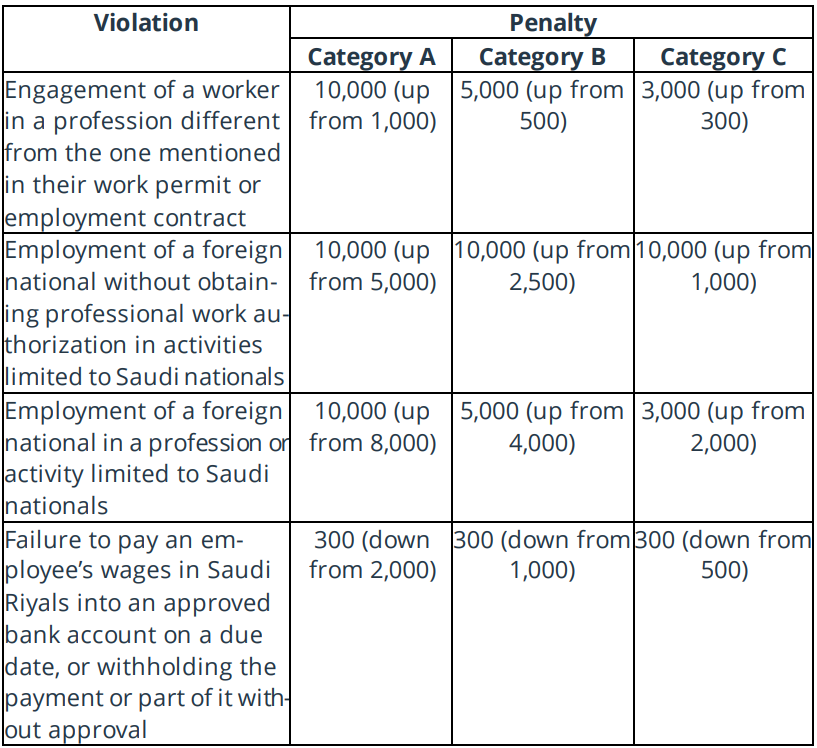
Unchanged Fines
Fine amounts for the following violations have not changed (all amounts in SAR):

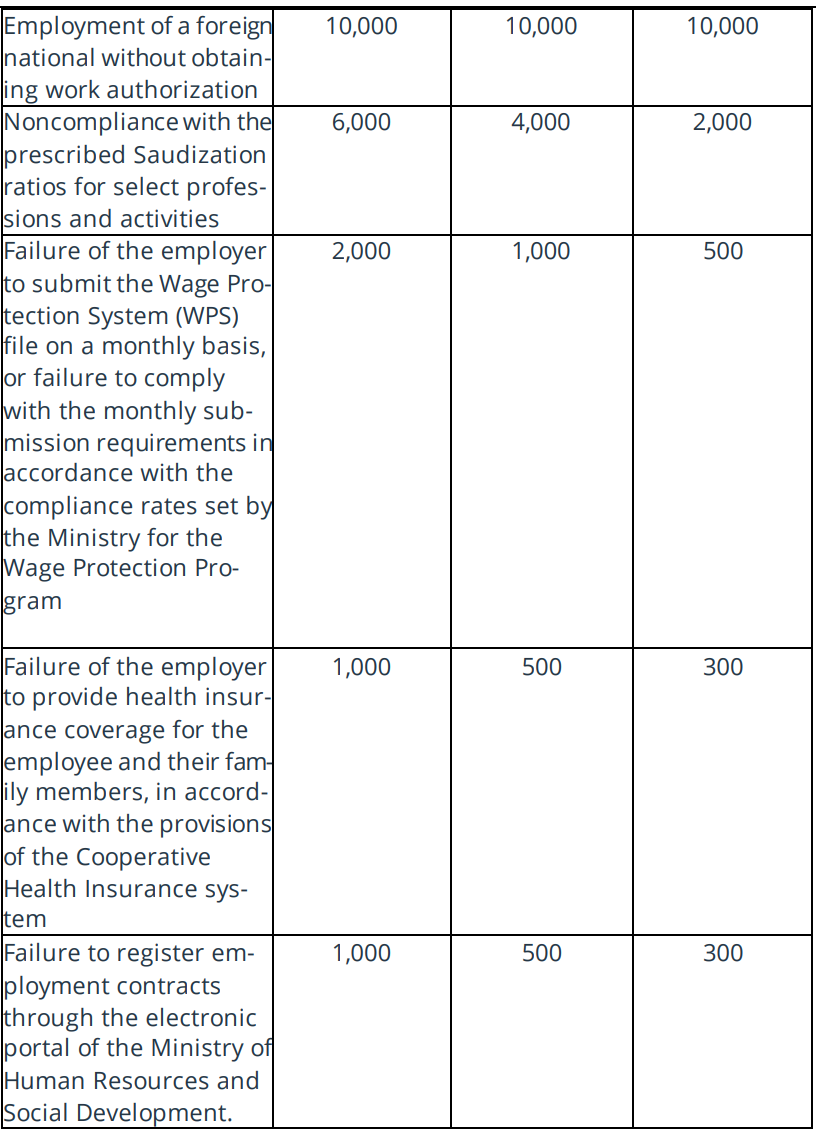
Fines must be paid within 60 days of notification. Fines may be doubled for repeated offenses. Continued repetition can result in suspension or license revocation.
25 March 2026 - Certain Private Sector Companies Now Required to Train Saudi National Graduates and Job Seekers
As of April 18, 2026, private sector companies with 50 or more employees are required to offer on-the job training opportunities to Saudi graduates and job seekers, at a minimum rate of two percent of their total workforce each year. Private sector companies with 5,000 or more employees must train at least 100 trainees per year. This is in accordance with a procedural guide issued by the Ministry of Human Resources and Social Development.
Affected companies are required to:
- announce training opportunities and upload all the training information, including the training contract through the Qiwa platform;
- specify the training duration (minimum two months, maximum six months), any applicable allowance, and the type of skills or professions to be covered;
- training contracts must outline key terms, including duration, training scope and the rights and obligations of both parties;
- agree on compensation (if any) – it is not mandatory under the regulation;
- ensure compliance with workplace rules and safety standards;
- supervise and evaluate trainees throughout the training period;
- provide appropriate facilities and equipment;
- issue training completion certificates; and
- note that registration of trainees with the General Organization for Social Insurance (GOSI) is not required.
Trainees are required to follow contract terms and internal regulations, perform assigned duties, maintain confidentiality, and uphold professional conduct.
OMAN
8 April 2026 - Mandatory Savings Scheme for Foreign Employees Forthcoming
Oman has announced a mandatory savings scheme for foreign employees, set to take effect in 2027. Under the scheme, employers will be required to contribute 9% of each employee’s basic salary to a regulated savings fund.
The savings scheme will be introduced in phases between 2026 and 2028 as part of wider social protection reforms, including additional insurance programs funded through salary-based contributions such as sick-leave insurance (1% salary contribution from 2026) and work-injury insurance (1% salary contribution from 2028, with compensation up to OMR 3,000).
It may replace or operate alongside the existing end-of-service gratuity system, subject to further regulatory guidance. Employers will be required to register with the Social Protection Fund and comply with the procedures once published, while maintainingcontribution records for each foreign employee throughout their employment and payable upon end of employment.
Oman’s foreign employee savings scheme, part of the 2026 - 2028 social protection reforms, is intended to enhance financial security, modernize end-of-service benefits, and improve transparency within the system. It also seeks to strengthen worker protections and ensure greater consistency, with further guidance expected on employer registration, contribution procedures, transition rules, and treatment of existing gratuity entitlements.
PAKISTAN
18 March 2026 - Suspension of visas-on-arrival and “Visa Prior to Arrival” programs
Pakistan has stopped issuing visas-on-arrival and has also stopped its so-called “Visa Prior to Arrival”, which allowed streamlined processing of visas for eligible nationals. No formal announcement has been issued regarding this change. It remains unclear whether the suspension is temporary or permanent.
Until further notice, affected foreign nationals travelling to Pakistan must obtain a visa in advance of travel via the standard eVisa process. Standard eVisa processing times are around 20 business days – unlike the “Visa Prior to Arrival” program, which offered processing times of one to two days. Accordingly, applicants are advised to apply well in advance of intended travel dates.
MIDDLE EAST
15 April 2026 - Increased Scrutiny on Visa and Entry Processes
Ongoing developments across parts of the Middle East have led to enhanced immigration controls, including increased security screening, additional documentation requirements, and the suspension of visa-on-arrival for some nationalities.
Authorities in several countries have introduced stricter screening measures, resulting in additional documentation requests for certain visa categories and the suspension of visa-on-arrival facilities for select nationalities (requiring visas to be obtained in advance). While visa-on-arrival continues to be issued at most border posts, decisions are increasingly discretionary and may not always align with standard, official guidelines; travellers are therefore advised to obtain a visa in advance where possible.
In practice, this means that previously straightforward immigration processes may now involve additional steps, longer processing times, or last-minute changes at both the visa application stage and at the point of entry. While these measures appear precautionary, most immigration processes continue to operate, albeit with increased scrutiny. These measures may be introduced at short notice and are not being applied uniformly across the region. Outcomes may vary on a case-by-case basis, even where eligibility criteria appear to be met.
ABOUT FRAGOMEN
Fragomen is a leading firm dedicated to immigration services worldwide. The firm has nearly 5,500 professionals and staff in 62 offices located in the Americas, Asia Pacific and EMEA. Overall, Fragomen offers support in more than 170 countries.
We are structured to support all aspects of global immigration, including strategic planning, efficiency, quality management, compliance, government relations, reporting, and case management and processing. These capabilities allow us to represent a broad range of companies, organizations and individuals, working in partnership with clients to facilitate the transfer of employees worldwide.
Our Middle East and North Africa (MENA) practice also provides corporate services, including social security assistance, end-to-end corporate setup, corporate secretarial services, corporate amendments, restructuring activities and more. Our corporate services and immigration professionals have extensive experience working with multinational businesses, conglomerates, local employers, start-ups and individual investors. We have a deep understanding of the MENA region and maintain strong professional relationships with relevant authorities.
To learn more about how we can assist you, please visit our website at www.fragomen.com or contact us at [email protected].
Events Calendar
Upcoming Events

BCCD Business Advance Members Speed Networking Sponsored by Barclays International Banking
Wed, 7th Oct 2026
The Black Sheep
Building on the success of the BCCD Speed Networking series, we recently started hosting n... Read more

Battle of the Business Councils Golf Day
Thu, 8th Oct 2026
Dubai Creek Golf Club
BCCD invites you to our Battle of the Business Councils Golf Day & Dinner on Thursday 8th ... Read more

Battle of the Business Councils Golf Day - Dinner Only Registration
Thu, 8th Oct 2026
Lakeview, Dubai Creek Golf Club
Post-golf dinner and tournament prize presentation at Lakeview terrace... Read more


