From Reactive to Ready: Using Your Data to Navigate Cost Uncertainty
Date Posted:Fri, 3rd Apr 2026

The UAE, Middle East and wider global economy are facing uncertain times. Ongoing geo-political pressures have sent shockwaves through established trade routes, impacted international travel, and are now feeding through into the price of everyday goods. The recent 30% rise in petrol prices is just the latest reminder of how quickly a stable operating plan can become an expensive one. For businesses across the UAE — whether you are a three-person logistics firm or a multi-site retailer — the challenge is the same: how do you make confident decisions when the ground is shifting beneath you?
The honest answer for most businesses is that they are better equipped to explain what happened than to anticipate what comes next. Dashboards show last week's performance. Reports explain last month's variance. By the time that analysis reaches a decision-maker, the context has already moved. In stable conditions, that lag is manageable. When costs are rising fast, it becomes a liability. But by using data you already have available, you can move from reactive evaluation to scenario-based "what-if" planning.
The question that changes everything
The businesses managing this period most effectively are not necessarily those with more data or bigger analytics teams. They are asking a different question.
Instead of "what happened?", they are asking: "what happens if this changes?"
This shift, from retrospective reporting to forward-looking simulation, is what separates businesses that absorb shocks from those that anticipate them. It is called what-if scenario planning, and the good news is that most businesses already have the data needed to start.
What it looks like in practice
The principle scales to any business size. You do not need a dedicated data team or expensive software to begin. You need to connect the operational data you already hold and use it to test decisions before committing to them.
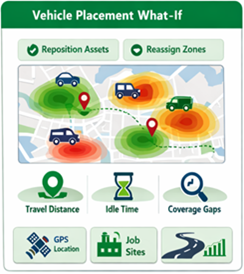
- A small logistics or delivery business facing higher fuel costs can model the impact of route adjustments or consolidated runs before implementing changes rather than discovering the margin hit after the fact.
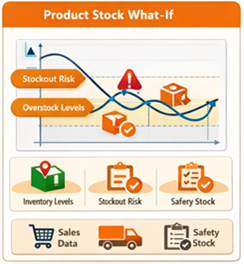
- A retailer watching supplier costs creep up can simulate inventory levels across a few demand scenarios, identify where cash is unnecessarily tied up in stock, and adjust reorder points accordingly.
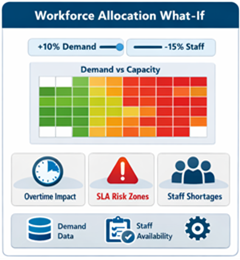
- A service business bracing for tighter margins can test different staffing configurations to understand exactly where service quality would be affected and where smarter redistribution creates more value than headcount reduction.
The underlying data for each of these already exists in your business: transaction records, supplier lead times, booking patterns, utilisation rates. The gap is not the data itself. It is the habit of using it to test the future rather than only explain the past.
A practical starting point
Pick one area of current cost pressure, fuel, inventory, or workforce - and ask yourself: if conditions shift by 20%, what breaks first?
If you cannot answer that today, that is where to begin. It does not require a sophisticated platform. It requires a structured way of connecting your existing data to the decisions that matter most.
In an environment where inflation signals are unpredictable and supply chains remain fragile, that capability is no longer a competitive advantage reserved for large enterprises.
It is a practical necessity for any business that wants to stay ahead of the curve, whatever size you are.
Contributed by HEMOdata — a UAE-based data and AI solutions consultancy helping businesses turn operational data into confident decisions.
Events Calendar
Upcoming Events

BCCD Business Advance Members Speed Networking Sponsored by Barclays International Banking
Wed, 7th Oct 2026
The Black Sheep
Building on the success of the BCCD Speed Networking series, we recently started hosting n... Read more

Battle of the Business Councils Golf Day
Thu, 8th Oct 2026
Dubai Creek Golf Club
BCCD invites you to our Battle of the Business Councils Golf Day & Dinner on Thursday 8th ... Read more

Battle of the Business Councils Golf Day - Dinner Only Registration
Thu, 8th Oct 2026
Lakeview, Dubai Creek Golf Club
Post-golf dinner and tournament prize presentation at Lakeview terrace... Read more


