What Does the Iran War Mean for the Economy of the United Arab Emirates?
Date Posted:Tue, 24th Mar 2026

Economist Intelligence: EIU has just released its latest UAE forecast update and it serves to provide some context and clarity among the lurid headlines predicting the demise of Dubai and Abu Dhabi, writes Robert Willock, Global Director of the Economist Intelligence Corporate Network.
The UAE economy will be among the most heavily affected by the Iran war, and its diversification model will be tested. In the short term the economic fallout will be severe but manageable for the UAE, which is supported by strong structural institutions and financial buffers.
Physical damage from the war has been limited, but the conflict has constrained the oil economy and revealed the susceptibility of other sectors to regional security risks, challenging the country’s carefully built image as a secure business and tourism hub.
Foreign investor confidence will take time to recover, particularly in sectors such as real estate and tourism. However, other service sectors, energy and infrastructure will continue to attract interest, especially as the conflict will reinforce the UAE leadership's efforts to improve protections for major economic assets.
The government (at both federal and emirate levels) will continue to promote the country's role as a regional centre for finance, technology and logistics, although its global ambitions in these sectors will take longer to realise, given the impact of the conflict on its safe haven reputation.
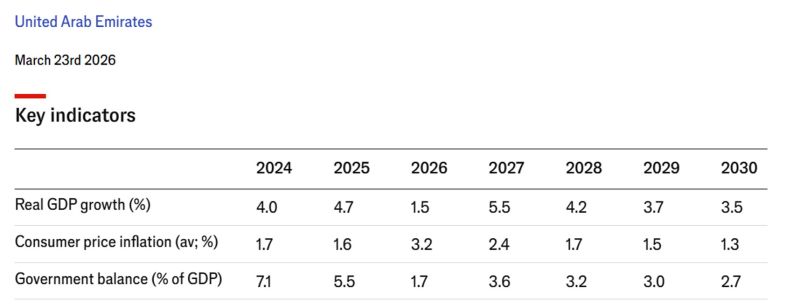
We have lowered our GDP growth forecasts for the remainder of the year. We expect a sharp contraction in the first quarter of 2026, with oil output recovering by mid-year, but tourism and services only gradually improving later in the year. We now forecast growth of 1.5% in 2026 (revised from 4.2% previously), rebounding to 5.5% in 2027 (revised from 3.9%) as oil production rises and the non-oil recovery strengthens.
Limited export capacity will prevent the UAE from fully benefitting from higher oil prices in 2026, and the war’s economic fallout will weigh on other government revenue. Higher spending on defence, household support and business assistance will meanwhile drive up government consumption. We therefore now expect the fiscal surplus to narrow to 1.7% of GDP in 2026 (revised from 4% of GDP previously).
For more information on our intelligence subscription services or to book a briefing from our experts, email: [email protected]
Events Calendar
Upcoming Events

BCCD Business Briefing: The Financial Landscape - Trust, Regulations and the Road Ahead, Sponsored by Canaccord Wealth
Tue, 13th Oct 2026
voco Dubai
As the wealth and investment landscape evolves, so does the expectation around regulation ... Read more

BCCD Masterclass - Clarity in Chaos: Navigating Leadership Decisions
Wed, 14th Oct 2026
Hotel Indigo Dubai Downtown
Join us for “Clarity in Chaos: Navigating Leadership Decisions”, an immersive, high-st... Read more

BCCD Breakfast Networking
Wed, 21st Oct 2026
Reform Social & Grill
Kickstart your morning with valuable connections & conversations. This casual yet engaging... Read more


