50M AED Revenue? Your E-Invoicing Deadline Starts Before Go Live
Date Posted:Tue, 10th Mar 2026

A lot of businesses are focusing on the go-live date of 1 January 2027. That matters, but it is not the first deadline that should be on your calendar. For businesses in the first revenue band, the earlier deadline is the one that creates the real pressure: you must appoint your Accredited Service Provider by 31 July 2026.
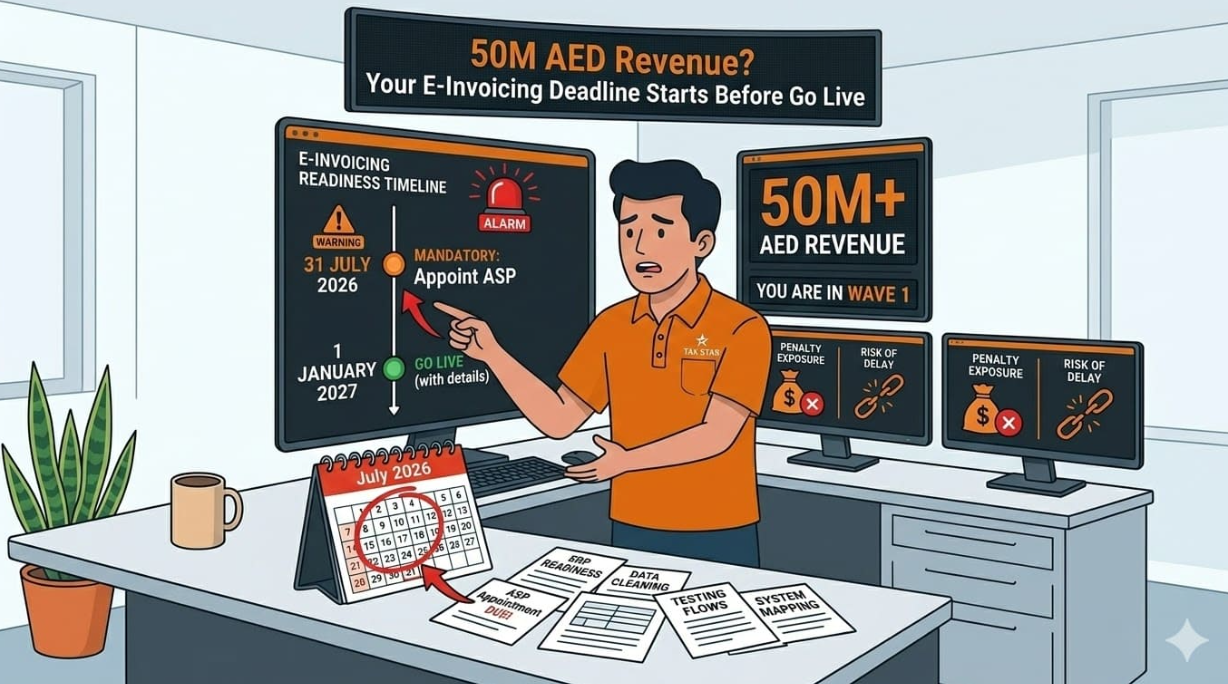
If your business generates AED 50 million or more in revenue, the UAE e-invoicing timeline starts earlier than many finance teams think.
That means if your team waits until late 2026 to act, you are not preparing early. You are already behind.
This article explains who falls into Wave 1, what the timeline looks like, and why the July 2026 date matters just as much as the January 2027 deadline.
Who Is in Wave 1?
Under the UAE e-invoicing rollout, the first mandatory group includes businesses with revenue of AED 50 million and above.
For that group, the timeline is clear:
- Appoint Service Provider by 31 July 2026
- Go live by 1 January 2027
Businesses below AED 50 million have a later timeline, while government entities follow a separate date. But if your business is at or above the AED 50 million mark, you are in the first wave and the preparation window is shorter than it may seem.
Why the July 2026 Date Matters More Than Many Teams Realise
The most common mistake is assuming that January 2027 is the real starting point.
It is not.
By the time your business reaches the go-live date, key decisions and setup work should already be complete. Appointing an Accredited Service Provider is not a last-minute administrative step. It sits at the beginning of a much larger readiness process that includes system mapping, onboarding, testing, validation, and internal process changes.
In practice, the July 2026 deadline is the point where your transition needs to be formally underway.
If your business waits until late 2026 to start speaking to providers, reviewing ERP readiness, or cleaning invoice data, that work is already happening too late.
What Happens Between Appointment and Go Live?
This gap between 31 July 2026 and 1 January 2027 is there for a reason.
Once a provider is appointed, businesses still need to work through the operational side of e-invoicing requirements. That includes linking the taxpayer profile, confirming the service provider connection, validating invoice data, reviewing required fields, testing transmission flows, and making sure internal finance and tax teams are ready to work in a system-validated environment.
This is also the stage where many hidden issues start to surface. Customer records may be missing identifiers. VAT logic may sit across different systems. Invoice numbering rules may not be consistent. Manual workarounds may exist in ways that are not visible until structured validation begins.
The timeline only looks comfortable if the business is already prepared.
Why Waiting Until January 2027 Creates Risk
Waiting until the go-live date to start acting is not simply inefficient. It can create direct compliance exposure.
The guidance makes it clear that failure to implement the e-invoicing system, including failure to appoint an Accredited Service Provider within the prescribed timeline, can trigger an administrative penalty of AED 5,000 for each month of delay, or part of a month.
That means the risk starts before go live if the appointment deadline is missed.
There are also additional penalties for failing to issue and transmit electronic invoices and credit notes within the required timelines once the mandate applies. So the real risk is not just missing one deadline. It is creating a chain of delays that affects implementation, invoice issuance, and compliance together.
What Finance Teams Should Be Doing Now
If your business is in the AED 50 million and above bracket, this is the right time to move from awareness to planning.
Finance teams should start by confirming whether the revenue threshold applies across the relevant entity and whether the business is clearly in Wave 1. From there, the priority should be understanding what needs to happen before service provider appointment, not after it.
That usually includes:
- reviewing which systems currently create invoice data
- identifying whether those systems can support structured invoice messages
- checking whether customer and supplier records contain the identifiers needed for validation
- clarifying who owns VAT logic, master data, and rejection handling
- starting service provider evaluation early enough to avoid time pressure
The businesses that struggle most are often not the ones with the least software. They are the ones that assume the change starts later than it actually does.
The Real Deadline Is Earlier Than It Looks
For Wave 1 businesses, 1 January 2027 may be the go-live date, but 31 July 2026 is the deadline that determines whether the business is actually on track.
That is the trap.
Teams that treat January as the starting point may discover too late that the real compliance clock started months earlier. Once that happens, the issue is no longer planning. It becomes delay, remediation, and penalty exposure.
If your business is above the AED 50 million threshold, the right question is not whether e-invoicing matters yet. It is whether your July 2026 deadline is already shaping your decisions now.
About Tax Star
Tax Star is a UAE-based tax technology company backed by Plug and Play and Dubai Chambers Digital. It is also part of Microsoft for Startups UAE. Tax Star supports accountants and finance teams in automating tax compliance processes using AI. Tax Star is Peppol registered and is currently in the process of becoming an Accredited Service Provider with the Ministry of Finance to support e-invoicing in the UAE.
Events Calendar
Upcoming Events

BCCD Business Briefing: The Financial Landscape - Trust, Regulations and the Road Ahead, Sponsored by Canaccord Wealth
Tue, 13th Oct 2026
voco Dubai
As the wealth and investment landscape evolves, so does the expectation around regulation ... Read more

BCCD Masterclass - Clarity in Chaos: Navigating Leadership Decisions
Wed, 14th Oct 2026
Hotel Indigo Dubai Downtown
Join us for “Clarity in Chaos: Navigating Leadership Decisions”, an immersive, high-st... Read more

BCCD Breakfast Networking
Wed, 21st Oct 2026
Reform Social & Grill
Kickstart your morning with valuable connections & conversations. This casual yet engaging... Read more


