UK Spring Statement 2026
Date Posted:Mon, 9th Mar 2026

The UK Chancellor held the Spring Statement on 3 March 2026. The government has been keen to have only one tax event per year (the Budget) and so the Spring Statement was intended to provide an interim update on the economy and public finances.
Whilst the Chancellor did meet the commitment not to make major tax announcements, there was plenty to say on the economy more generally.
Looking back a year, the previous Statement focused on a commitment to increasing defense spending, cuts to the welfare state and economic growth. Over the last year, the majority of those cuts to welfare spending were not supported by backbench MPs and the economy has continued to grow slowly, so what did the Chancellor have to say a year on?
The strap line was that current policies mean that the government has the right economic plan for Britain. The Chancellor stated that the ‘…Spring Forecast has shown that the government’s economic plan to cut the cost of living, cut national debt and grow the economy, is the right one.’
Whilst the speech was highly political, the Chancellor specifically referred to three particular areas to show that the government’s policies were working:
Cutting the cost of living – the OBR’s forecast shows inflation, borrowing and debt interest are falling, whilst investment is rising.
Cutting borrowing – the OBR’s forecast shows borrowing is down by nearly £18 billion compared to the autumn, with borrowing this year set to be the lowest in six years and falling below the G7 average.
Growing the economy – the OBR’s forecast shows GDP per person is now set to grow more than was expected in the Budget, with growth of 5.6% over the parliament.
That was what the government said but what did the OBR have to say in its 125-page report? The start of the report stated that the fiscal context for the next Budget will remain challenging, so does this mean even more tax rises? It certainly does not appear that tax cuts are on the way anytime soon.
Highlights of the report were summarised by the OBR:
- productivity growth will pick up to 1% in the medium term
- labour supply growth will decline, mainly due to lower net migration and population ageing
- GDP growth will slow down to 1.1% in 2026, before averaging 1.6% over the rest of the five-year forecast
- inflation will reach its 2% target in late 2026
- public sector net borrowing is projected to fall from 5.2 % of GDP in 2024/25 to 4.3% of GDP this year and then to 1.6% in 2030/31
- weekly wage growth will slow to around 3.5% in 2026 and then average 2.25%
- unemployment will rise from 4.75% in 2025 to a peak of 5.33% in 2026, primarily driven by new entrants into the labour market struggling to find work.
Of course, the Spring Forecast is exactly that; for example, the effects of the current situation in the Middle East have not been factored into any of the data released by the OBR.
The OBR also makes some other important points:
- the tax-to-GDP ratio is forecast to increase to a post-war high of 38% of GDP in 2030/31
- there continue to be pressures on the government’s departmental spending plans
- there are concerns that the future costs of welfare spending may follow the sharp growth of disability and health caseloads since the pandemic.
To summarise, not a great deal of growth appears to be around the corner. Public spending is one side of the equation but taxation is the other, so what does the tax system have to offer over the next year?
Personal Tax
Tax bands and rates
The basic rate band remains at £37,700, with the higher rate threshold remaining at £50,270. The additional rate threshold remains at £125,140. The freeze of these thresholds will continue until April 2031. The NICs Primary Threshold and Lower Profits Limit remain at £12,570. The NICs Upper Earnings Limit and Upper Profits Limit will remain aligned to the higher rate threshold at £50,270 up to April 2031. Other employer NICs relief thresholds aligned to the Upper Earnings Limit will also be maintained at this level.
The additional rate for non-savings and non-dividend income will apply to taxpayers in England, Wales and Northern Ireland. The additional rate for savings and dividend income will apply to the whole of the UK.
Scottish residents
The tax on income (other than savings and dividend income) is different for taxpayers who are resident in Scotland from that paid by taxpayers resident elsewhere in the UK. The Scottish Income Tax rates and bands apply to income such as employment income, self-employed trade profits and property income.
The rates and bands for 2026/27 are as follows:
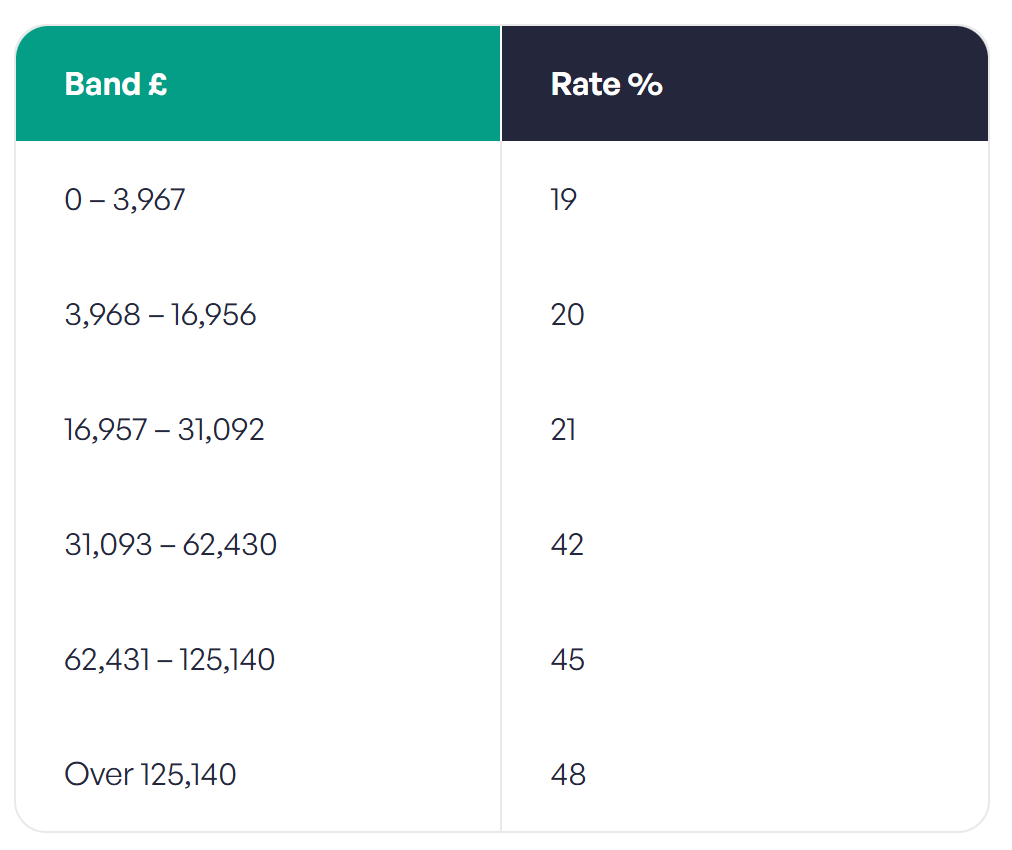
Scottish taxpayers are entitled to the same personal allowance as individuals in the rest of the UK.
Welsh residents
Since April 2019 the Welsh Government has had the right to vary the rates of Income Tax payable by Welsh taxpayers (other than tax on savings and dividend income). For 2026/27 the tax payable by Welsh taxpayers is the same as that payable by English and Northern Irish taxpayers.
The personal allowance
The Income Tax personal allowance is fixed at the current level of £12,570 and will remain frozen until April 2031.
There is a reduction in the personal allowance for those with ‘adjusted net income’ over £100,000. The reduction is £1 for every £2 of income above £100,000. This means that there is no personal allowance where adjusted net income exceeds £125,140.
The government will increase the married couple’s allowance and blind person’s allowance from 6 April 2026 by the CPI rate for September 2025 of 3.8%. These become £11,700 and £3,250 respectively.
Tax on property income
Property income is any income from letting land and buildings.
Individuals have a Property Allowance. This exempts property income of £1,000 or less. Property income over £1,000 can be offset either by the £1,000 Property Allowance or by deducting relevant expenses.
The government is introducing the following separate tax rates for property income from 2027/28:
- 22% for basic rate taxpayers
- 42% for higher rate taxpayers
- 47% for additional rate taxpayers.
It remains to be seen whether the Scottish and Welsh governments will follow suit by increasing taxes on property income in the future, as the government is devolving that power to those governments.
Tax on savings income
Savings income is income such as bank and building society interest.
The Savings Allowance applies to savings income and the available allowance in a tax year depends on the individual’s marginal rate of Income Tax. Broadly, individuals taxed at up to the basic rate of tax have an allowance of £1,000. For higher rate taxpayers the allowance is £500. No allowance is due to additional rate taxpayers.
Savings income within the allowance still counts towards an individual’s basic or higher rate band and so may affect the rate of tax paid on savings above the Savings Allowance.
Some individuals qualify for a 0% starting rate of tax on savings income up to £5,000. This will remain at £5,000 until 5 April 2031. However, the rate is not available if taxable non-savings income (broadly earnings, pensions, trading profits and property income, less allocated allowances and reliefs) exceeds £5,000.
The current tax rates on savings income will be maintained for 2026/27. From 6 April 2027, there will be a 2% increase in the applicable tax rates. The basic rate will increase to 22%, the higher rate will increase to 42% and the additional rate will increase to 47%.
These rules apply to the whole of the UK.
Tax on dividends
Currently, the first £500 of dividends is chargeable to tax at 0% (the Dividend Allowance). This £500 is retained for 2026/27.
From 6 April 2026, there will be a 2% increase in the ordinary and upper rates of Income Tax applicable to dividends. The additional rate will remain unchanged at 39.35%.
Dividends received above the Dividend Allowance will be taxed at the following rates for 2026/27:
- 10.75% for basic rate taxpayers
- 35.75% for higher rate taxpayers
- 39.35% for additional rate taxpayers.
Dividends within the allowance still count towards an individual’s basic or higher rate band and so may affect the rate of tax paid on dividends above the Dividend Allowance.
To determine which tax band dividends fall into, dividends are treated as the last type of income to be taxed.
These rules apply to the whole of the UK.
Comment: There had been some speculation before the Budget about charging National Insurance contributions on investment income. Increasing rates on dividend income is a similar way of raising revenue. Unlike National Insurance contributions, though, it will affect those over state retirement age. In addition, tax computations will become increasingly complex.
Pension tax limits
For 2026/27:
- The Annual Allowance (AA) is £60,000.
- Individuals who have ‘threshold income’ for a tax year of greater than £200,000 have their AA for that tax year restricted. It is reduced by £1 for every £2 of ‘adjusted income’ over £260,000, to a minimum AA of £10,000.
- The Lump Sum Allowance, which relates to the general maximum that may be able to be taken as a tax-free lump sum, is £268,275.
- The Lump Sum and Death Benefit Allowance, which relates to the general maximum that may be able to be taken as a tax-free lump sum in certain circumstances, is £1,073,100.
Comment: There had been much speculation that some of the above limits would be reduced or that the amount of tax free lump sum would be cut but such changes did not happen.
Individual Savings Accounts
For 2026/27, the limits are as follows:
- Individual Savings Accounts (ISAs) £20,000
- Junior ISAs £9,000
- Lifetime ISAs £4,000 (excluding government bonus)
- Child Trust Funds £9,000.
- These limits will remain frozen until 5 April 2031.
From 6 April 2027, the annual ISA cash limit will be set at £12,000. The remaining £8,000 will be designated for stocks and shares ISA investment. This restriction will not apply for those over the age of 65, where the cash ISA limit will remain at £20,000.
Comment: This change had been widely trailed by the government. It appears as though the government wishes more people to use their ISA allowance on shares rather than cash, so this seems to be an attempt to ‘force’ that change. However, with interest rates falling and the volatility that can arise with stocks and shares, quite whether this change will have the desired effect remains to be seen.
Learn more about Employment, Capital Taxes, Inheritance Tax, and Business by reading more here.
Please note
Tax treatment depends upon individual circumstances and is based on current UK tax legislation, that is subject to change at any time.
Important Note
The information contained within this document is subject to the UK regulatory regime and is therefore primarily targeted at consumers based in the UK.
This article is distributed for educational purposes only. This communication does not constitute financial advice. Individuals must not rely on this information to make a financial or investment decision. Before making any decision, we recommend you consult your financial planner to take into account your particular investment objectives, financial situation and individual needs.
The opinions stated in this document are those of the author and do not necessarily represent the view of Progeny and should not be relied upon to make a financial decision.
Information contained herein has been obtained from sources believed to be reliable but is not guaranteed.
Any links to third party websites provided are for convenience only. We do not control, endorse, or guarantee the content, accuracy, or availability of these external sites. Users access these links at their own risk.
Past performance is no guarantee of future performance.
The value of an investment and the income from it can fall as well as rise and investors may get back less than they invested. Your capital is therefore always at risk. It should be noted that stock market investing is intended for the longer term.
Events Calendar
Upcoming Events

BCCD Business Briefing: The Financial Landscape - Trust, Regulations and the Road Ahead, Sponsored by Canaccord Wealth
Tue, 13th Oct 2026
voco Dubai
As the wealth and investment landscape evolves, so does the expectation around regulation ... Read more

BCCD Masterclass - Clarity in Chaos: Navigating Leadership Decisions
Wed, 14th Oct 2026
Hotel Indigo Dubai Downtown
Join us for “Clarity in Chaos: Navigating Leadership Decisions”, an immersive, high-st... Read more

BCCD Breakfast Networking
Wed, 21st Oct 2026
Reform Social & Grill
Kickstart your morning with valuable connections & conversations. This casual yet engaging... Read more


