PDFs Are Not E-Invoicing: What UAE Businesses Need to Know
Date Posted:Tue, 10th Feb 2026

If your business issues invoices to other companies in the UAE, the way you invoice is about to change. Sending PDFs by email is no longer enough. Under the UAE e-invoicing framework, invoices are no longer treated as documents. They are treated as data.
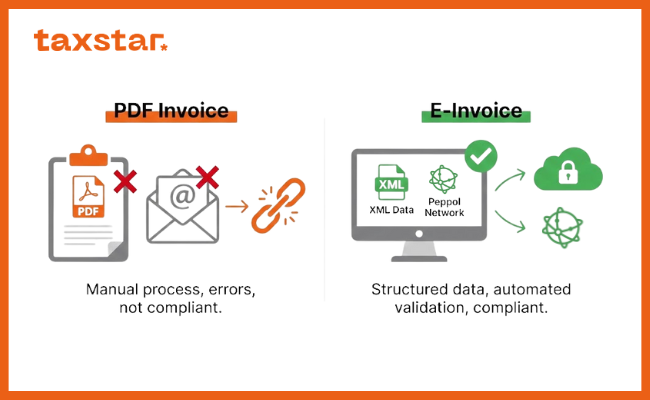
Many businesses still assume that e-invoicing simply means replacing paper invoices with digital files. That assumption creates risk. A PDF is only a visual representation of information. It cannot be reliably validated or processed by systems without manual work.
The UAE model requires something different. It requires structured invoice data that can move directly from one system to another.
This article explains what that shift really means, who it affects, and what finance teams should start reviewing now.
What Is E-Invoicing in the UAE?
E-invoicing in the UAE is the exchange of invoice data in a structured format that systems can read, validate, and process automatically. Instead of emailing invoices as PDFs, businesses must generate invoices as structured data files, typically in XML or JSON format.
These files follow the UAE data specification known as PINT AE. Once created, they are transmitted through a secure Peppol-based network rather than through email.
In simple terms, the invoice becomes data first, not a document.
This approach allows invoices to be checked for accuracy and completeness before they are sent, rather than being reviewed manually after receipt.
Why PDFs Are No Longer Enough
A PDF invoice is essentially an image of information. While it may look complete to a human reader, it still requires manual handling by the recipient. Data must often be re-entered, checked, or corrected after the invoice is received.
This is where many common problems occur. Errors in VAT, missing identifiers, or incorrect totals are often discovered late, during reconciliation or payment discussions.
The UAE e-invoicing model shifts these checks earlier in the process.
Invoices are validated automatically before transmission. If mandatory fields or identifiers are missing, the invoice may be rejected before it ever reaches the buyer system. This reduces disputes later but requires better data quality upfront.
What Changes in Practice
The move from PDFs to structured e-invoices introduces several practical changes for businesses:
- Invoices are transmitted through a secure network rather than unsecured email
- Validation of VAT and identifiers happens before the invoice is sent
- Manual re-keying and post-receipt checks are reduced
- Sending PDFs for business-to-business and business-to-government transactions will not be compliant once mandates apply
Instead of discovering issues weeks later, errors are surfaced immediately at transmission stage.
What Finance Teams Should Review Now
As validation moves earlier in the invoicing process, finance teams should start reviewing how ready their current setup is.
Key questions to consider include:
- Can current ERP or accounting systems generate structured invoice data?
- Who owns data quality for VAT logic, identifiers, and master data?
- How will invoice rejections and corrections be handled once validation happens before transmission?
Many CFOs and accounting leads are now documenting these gaps as part of their e-invoicing readiness planning. For teams looking for a deeper walkthrough of the UAE requirements, including timelines, roles, and data standards, you can check Tax Star’s free UAE e-invoicing guide for CFOs and accounting teams.
About Tax Star
Tax Star is a UAE-based tax technology company backed by Plug and Play and Dubai Chambers Digital. It supports accountants and finance teams in automating tax compliance processes using AI. Tax Star is Peppol registered and is currently in the process of becoming an Accredited Service Provider with the Ministry of Finance to support e-invoicing in the UAE.
Events Calendar
Upcoming Events

BCCD Business Briefing: The Financial Landscape - Trust, Regulations and the Road Ahead, Sponsored by Canaccord Wealth
Tue, 13th Oct 2026
voco Dubai
As the wealth and investment landscape evolves, so does the expectation around regulation ... Read more

BCCD Masterclass - Clarity in Chaos: Navigating Leadership Decisions
Wed, 14th Oct 2026
Hotel Indigo Dubai Downtown
Join us for “Clarity in Chaos: Navigating Leadership Decisions”, an immersive, high-st... Read more

BCCD Breakfast Networking
Wed, 21st Oct 2026
Reform Social & Grill
Kickstart your morning with valuable connections & conversations. This casual yet engaging... Read more


