Why AI Governance Is the Next Competitive Advantage for UAE and UK Businesses
Date Posted:Tue, 10th Feb 2026

Artificial intelligence is already embedded in most modern businesses often without those businesses fully realising it. AI is now routinely used in product development, customer interaction, marketing, recruitment and internal decision-making. Yet while adoption has accelerated, governance, compliance and risk frameworks have not kept pace.
AI adoption has outpaced governance
Many businesses still view AI risk as a future regulatory problem, or something that only applies to big technology companies. In reality, exposure already exists today. Businesses in the UAE that work with European customers, UK partners or international data are already touching UK and European-level regulation, whether they realise it or not and should ideally have a compliance framework that protects it and its customers.
From the perspective of a Regulated UK technology solicitor advising companies operating across borders, on data protection, risk management and AI governance is no longer optional. It is foundational.
WE WANT TO PROTECT AND TRAIN YOU AND YOUR BUSINESS
Europe sets a global benchmark and UAE businesses should be paying attention that’s where we can come in
Europe is currently the most regulated environment in the world when it comes to data protection, AI governance and accountability. More importantly, it is exporting those standards and categorising different levels of risk of AI globally through commercial relationships, contractual requirements and regulatory expectations. For businesses developing AI products, or incorporating AI into their operations, governance is not about waiting for the law to catch up. It is about anticipating regulation, mitigating risk early and building systems that are resilient as legal frameworks evolve. It helps attract customers; deal with crisis when they arise and prepare your business for safe growth.
The GDPR still remains the global gold standard for data protection, and the EU AI Act and related guidance are now shaping expectations around transparency, accountability, human oversight and risk classification when it comes to AI. Even where a business is based in the UAE, develops products locally or uses third-party AI tools, it may still be caught by these standards due to customer location, data flows, hosting arrangements or commercial relationships.
MITIGATING RISK
The real risk with AI is not really the technology itself at this stage, but how it is used, trained, accessed and governed within a business.
One of the most immediate areas of exposure is data protection and misuse. Businesses often do not have a clear view of what data is being input into AI tools, how that data is processed, where it is stored or whether it is being shared or used further down the line. There is a critical distinction between closed systems, open AI tools and third-party platforms, yet in practice these lines are frequently blurred. We create staff usage policies, mirror this into commercial and employment contracts, operational policies and systems. We use this to train you and your staff, monitor and address.
In many organisations, staff unknowingly input confidential information, client data or commercially sensitive material into open AI environments. Once that data leaves the business’s control, both liability and risk often follow. This is exactly where we step in helping companies map AI usage, identify vulnerabilities, and implement practical governance frameworks that mitigate risk while allowing innovation to flourish.
SECURITY GAPS, ACCESS CONTROLS AND OPERATIONAL RISK
Over-permissioning is one of the most common causes of data breaches and AI risks. We help you assess who in the organisation can access AI tools? Who can input data, and who can extract outputs? Is access role-based, monitored and logged? Are contractors and temporary staff included? We advise businesses on structuring access controls, monitoring protocols, and staff training to ensure AI use is both secure and compliant.
AI BIAS, DISCRIMINATION AND HR EXPOSURE
Increasingly, AI is being used in recruitment, CV screening and performance management. While this can deliver efficiency, it also introduces legal and reputational risk. AI systems learn from historical data and publicly available sources, both of which frequently contain embedded bias. Without proper oversight, this can result in unconscious bias, direct discrimination, exclusion of talent and regulatory scrutiny.
We work with companies to review HR policies, recruitment processes and AI tools to reduce bias, ensuring fairness and compliance with employment laws, data protection rules, and regulatory expectations.
HUMAN OVERSIGHT IS NOT OPTIONAL
AI cannot be treated as a “set and forget” tool. Even where decisions are automated, human oversight remains essential. Clear accountability is required: who is responsible if something goes wrong, and who has authority to intervene? Ongoing monitoring and testing of AI outputs is critical, not only for accuracy but for unintended consequences. Technology may automate decisions, but liability still sits with humans.
We help implement governance structures that integrate human oversight at every stage, providing clarity on responsibilities, escalation protocols and monitoring systems.
CONTRACTS, TRANSPARENCY AND COMMERCIAL REALITY
Effective AI governance must be reflected in contracts, policies and customer-facing documentation. Transparency is not just a regulatory requirement; it is a commercial necessity.
Commercial contracts and terms and conditions should clearly disclose where AI is used, what data is processed, for what purpose and where that data is stored. Liability, indemnities and responsibility between parties must be carefully allocated, particularly where third-party AI providers are involved. Businesses need clarity on who controls the data, who responds to incidents and who ultimately bears the risk.
We draft and review commercial agreements, supplier contracts and customer-facing documentation to ensure AI usage is transparent, liability is properly allocated, and compliance obligations are embedded in everyday operations.
A PRACTICAL ROADMAP FOR FOUNDERS AND SMES
Building AI governance requires a step-by-step approach. First, you need to audit current AI usage: identify where AI is used, what data is involved, and who has access. Next, identify risk gaps including data protection, security weaknesses, bias and HR exposure, and contractual blind spots. Then implement governance frameworks including AI usage policies, access controls, monitoring, and management training. Update contracts and documentation to reflect AI use, and create a practical crisis management plan supported by ongoing oversight and training.
This is exactly the kind of infrastructure we implement for our clients. From commercial agreements, staff policies and AI usage frameworks, to training for management and employees, we provide end-to-end support to make AI governance practical, defensible and business-focused.
BLOCKCHAIN AND AI INTEGRATION
Where AI and blockchain intersect, additional complexity arises around data ownership, access rights and control mechanisms. Clear contractual frameworks are essential to manage disputes, handle failures and ensure continuity. We advise on the intersection of AI and blockchain, helping businesses create clear, enforceable agreements that protect value while supporting innovation.
WHAT HAPPENS WHEN SOMETHING GOES WRONG?
Despite widespread AI adoption, many businesses do not have a workable AI-related crisis management plan. If a data breach occurs, policies are often theoretical rather than practical. Staff may not know what to do, who should report the incident or within what timeframe. Regulatory reporting obligations, customer communications, reputational management and insurance considerations all come into play. Increasingly, insurers are assessing governance maturity when underwriting risk.
We help companies create practical, actionable crisis management plans, ensuring staff understand their responsibilities, and that reporting, mitigation and communication processes are ready for real-world events.
WHY THIS MATTERS NOW NOT LATER
Businesses that adopt AI governance early gain a clear commercial advantage. Strong governance reduces regulatory and litigation risk, strengthens relationships with insurers, investors and enterprise clients, and builds customer trust. It also enables smoother cross-border expansion and future-proofs the business against incoming regulation.
Good governance does not slow innovation. It enables sustainable growth, and businesses that get it right now are positioned to lead their markets.
WHY REGULATED, CROSS-BORDER EXPERTISE MATTERS
AI governance is not purely technical. It is legal, regulatory and commercial. Businesses operating across the UK and UAE need advisers who understand European regulatory expectations as well as UK, UAE and global commercial realities.
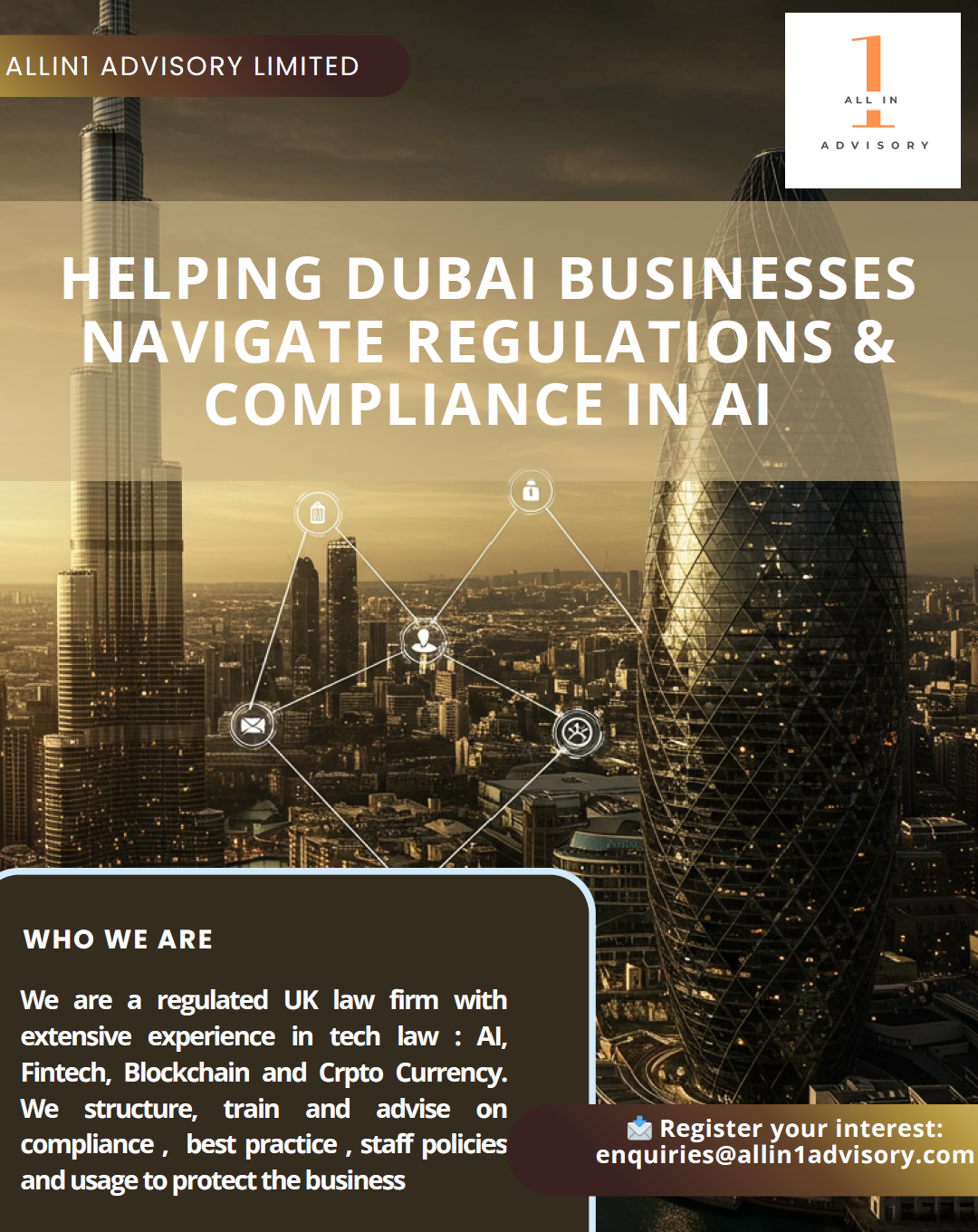
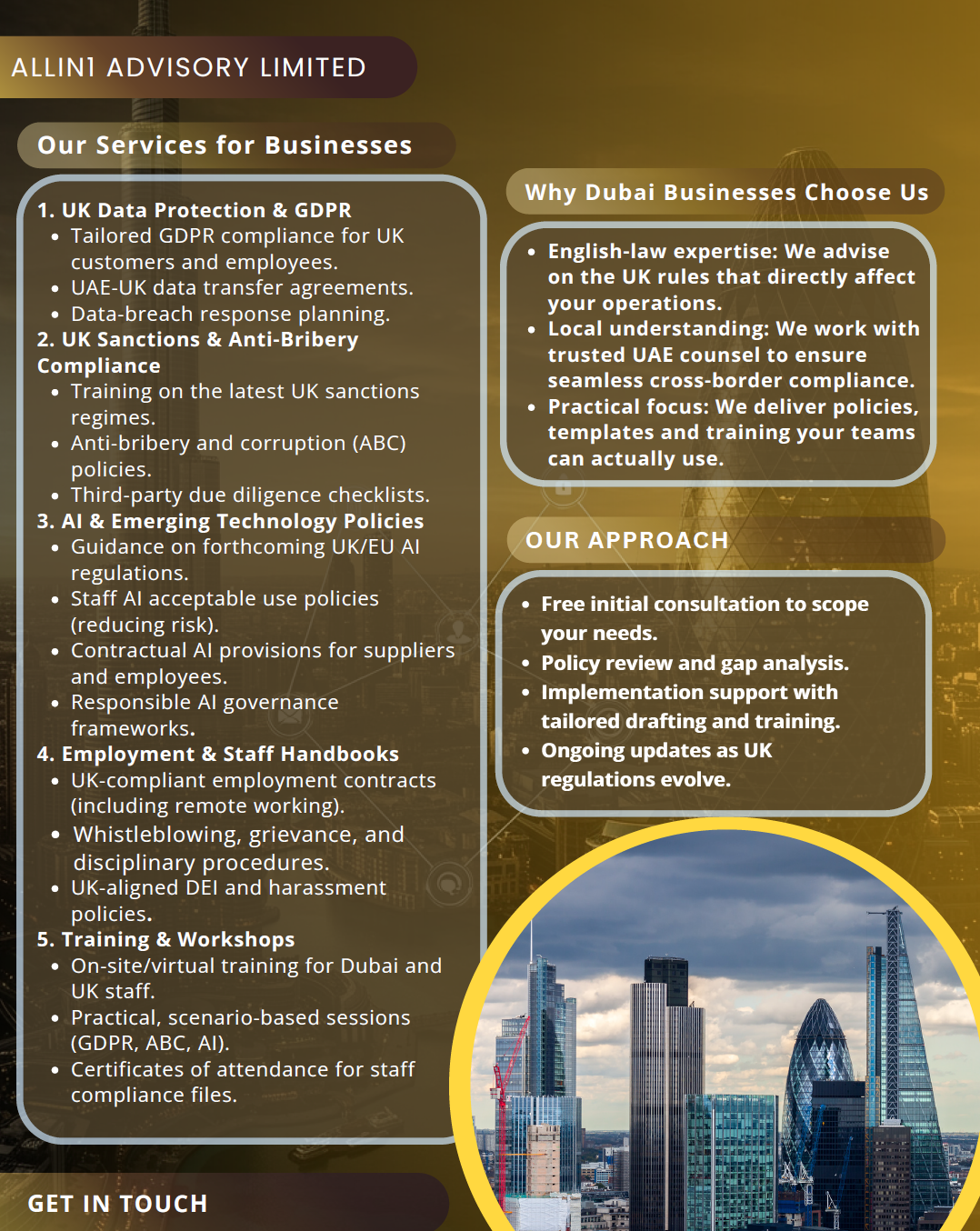
We are regulated UK solicitors with extensive experience advising founders, SMEs and scaling businesses across borders on new and emerging technology. We combine legal, regulatory and commercial insight to create governance solutions that work in the real world. Whether through remote training or in-person sessions in Dubai, we help clients audit their AI systems in use and then put in place AI policies, commercial contracts, governance structures and crisis management systems that protect value, mitigate risk, and enable growth.
CONCLUSION: AI GOVERNANCE AS A BUSINESS ASSET
AI is here. Regulation is coming. Risk already exists. Businesses that act now will protect themselves, build trust and gain a competitive edge.
Founders and SMEs who treat AI governance as part of their growth strategy rather than a compliance burden will be better positioned for the next phase of innovation.
By taking a proactive approach today, companies can ensure their AI adoption is not only innovative but also secure, compliant and commercially advantageous.
Click here to learn more.
Events Calendar
Upcoming Events

BCCD Business Briefing: The Financial Landscape - Trust, Regulations and the Road Ahead, Sponsored by Canaccord Wealth
Tue, 13th Oct 2026
voco Dubai
As the wealth and investment landscape evolves, so does the expectation around regulation ... Read more

BCCD Masterclass - Clarity in Chaos: Navigating Leadership Decisions
Wed, 14th Oct 2026
Hotel Indigo Dubai Downtown
Join us for “Clarity in Chaos: Navigating Leadership Decisions”, an immersive, high-st... Read more

BCCD Breakfast Networking
Wed, 21st Oct 2026
Reform Social & Grill
Kickstart your morning with valuable connections & conversations. This casual yet engaging... Read more


