Fragomen Monthly MENA Newsletter: Insights on Immigration, Corporate, Social Security and Destination Services
Date Posted:Tue, 20th Jan 2026

This newsletter provides timely insights across immigration, corporate, social security, and destination services, helping organizations stay informed and adapt to evolving regulatory and operational changes.
UNITED ARAB EMIRATES
26 December 2025 – Updated Birth Date Cut-Off for School Admissions Announced
The United Arab Emirates has updated the birth date cut-off for school admissions in Kindergarten and Grade 1.
For the 2026–2027 academic year, children will need to be born on or before December 31 of the admission year, replacing the previous August 31 deadline. This applies to all schools and kindergartens with an August/September academic start; schools with April intakes will maintain a March 31 birth date cut-off.
Current students are not affected; the policy applies only to those entering Kindergarten or Grade 1 in the 2026–27 academic year.
30 December 2025 – Implementation of Relaxed Stay Rules for Visit Visas for Work Assignments Forthcoming
The United Arab Emirates has updated its immigration regulations so that the Visit Visa for Work Assignments (also known as the Mission Visa or Mission Work Permit) will be issued as a multiple-entry visit visa valid for two years. Under the previous framework, multiple entries were allowed, but the regulations did not clearly define the validity period or the permitted duration of stay per entry. In practice, only single-entry visas with a maximum stay of 90 days are currently being issued.
Once the multiple-entry visa is implemented in practice, foreign nationals will be allowed to remain in the country for up to 60 days per entry, provided that the total duration of stay does not exceed 180 days within a single year. In addition, visa holders will be required to undergo a medical examination within 15 days of their first entry on the visa.
At present, the timeline for practical implementation of the multiple-entry visa remains unclear. Further guidance is expected to be issued, including the requirements for eligible companies, the professionals eligible for this visa type and any rules or conditions that may apply.
5 January 2026 – Increased Minimum Salary for Emirati Employees in the Private Sector Announced
Effective January 1, 2026, the Ministry of Human Resources and Emiratisation (MOHRE) has increased the monthly minimum wage for Emirati nationals working in the private sector to AED 6,000, up from AED 5,000.
Emirati nationals are required to obtain a work permit to work in the private sector. This increased minimum salary threshold applies to all new, renewed, or amended work permits for Emirati employees.
SAUDI ARABIA
8 January 2026 - New Saudization Requirement Announced for Sports Sector and Housing Supervisors
The Ministry of Human Resources and Social Development (MHRSD) and the Ministry of Sports have announced that men’s and women’s sports centers and gyms with four or more employees in the following roles must ensure that 15% are filled by Saudi nationals by November 18, 2026:
- Sports coach
- Professional football coach
- Professional aquatic sports coach
- Sports supervisor
- Professional ice sports coach
- Professional self-defense coach
- Fitness trainer
- Professional racket sports coach
- Personal trainer
- Professional athletics coach
- Professional equestrian coach
- Professional coach (ball sports)
Separately, MHRSD and the Ministry of Municipalities and Housing now require companies that provide shared accommodations for 20 or more individuals - such as residential complexes, mobile cabins and residential buildings to comply with Saudization requirements. The housing supervisor role will be subject to a 100% Saudization rate, effective February 1, 2026. Saudi Housing Supervisors will be counted toward the Saudization percentage only if their monthly salary registered with the General Organization for Social Insurance is at least SAR 5,000; if it is below, they will not be counted.
KUWAIT
12 January 2026 - New Immigration Law Implemented
As part of new immigration legislation and regulations, Kuwait has increased and clarified residence and entry visa fees, clarified the rules regarding converting a visit visa to a residence permit, relaxed passport requirements for residence permit applications and extended the period in which newborns can obtain a residence permit.
The new law has implemented the following changes, among others:
- Revised residence permit fees. Residence permit fees now cost KWD 20 per year, investors and property owners KWD 50 per year, self-sponsored residents KWD 500 per year; dependent fees will range between exempt up to KWD 300 per year. Previously, residence permit fees were KWD 10 per year, and investor, property owner and dependent fees were not clearly defined.
- Increased entry visa fees. Entry visas including work, family visit, tourism and medical now cost KWD 10 per month of stay, up from varied lower rates like KWD 1–3 per visa type before.
- Increased residence sponsorship fees. The annual residence permit fee for sponsoring dependents other than a spouse or children has increased to KWD 300, up from KWD 200.
- Clarification of visit visa to residence permit conversion situation. The new regulations clarify that conversion from visit visas to regular residence per-mits is possible for certain government-issued visas, family visit or tourist visas, domestic worker visas, anyone on a work visa who began the residency process but stayed outside Kuwait for up to one-month, and exceptional cases.
- Relaxed passport requirements for residence permit applications. Residence permit applicants now need a passport valid for at least six months at the time of application, instead of the previous two-year requirement for new residence permit applications and one year for in country residence permit transfer or renewal. In addition, the residence permit validity is no longer linked to passport expiry date.
- Extended period to apply for newborn residence permits. Newborns of foreign nationals can now obtain a residence permit within four months of being born in Kuwait, up from the previous two months.
OMAN
23 December 2025 - Technical Issues Cause Delays in Payment Confirmation by the Oman Social Protection Fund
The Social Protection Fund of Oman is currently facing payment confirmation delays due to a technical issue while processing payments through Bank Sohar. This is impacting many contribution payments, including those that may have already been processed.
It is currently unclear when the technical issues will be resolved.
25 December 2025 - Grace Period for Obtaining Mandatory Professional Practice Licenses Announced
The Ministry of Labour has announced a grace period until June 1, 2026, to allow workers in the energy and minerals sectors additional time to obtain the required professional practice licenses (or classification certificate, where applicable). This requirement was first introduced in September 2025.
While the licensing obligation applies to a wide range of roles, only positions within the energy and minerals sectors, including crane operators, welders and technicians, benefit from this grace period. The Sector Skills Unit for the Energy and Minerals Sector is responsible for issuing the licenses for all designated professions within the sector.
Until June 1, 2026, unlicensed work permit applicants in the energy and minerals sec-tors will remain eligible for work permits. In addition, existing unlicensed employees may continue working without a license during the grace period but must obtain the required license by June 1, 2026.
7 January 2026 - Job Code Updates and Education Certificate Requirements
The Ministry of Labor in Oman has updated its official job codes list. Any Employment Visa and Residence Card applications, including amendments or renewals, must accu-rately reflect the revised job titles and codes.
Additionally, Employment Visa and Residence Card renewal applications must now include an attested education certificate; while Dependent Residence Permit renewal applications must now include marriage and birth certificates. Previously such documentation was only required for first-time applications, and not renewals.
12 January 2026 - Visa-Free Entry for Belarus Nationals Forthcoming
Nationals of Belarus will soon be able to travel to Oman without a visa for tourism purposes. Eligible individuals may stay for up to 30 days per visit, with a maximum total stay of 90 days within a calendar year.
Under the new mutual visa-exemption agreement, Omani nationals, who were already visa-exempt for tourism or business purposes when entering Belarus via air, will now be able to enter through air and land routes for tourism purposes. It is not yet clear whether entry for business purposes will also be permitted.
To be able to enter Oman visa free, individuals must have a passport with a minimum of six months validity from the intended date of entry, valid health insurance, and a return or onward ticket. Individuals travelling for other purposes (including study, business, or work) must continue to obtain a relevant visa in advance.
While it currently remains unclear when this new policy will go into effect, it is expected to be implemented in the coming months.
BAHRAIN
23 December 2025 - Mandatory Appointment of a Wages Responsible Person for Private Sector Companies
Effective February 2026, all private sector companies will need to have appointed a so-called “Wages Responsible Person” (WRP) so as to avoid penalties for non-compliance - a new requirement introduced as part of the final phase enhancement of the Wages Protection System. This is currently not required.
The WRP will be responsible for:
- Reviewing, and ensuring the accuracy of, payroll data;
- Ensuring that salary disbursements comply with contractual terms and applicable regulations;
- Managing the registration of authorized personnel in the Expat Management System, including defining and maintaining “maker” and “checker” roles to ensure proper segregation of duties.
Only the individual registered as the “Responsible Person” with the Labour Market Regulatory Authority will be authorised to appoint the WRP.
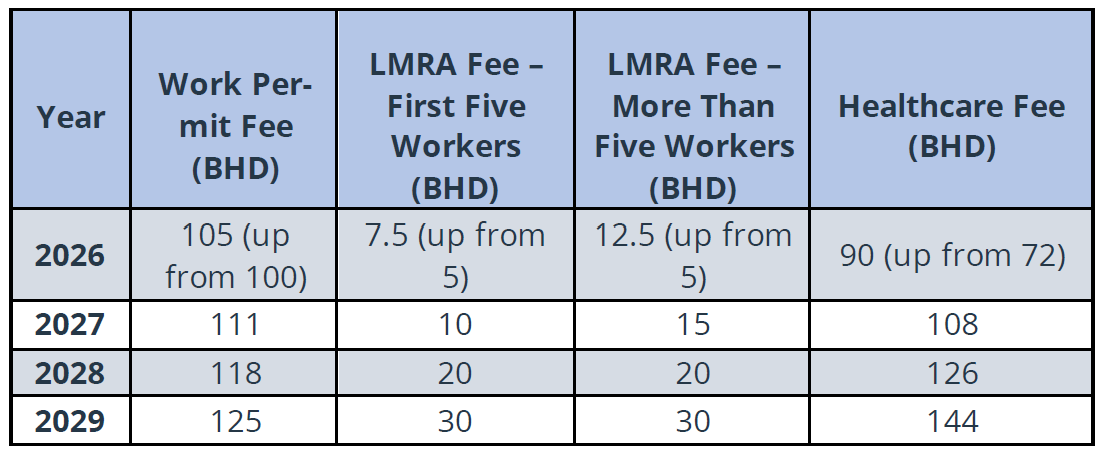
15 January 2026 - Increase in Work, Residence Permit and Healthcare Fees for Foreign Nationals
Bahrain has increased work and residence permit applications fees (including renew-als), the Labour Market Regulatory Authority monthly fee, and the annual basic healthcare fees.
As set out in the table below, fees have increased – and will continue to increase into 2029 – for:
- Work permit applications fees (including for renewals). This encompasses residence and re-entry permits, medical examination costs and identity card issuance costs.
- The Labour Market Regulatory Authority (LMRA) monthly fee per foreign national working in Bahrain; and
- Annual basic healthcare fees for each foreign national working in Bahrain.
MIDDLE EAST
9 January 2026 - Scheduled Increase in Employer Monthly Contribution Rate
Effective January 2026, the employer monthly contribution rate increased by 1% for Bahraini nationals employed in Gulf Cooperation Council (GCC) countries to reach a total contribution for both employee and employer of 22% of the pensionable salary. This continues Bahrain’s current policy of increasing its employer contribution rate annually by 1% between 2023 and 2028.
As was the case previously, the maximum monthly employer contribution rate of Bahraini nationals employed in other GCC countries must not exceed the contribution rate paid for local employees in that country. If the contribution rate paid to local employees in that country is lower, the Bahraini employee must themselves cover the difference to ensure that a total contribution of 22% of the pensionable salary occurs.
Events Calendar
Upcoming Events

BCCD Business Briefing: The Financial Landscape - Trust, Regulations and the Road Ahead, Sponsored by Canaccord Wealth
Tue, 13th Oct 2026
voco Dubai
As the wealth and investment landscape evolves, so does the expectation around regulation ... Read more

BCCD Masterclass - Clarity in Chaos: Navigating Leadership Decisions
Wed, 14th Oct 2026
Hotel Indigo Dubai Downtown
Join us for “Clarity in Chaos: Navigating Leadership Decisions”, an immersive, high-st... Read more

BCCD Breakfast Networking
Wed, 21st Oct 2026
Reform Social & Grill
Kickstart your morning with valuable connections & conversations. This casual yet engaging... Read more


