Investing in AI-Driven Fintech Startups in the UAE and GCC
Date Posted:Tue, 3rd Nov 2026

Where investment capital meets the next wave of banking innovation
The UAE offers investors a compelling platform for backing the next generation of financial technology businesses. Its financial institutions, investment infrastructure and commitment to innovation create an opportunity to connect sophisticated capital with practical applications of artificial intelligence. The strongest investment thesis begins with a bank or business willing to pay for a measurable improvement in financial performance.
My priority would be AI businesses embedded in financial workflows: detecting fraud, supporting compliance, reconciling payments and improving treasury decisions. These products can generate recurring income while solving expensive operational problems. Whether they produce attractive shareholder returns depends on their commercial evidence, entry valuation and capital requirements. No public dataset reviewed for this article establishes a universally most profitable AI-driven fintech subsector.
Capital is returning with greater selectivity
KPMG reports US$103.1 billion of global fintech investment in H1 2026, of which US$31.5 billion was venture capital and US$67.9 billion was M&A. AI-focused fintech transactions attracted US$21.4 billion. These categories overlap: AI is a theme within fintech, not an additional market to add to the total. [1]
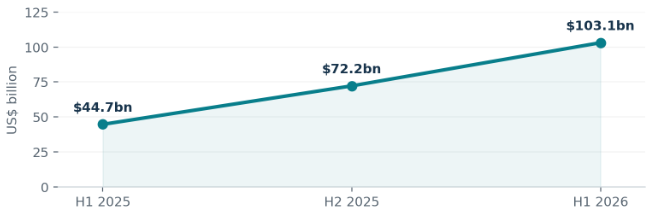
Figure 1. Global fintech investment across VC, private equity and M&A. Sources [1, 2]. Half-year observations joined by straight lines; no forecast. Historical releases may be revised.
The recovery is relevant to potential acquisition routes, but aggregate deal value is not a measure of startup profitability. An investor must separate the value of mature-company acquisitions from the financing available to an early-stage business.
The UAE and GCC investment context
The UAE’s strength lies in the concentration of customers, specialist talent and capital within a connected financial ecosystem. DIFC reported 1,677 AI, fintech and innovation entities at the end of 2025, alongside 1,052 regulated financial firms. The former is a broad ecosystem count, not a count of licensed AI-driven fintech startups. [4]
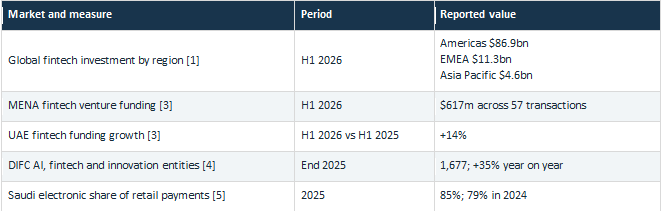
Table 1. Global regional values include VC, PE and M&A; MENA covers venture funding. EMEA includes MENA. Regional values as published total $102.8bn, versus the $103.1bn global headline; the source discrepancy is retained. All dollar figures are US dollars.
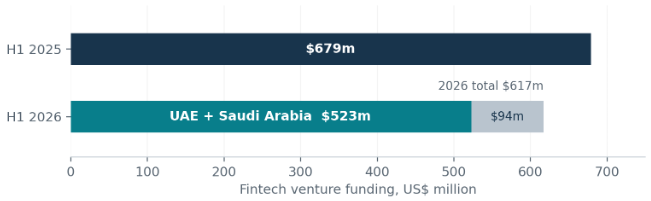
Figure 2. MENA fintech venture funding. Source [3]. The UAE and Saudi Arabia received approximately 85% of the H1 2026 total. Other MENA markets equal $94m, calculated as $617m less $523m. No country split is inferred for 2025.
MENA funding declined from US$679 million in H1 2025 to US$617 million in H1 2026, while transaction activity fell 50%. [3] This suggests a more concentrated financing market. For investors, access to promising founders matters, but the ability to support companies through a longer fundraising cycle matters too.
Saudi Arabia’s digital payments adoption offers a complementary demand signal. [5] Together, the UAE and Saudi markets can anchor a regional expansion strategy, while each additional GCC market needs its own customer economics and implementation plan. MENA statistics should not be presented as a complete GCC dataset.
Where AI could generate durable financial value
I would assess opportunities by how much verified customer value the startup can retain as revenue after delivery costs. A useful product can still be a poor investment if its price is too high, its customers are too expensive to win or its technology is easily replicated. The following priorities are an investment framework, not a ranking of observed returns.
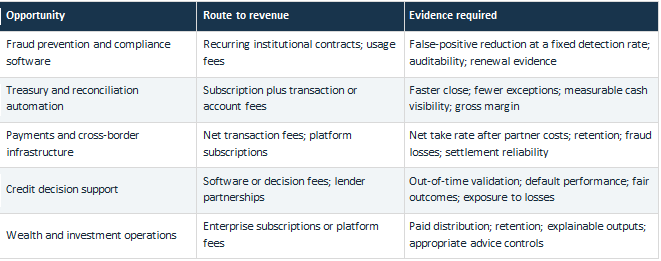
Table 2. Author’s qualitative investment priorities. Commercial potential depends on company execution, valuation and the applicable regulatory perimeter.
Fraud and compliance software merits early attention because a buyer can test a concrete economic proposition. A startup should demonstrate lower investigation costs without weakening detection. If fewer false alerts simply conceal more genuine fraud, the apparent efficiency gain disappears. The commercial advantage comes from reliable performance within the institution’s actual workflow.
Treasury and reconciliation can be equally attractive where the product integrates into accounting systems and solves persistent exceptions. Embedded workflows may support retention, but integration work must not turn every new customer into an unprofitable consulting project. Investors should separate recurring software income from implementation revenue.
The Central Bank of the UAE describes open finance as consent-based access for accredited third parties. [6] This creates a promising foundation for financial data services. My inference is that startups combining lawful access with useful analytics can build stronger products; access itself does not guarantee customer demand or exclusive data rights.
Credit platforms and digital-asset infrastructure can offer substantial upside, but require different underwriting. A lender carries funding and credit risk that a software vendor may avoid. A digital-asset business needs defensible custody, compliance and counterparty arrangements. High funding growth in a category is insufficient evidence of superior risk-adjusted returns.
How investors can participate and earn returns
Angels can invest directly in an equity round or participate through a syndicate with an experienced lead. The investment case should specify the ownership purchased, governance rights, use of proceeds and milestones before further funding. Convertible instruments defer some pricing decisions, so investors must model conversion, valuation caps and future dilution rather than assume a fixed ownership percentage.
A venture fund offers delegated selection and a portfolio of companies, with fees, carried interest, illiquidity and manager risk. Direct investors should diversify and budget for follow-on rounds rather than exhaust capital at entry. Bank-led strategic investment can combine capital with customer access, but excessive exclusivity may deter future customers or acquirers. Each route requires appropriate eligibility, documentation and professional advice for the investor’s jurisdiction.
Incubators and accelerators create economic value when mentoring and introductions become paid contracts. Their equity stakes should be evaluated against the full cost of staff, facilities and programme delivery. A strong programme would track pilot-to-contract conversion, follow-on capital and realised distributions, alongside founder participation. Demo-day attendance alone says little about investment performance.
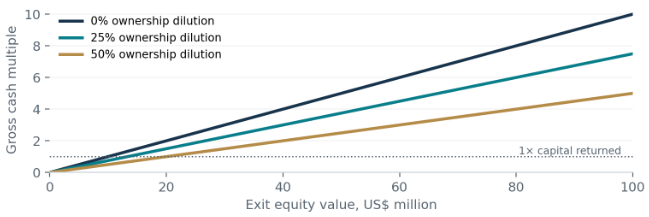
Figure 3. Illustrative return sensitivity, not a forecast. A $100,000 investment at a $10m post-money valuation buys 1%. Lines show 0%, 25% or 50% reduction in that ownership. Assumes ordinary pro-rata distributions, no preferences, fees, taxes or follow-on investment. Source: author’s calculation.
For example, 25% ownership dilution reduces a 1% stake to 0.75%. At a US$40 million exit equity value, this produces US$300,000, or 3.0 times the initial investment. If paid after seven years with no interim cash flows, the gross annualised return is about 17.0%. A US$10 million exit produces only US$75,000, a 25% capital loss. These are scenarios, not expected outcomes.
The calculation is simple: gross cash multiple equals exit equity value multiplied by final ownership, divided by invested capital. Actual proceeds depend on the distribution waterfall, debt, preferences and transaction costs. An increase in paper valuation is not a realised return. Complete loss and extended periods without liquidity must remain within the investment case.
Diligence that connects AI performance to cash flow
Before investing, I would ask management to substantiate five questions with customer and financial evidence. The aim is to establish whether the company can convert technical capability into repeatable, defensible revenue.
Who pays and why do they renew
Examine contracts, collected revenue, customer concentration and renewal cohorts. Separate paid production use from pilots and non-binding expressions of interest. Validate the customer’s savings against a baseline agreed with its finance team, including the cost of integration and oversight.
What remains after delivering the service
Recalculate margins after model inference, data licensing, human review, support and compliance costs. Stress-test a lower selling price, longer procurement cycle and higher computing costs. Model cash runway through the next commercial milestone without assuming that another funding round will arrive on schedule.
What can the company defend
Look for durable customer integration, lawful data advantages, distribution relationships and independently tested performance. Establish ownership of software and intellectual property. A product built around a readily available model needs a credible reason why customers cannot obtain equivalent value elsewhere.
Who controls consequential decisions
For agents that initiate payments, recommend credit actions or escalate compliance cases, define approval limits, intervention responsibilities and recovery procedures. Review access controls, logs and independent validation. These capabilities can influence procurement confidence and reduce costly remediation; their financial value should be tested, not assumed.
Who could return capital to shareholders
Develop a plausible buyer universe and acquisition rationale before entry. A bank may value distribution or risk capability; a payments group may value transaction infrastructure; a software consolidator may value recurring earnings. Underwrite the business without relying on an IPO or multiple expansion, and model the preference stack under downside exits.
The investor opportunity
Investors and business leaders can contribute more than finance. Banking expertise, accounting discipline, insurance knowledge and enterprise relationships can help a UAE startup validate a product and secure its first durable contracts. A practical approach is to pair an experienced sector specialist with a UAE institutional customer, then fund expansion once the commercial evidence justifies it.
The UAE’s investment in financial innovation provides an exceptional platform for this collaboration. The opportunity is to back businesses that improve the economics of finance and earn an enduring share of that improvement. Attractive returns will depend on disciplined selection, sensible ownership terms and realised exits. That is the investment standard AI-driven fintech should meet.
References and methodology
Research cut-off: 30 October 2026. H1 means January to June; H2 means July to December. Latest accessible comparable observations are used, not an estimate of full-year 2026. Sources report different market definitions and may revise historic figures. No comparable realised-return series for UAE or GCC AI-driven fintech subsectors was identified in the sources reviewed. All strategic priorities and scenarios are the author’s analysis.
[1] KPMG. Pulse of Fintech H1 2026 — Global insights
https://kpmg.com/xx/en/what-we-do/industries/financial-services/pulse-of-fintech.html
[2] KPMG UK. UK fintech investment hits $7.2 billion in H1 2025 — down 5% from H1 2024. 12 August 2025. Used for the global H1 2025 observation.
https://kpmg.com/uk/en/media/press-releases/2025/08/uk-fintech-investment-hits-down.html
[3] MAGNiTT. MENA FinTech Venture Capital: The H1 2026 Review. Public report summary.
https://www.magnitt.com/research/mena-fintech-venture-capital-the-h1-2026-review-51057
[4] DIFC. Dubai International Financial Centre announces landmark annual results for 2025. 5 February 2026.
[5] Saudi Central Bank. SAMA: E-Payments Account for 85% of Total Retail Payments in 2025. 12 April 2026.
https://sama.gov.sa/en-US/MediaCenter/News/Pages/news-1139.aspx
[6] Central Bank of the UAE. Open Finance. Updated 31 March 2026.
https://centralbank.ae/en/our-operations/fintech-digital-transformation/open-finance/
About the author
Dr Ali Bagheri holds a PhD in Technology and Innovation Management and a DBA in Digital Transformation. He is a UAE-based AI Readiness, Governance & Innovation Advisor and International Speaker, with more than 20 years of consulting, training and leadership experience.
Events Calendar
Upcoming Events

BCCD Connect After Work
Thu, 5th Nov 2026
Replay Lounge, Bla Bla by McGettigan's
Unwind at the end of the working day with good company and great conversation. BCCD Connec... Read more

BCCD Masterclass: The Communication Advantage - How to Connect, Influence and Create Impact
Tue, 10th Nov 2026
Radisson RED Dubai Silicon Oasis
Clear communication helps people build trust, win support and move ideas forward. In this ... Read more

BCCD Speed Networking Sponsored by Barclays International Banking
Wed, 11th Nov 2026
Mezzanine Bar & Kitchen
Expand your professional circle, make meaningful connections, and exchange ideas in rapid-... Read more


