When AI Gets Spending Power
Date Posted:Tue, 20th Oct 2026

The UAE’s next fintech advantage and the opportunity for British businesses.
Your next customer may send an AI agent to negotiate, select and pay. Will that agent choose your business—and will the transaction still be profitable?
The emerging fintech opportunity lies in delegated spending: software executing a bounded commercial mandate on behalf of a person or business. For British companies operating in the UAE, this changes more than checkout. It could alter who controls customer discovery, how purchasing decisions are made and where transaction margins accumulate.
My central argument is that the most defensible advantage will belong to businesses that make their offers easy for agents to evaluate and their transactions safe to complete. A persuasive AI interface alone creates little protection from competitors. Reliable execution, transparent economics and recoverable mistakes are harder to replicate.
The market signal has become concrete
Visa launched its Agentic Ready programme in the UAE on 20 May 2026, with participating institutions including Emirates NBD, Mashreq, Wio and Ziina. Its initial phase enables controlled testing of agent-initiated transactions. The accompanying research points to commercial interest, but does not establish widespread deployment or realised returns. [1]

Source: Visa and Fast Company Middle East research reported by Visa, 20 May 2026 [1]. These are survey indicators, not adoption rates. The release does not disclose sample size or fieldwork details. The priorities are not presented as an exhaustive distribution.
By July, Visa reported live transactions with participating European merchants and work with more than 30 European issuers. That gives British businesses a useful bridge between developments in their home market and commercial experimentation in the UAE. It does not establish universal acceptance or cross-border interoperability. [2]
The economic question is who captures the margin
When an agent compares suppliers, conventional advantages can weaken. A beautiful website may matter less if availability, cancellation rights, delivery reliability and total cost are difficult to retrieve. British travel, hospitality, retail and professional-service businesses in Dubai should examine whether their commercial proposition survives translation into structured data.
A second effect concerns intermediation. An agent platform could influence which suppliers enter a customer’s consideration set, then charge for discovery, execution or preferred access. Merchants may gain conversion while surrendering margin and customer knowledge. Executives should therefore assess ownership of the mandate, access to transaction evidence and the ability to change providers alongside the headline conversion rate.
On the purchasing side, delegation can reduce the effort required to compare offers or replenish approved services. Yet paying sooner is not automatically better cash management. An agent that captures a small discount while unnecessarily accelerating a large payment can destroy more financing value than it creates. Treasury should specify the objective, including liquidity, supplier continuity and total cost.
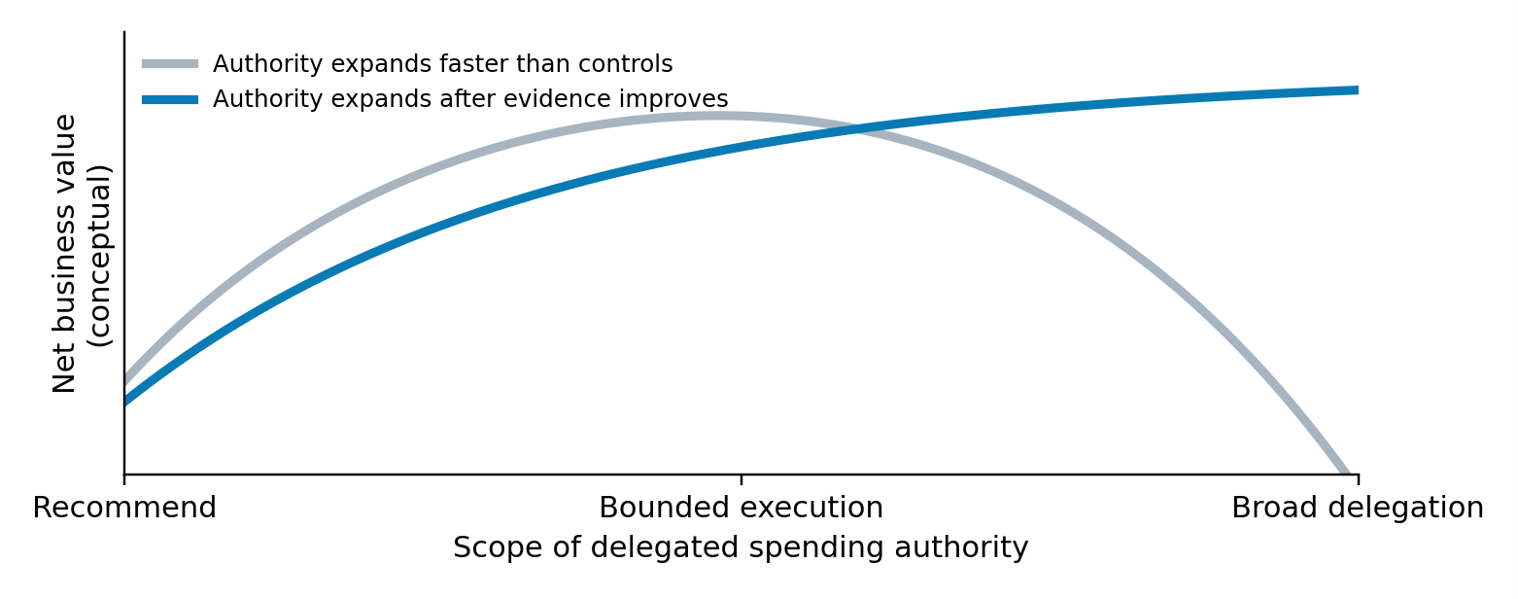
Figure 2 The delegated spending value curve. Author’s conceptual model, not measured data or a forecast. Curve shapes illustrate a hypothesis: net value can fall when financial exposure grows faster than execution controls. No empirical optimum is implied.
Figure 2 reframes the scaling decision. Broader autonomy is useful only when its incremental economic benefit exceeds its incremental operating cost and expected loss. Improving controls can expand the viable scope of delegation; it cannot guarantee that every workflow should become autonomous.
For investment appraisal, define net annual value as incremental contribution profit plus verified operating savings and financing benefits, minus integration, platform, supervision and expected-loss costs. Avoid counting the same productivity benefit twice. Test adverse scenarios separately because a small expected loss can conceal a severe but infrequent failure.
The correct board metric is therefore contribution after exceptions and losses, supported by service quality and liquidity measures. Gross payment volume, tasks completed and model accuracy are useful diagnostics, but none is a substitute for a business case.
Build the commercial mandate before the agent
The UAE’s Open Finance initiative creates a relevant foundation: the Central Bank describes consented financial data sharing with accredited third parties as a way to enable innovative services for individuals, SMEs and corporates. Data access, however, should not be treated as permission to spend. A company must define both the information an agent may use and the financial actions it may initiate. [3]
I propose a mandate-to-margin model for evaluating such projects. It follows a transaction from commercial intention to financial outcome, making the business owner responsible for the objective while separating the agent’s recommendations from payment authority. This is an original management framework, not a regulatory standard.
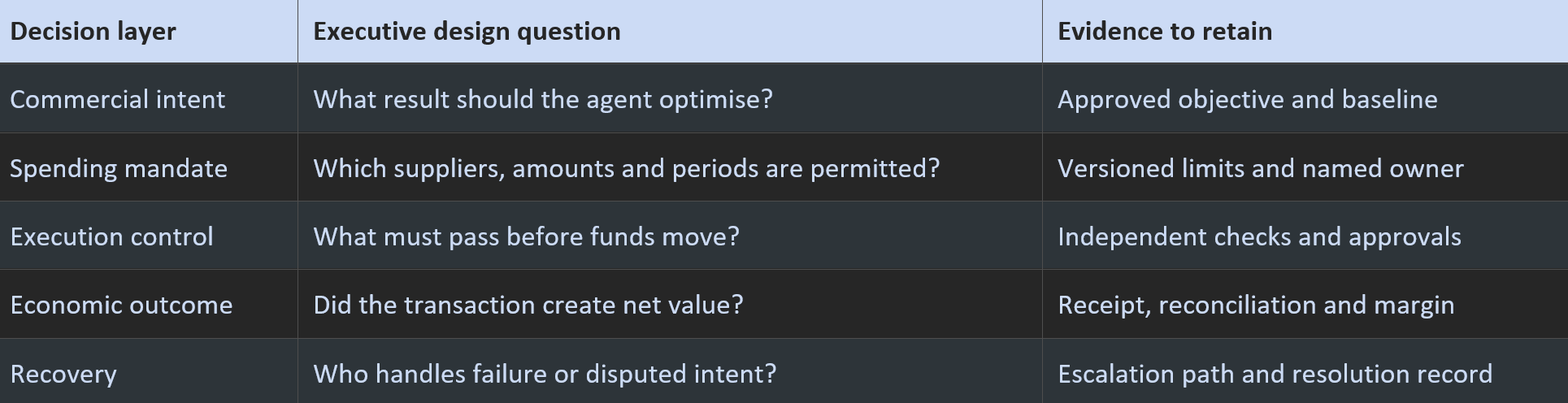
Author’s mandate-to-margin framework. The table specifies management design choices; implementation depends on the payment product, counterparties and applicable requirements.
Consider a hypothetical British distributor in Dubai. Its agent may reorder specified stock from approved suppliers within a weekly budget. The mandate also sets maximum unit prices, delivery tolerances and a minimum cash buffer. A cheaper offer from an unfamiliar supplier triggers review rather than an automatic purchase. The example is a proposed design, not an observed deployment.
The important boundary is architectural. The same language model should not be able to rewrite its spending policy and approve its own exception. An independent execution service should check limits against current records, reject duplicate requests and stop transactions when required evidence is missing. External supplier text should be treated as untrusted input, particularly when it contains instructions directed at the agent.
Recent infrastructure announcements reinforce this direction. On 30 September 2026, Mastercard described new identity, intent and fraud-related intelligence for agentic transactions; the initial probability-score service is being tested in the United States. Its relevance here is the emerging design pattern, not proof of UAE availability. [4]
For a British–UAE pilot, assess the actual operating entities, data flows and payment arrangements with the relevant specialists. Neither UK experience nor participation in a network programme establishes permission for every UAE activity. Keep the first mandate narrow enough that commercial and operational responsibilities remain explicit.
A 90 day test of commercial value
The best first project has frequent transactions, reliable source data, bounded financial exposure and a clear recovery process. Approved supplier replenishment or limited business-travel purchases may fit those conditions. Credit decisions, unrestricted treasury transfers and complex investment execution require a different assessment and should not be bundled into the same pilot.
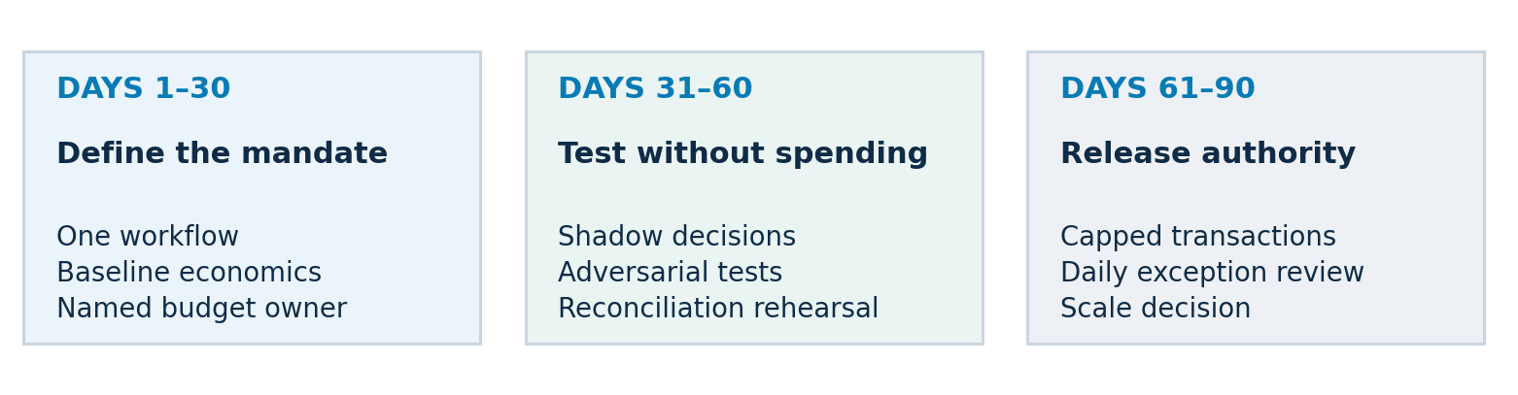
Figure 3 A proposed 90-day roadmap. Author’s implementation model; the timetable is illustrative, not a regulatory deadline or a guarantee of readiness.
During the first month, the CFO and commercial owner should establish baseline handling time, margin, failures and cash impact. Distinguish avoidable costs from those that remain. Set transaction and aggregate limits, an exception owner and measurable stop conditions.
During the second month, compare proposed actions with real decisions without moving money. Test revoked mandates, stale prices, supplier impersonation, duplicate requests and network interruptions. Rehearse reconciliation and recovery, including changed supplier terms and delayed payment confirmations.
During the final month, permit a small, authorised transaction set through suitable providers. Use a comparison group where practical. Review contribution per transaction, intervention, reconciliation, liquidity and losses. Suspend and investigate any unauthorised payment. Zero incidents in a small pilot cannot prove safety at scale.
The innovation opportunity extends beyond checkout
Mastercard’s June 2026 Agent Pay for Machines announcement points towards software buying services through frequent, low-value transactions. That suggests a further opportunity for UAE businesses: selling narrowly defined business capabilities that agents can purchase on demand. The announcement describes an emerging infrastructure direction, not established mass adoption. [5]
A British specialist firm might sell a verified data check, logistics service or discrete analytical task this way. The business-model hypothesis is whether capabilities currently sold through long sales cycles can become repeatable purchases while preserving quality and margin.
British businesses can combine sector expertise with dependable execution in the UAE. Leaders should decide which commercial promises software may fulfil and what evidence justifies wider authority.
If an authorised AI agent approached your business tomorrow, could it understand your offer, complete a purchase and resolve a failure without eroding your margin?
References and evidence notes
Primary sources checked on 16 October 2026. All references below were published or updated in 2026. Dates reflect the publisher’s article text where search metadata differs. Commercial announcements demonstrate stated programmes or capabilities, not independently audited business outcomes.
[1] Visa (20 May 2026). Visa Launches “Agentic Ready” Program in UAE to Accelerate Agent Led Commerce.
https://www.visa.com/en-ae/newsroom/agentic-ready-ai-commerce-uae
[2] Visa (2 July 2026). Visa and Banks Across Europe Reach the Next Phase of Agentic Commerce, Unlocking Secure Access to Merchants.
https://www.visa.co.uk/about-visa/newsroom/press-releases.3457328.html
[3] Central Bank of the UAE (Updated 31 March 2026). Open Finance.
https://centralbank.ae/en/our-operations/fintech-digital-transformation/open-finance/
[4] Mastercard (30 September 2026). Mastercard advances agentic commerce with new trust and intelligence services.
[5] Mastercard (10 June 2026). Mastercard launches Agent Pay for Machines to unlock super-fast, always-on payments.
How to read the figures
Figure 1 reproduces reported survey indicators with their limitations. Figure 2 is an uncalibrated conceptual curve: its axes carry no measured units and its apparent turning point is not an estimate. Figure 3 is a proposed delivery sequence. The mandate-to-margin table and distributor example are the author’s analytical contributions. No causal relationship or return on investment is claimed from the survey.
About the author
Dr Ali Bagheri holds a PhD in Technology and Innovation Management and advises on AI governance, leadership and innovation. Based in Dubai, his work focuses on helping leaders connect technology decisions with business strategy and organisational capability.
Events Calendar
Upcoming Events

BCCD Breakfast Networking
Wed, 21st Oct 2026
Reform Social & Grill
Kickstart your morning with valuable connections & conversations. This casual yet engaging... Read more

Quick Connect: Meet, Greet, Repeat!
Thu, 22nd Oct 2026
Pronto, Fairmont Dubai
Join us for an exciting evening of speed networking that’s all about making new connecti... Read more

Breast Cancer Awareness Morning
Tue, 27th Oct 2026
SEE Institute
October is Breast Cancer Awareness Month, a time to bring a difficult subject into the ope... Read more


