The AI Innovation Paradox: How UAE Businesses Can Scale Intelligence Without Standardising Their Strategy
Date Posted:Tue, 13th Oct 2026

AI can expand the capacity to experiment while narrowing the assumptions through which opportunities receive funding. For CEOs, the challenge is to convert faster experimentation into distinctive learning and defensible commercial value.
What happens when competing businesses become more intelligent in increasingly similar ways? A company may use AI to accelerate product development and explore new opportunities, yet find that its investment choices increasingly resemble those of its rivals. This is the paradox examined here: expanding the capacity to innovate can coexist with convergence in strategic choice.
Drawing on my PhD in Technology and Innovation Management, more than 20 years of experience across training, consulting and organisational leadership, and my current professional work in the UAE, I approach this issue through the relationship between technology, organisational learning and commercial value. My argument is that the organisation’s rules for selecting and learning from opportunities deserve as much executive attention as its access to AI.
What the research supports
In an experiment involving short-story writing, Doshi and Hauser (2024) found that AI assistance improved evaluations of individual outputs while making the resulting stories more similar collectively. However, Ashkinaze et al. (2025) found increased collective idea diversity under high AI exposure in a different experimental setting. These findings concern creative tasks, not UAE corporate strategy. Together, they caution against assuming that AI necessarily produces either originality or conformity.
The framework developed here is a conceptual extension of this evidence and established innovation research. It proposes mechanisms and management responses; it does not report a new empirical study or establish that UAE businesses are already converging. Its central question is conditional: when does scaling AI strengthen a firm’s distinctiveness, and when might it reinforce familiar choices?
The hidden bottleneck is opportunity selection
The most visible concern is similarity in AI-generated outputs. A less visible risk arises after ideas have been generated, when organisations decide which opportunities deserve investment. Diverse concepts can pass through similar scoring systems and emerge as strikingly similar commitments.
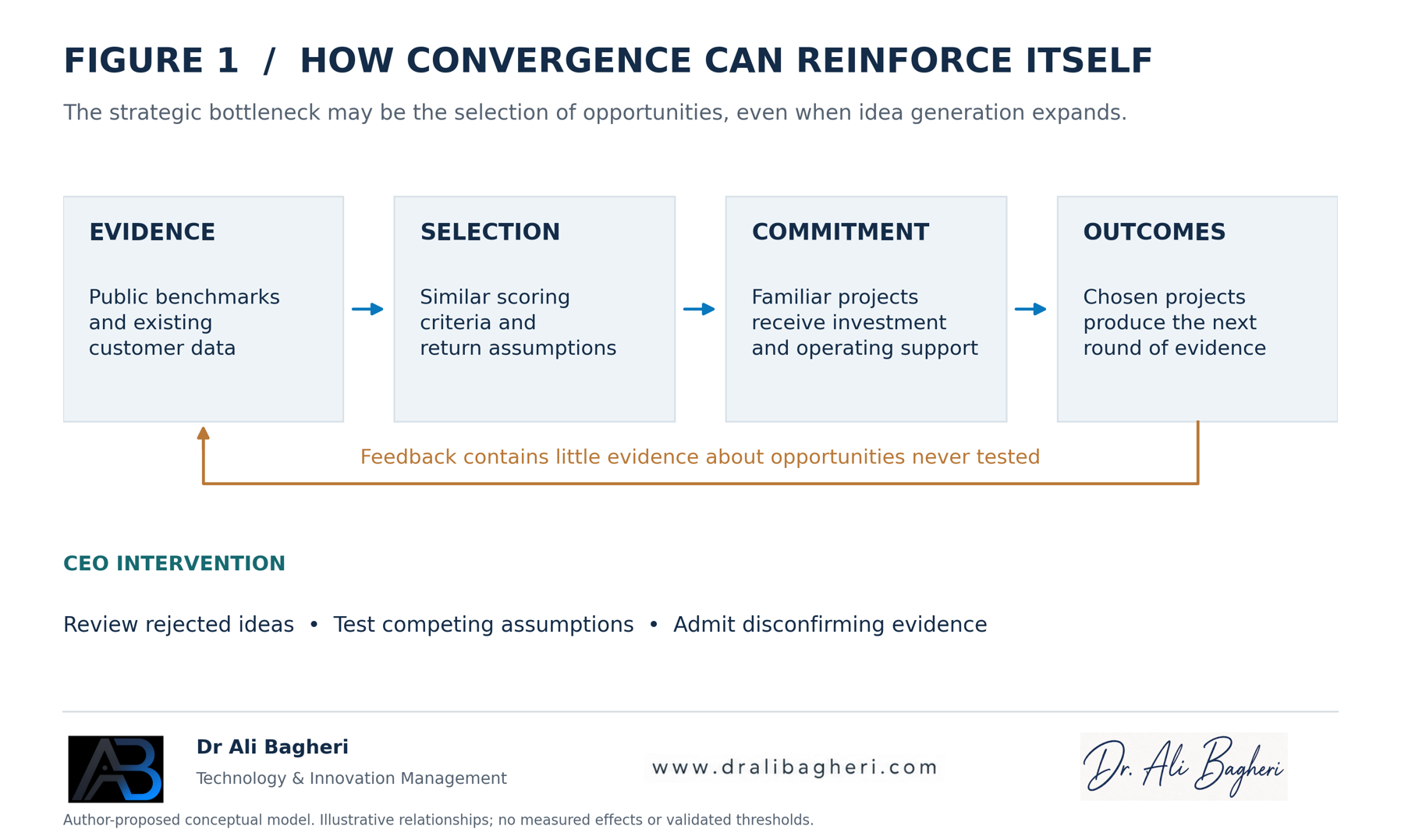
Figure 1. A proposed feedback mechanism linking evidence, selection, investment and subsequent learning. Convergence is a risk under shared assumptions, not an inevitable consequence of AI adoption.
When competing firms use comparable benchmarks, hurdle rates and assumptions about demand, opportunities supported by historical evidence may consistently outrank unfamiliar propositions. A new business model can appear unattractive precisely because its market has not yet been tested. The decision process then rewards what can already be demonstrated and underinvests in what must first be discovered.
The effect can reinforce itself. Funded projects generate the next round of evidence; rejected opportunities remain poorly understood. Recommendations become better calibrated to the activities the organisation has chosen to pursue, while the range of alternatives it seriously investigates may contract. Figure 1 shows this potential feedback mechanism.
March (1991) explains the tension between exploiting existing knowledge and exploring new possibilities. The proposed AI extension is that faster evaluation can accelerate an existing imbalance when familiar projects repeatedly win funding. More experiments therefore need not mean broader strategic exploration. A useful portfolio review asks which materially different assumptions were tested, including assumptions that challenged the current business model.
Two capabilities determine the strategic direction
Figure 2 separates AI-enabled experimentation capacity from firm-specific learning capability. The former concerns how effectively a business generates and tests hypotheses. The latter concerns whether distinctive evidence changes decisions and becomes reusable organisational knowledge.
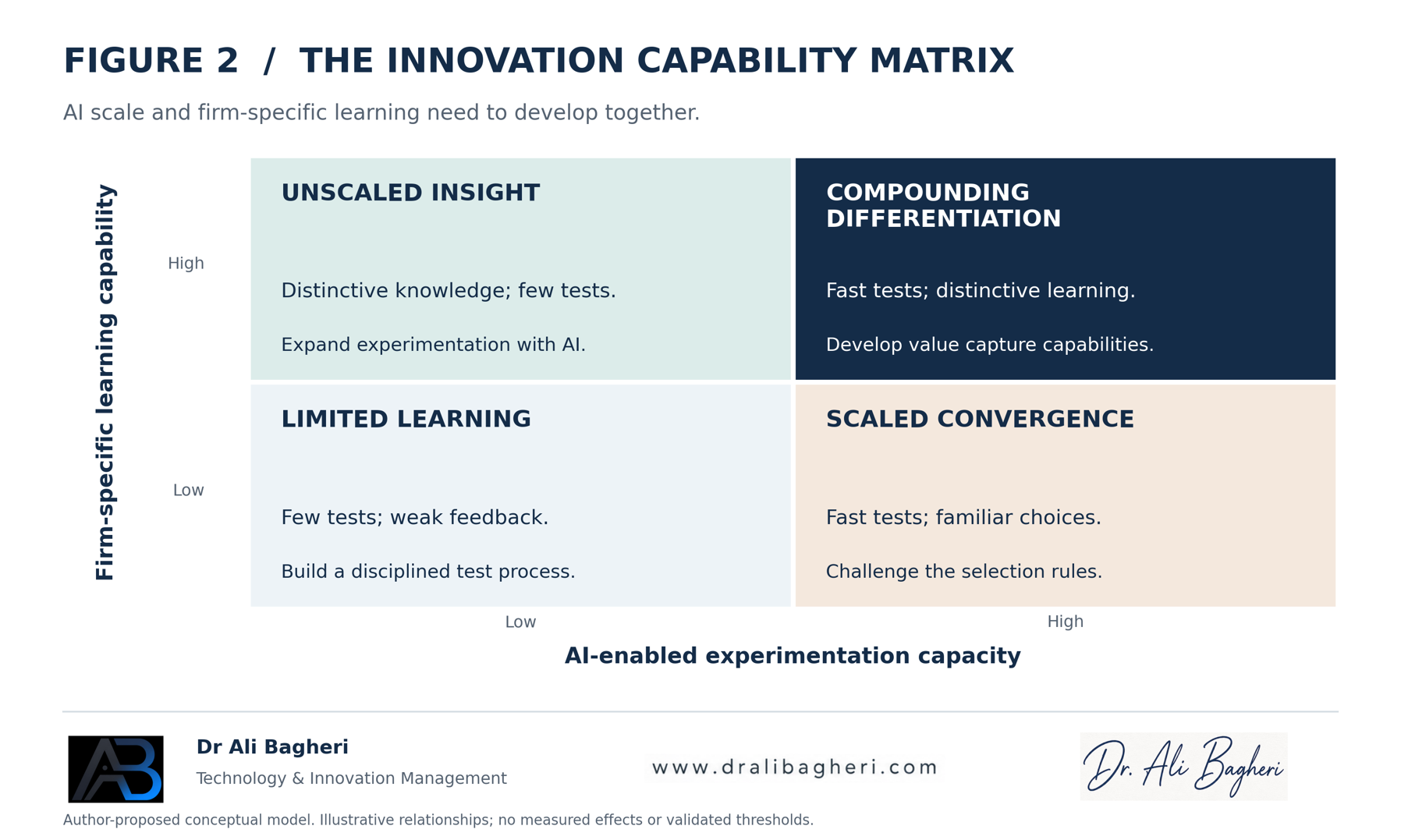
Figure 2. Four conceptual conditions for discussion at business-unit or portfolio level. The axes are qualitative; positions require evidence and do not imply a validated score or guaranteed outcome.
A business with Unscaled Insight understands customer problems but cannot investigate enough solutions. AI may help it design prototypes and test alternatives. A business facing Scaled Convergence runs many tests, yet repeatedly selects familiar propositions. Its immediate constraint is the quality of its questions, evidence and selection rules.
Compounding Differentiation describes the intended relationship: experiments create distinctive knowledge, and that knowledge improves subsequent experimentation. Reaching this condition requires evidence that changes decisions. Possessing proprietary data, or attaching human approval to an AI recommendation, is insufficient by itself.
Research by Krakowski, Luger and Raisch (2023), conducted in competitive chess settings, shows how human-AI interaction can shift the capabilities underlying performance differences. It supports examining how resources are combined, while not validating this matrix. The practical implication is to assess business units separately: the same enterprise may combine strong customer learning in one unit with highly standardised investment decisions in another.
Making the framework useful in the UAE
Dubai’s support for entrepreneurial AI adoption provides a relevant setting. The Dubai Chamber of Digital Economy’s Entrepreneur’s AI Playbook addresses AI applications across venture development and operations (Dubai Chambers, 2025). As businesses gain access to these capabilities, executives must determine what their organisation contributes beyond tools available to the wider market.
Consider an illustrative Dubai hospitality operator developing a service for extended-stay guests. Public reviews and competitor packages could generate several plausible concepts. The operator could add evidence from its own service requests, abandoned bookings and interviews with guests across relevant language groups. These inputs might reveal an unmet coordination need involving work schedules, family routines or transport. These are hypotheses to investigate, not assumed characteristics of UAE customers.
Management could compare a limited service prototype with the existing offer, using observed take-up, willingness to pay, delivery cost and repeat use. AI-generated customer personas could help prepare questions, but would not substitute for customer evidence. The resulting advantage would depend on what the business learns and whether its staff and partners can deliver the service consistently.
A Dubai logistics SME could apply the same logic to shipment exceptions on a particular trade route. Customer-specific exception records and partner relationships might support a differentiated service. The investment decision would still need evidence that customers value the improvement and that the firm can deliver it profitably.
Distinctiveness must translate into captured value
A service can be novel yet commercially weak, or valuable yet easy to imitate. Teece (1986) explains why profiting from innovation depends on appropriability and complementary assets such as manufacturing, distribution and service capabilities. In this context, a proprietary insight matters when the organisation can combine it with the capabilities needed to reach customers and retain economic value.
This creates a demanding board question: if a competitor copied the visible offering, what would remain difficult to reproduce? The answer might concern an operating capability, access to customers, accumulated experience or a partner network. A larger dataset alone is not sufficient if it adds little useful information or cannot lawfully and reliably be used.
Standardisation remains sensible where common processes improve reliability or reduce unnecessary cost. The strategic task is to identify where distinctive learning matters to customer choice. Firms should avoid expensive customisation that creates no corresponding customer benefit.
A practical architecture for executive decisions
CEOs can use the proposed sequence in Figure 3 to match capital commitments to the evidence available. It is a management design, not an empirically established funding formula. Project teams should agree decision criteria before results are known and retain the option to redesign or stop.
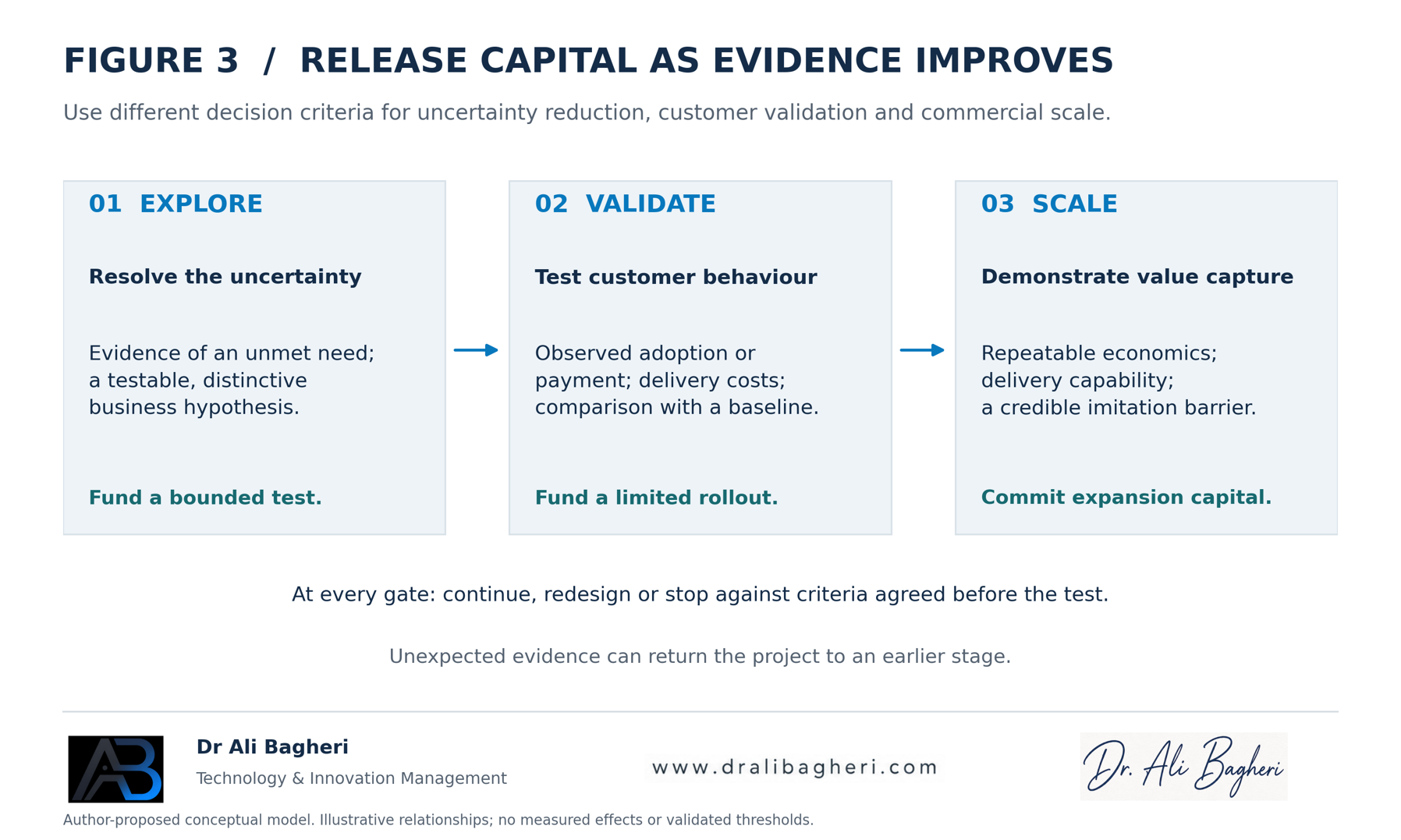
Figure 3. A proposed sequence for funding uncertain opportunities. Evidence requirements change as the decision moves from exploration to validation and scale; no fixed budget proportions are implied.
Review selection quality alongside project performance
For the next quarterly portfolio review, the CEO and CFO can examine a sample of funded and rejected AI initiatives. Compare their assumptions, evidence sources and reasons for approval. Require an independent challenge to proposals whose commercial logic relies mainly on competitor imitation or model-generated market estimates.
Record what evidence changes
Each exploratory project should name the uncertainty it addresses, its decision owner and the evidence that would trigger further funding or closure. Report material assumption changes and customer behaviour alongside efficiency gains. Human oversight should contribute expertise and challenge; research on the automation–augmentation paradox emphasises the interdependence of human and AI work (Raisch & Krakowski, 2021).
Make the scaling decision explicit
Before expansion, require evidence of customer value, repeatable delivery economics and a credible means of retaining returns. Learning may justify a redesign even when a pilot meets its technical targets. The leadership responsibility is to preserve this distinction as AI makes experimentation faster.
The strategic test for UAE businesses is therefore whether AI investment develops knowledge and capabilities that matter to customers and remain difficult to reproduce. When every competitor can access intelligence, what does your business learn that others cannot easily replicate?
References
Ashkinaze, J., Mendelsohn, J., Qiwei, L., Budak, C., & Gilbert, E. (2025). How AI ideas affect the creativity, diversity, and evolution of human ideas: Evidence from a large, dynamic experiment. Proceedings of the ACM Collective Intelligence Conference, 198–213.
https://doi.org/10.1145/3715928.3737481
Doshi, A. R., & Hauser, O. P. (2024). Generative AI enhances individual creativity but reduces the collective diversity of novel content. Science Advances, 10(28), eadn5290.
https://doi.org/10.1126/sciadv.adn5290
Krakowski, S., Luger, J., & Raisch, S. (2023). Artificial intelligence and the changing sources of competitive advantage. Strategic Management Journal, 44(6), 1425–1452.
https://doi.org/10.1002/smj.3387
March, J. G. (1991). Exploration and exploitation in organizational learning. Organization Science, 2(1), 71–87.
https://doi.org/10.1287/orsc.2.1.71
Raisch, S., & Krakowski, S. (2021). Artificial intelligence and management: The automation–augmentation paradox. Academy of Management Review, 46(1), 192–210.
https://doi.org/10.5465/amr.2018.0072
Teece, D. J. (1986). Profiting from technological innovation: Implications for integration, collaboration, licensing and public policy. Research Policy, 15(6), 285–305.
https://doi.org/10.1016/0048-7333(86)90027-2
UAE context source
Dubai Chambers. (2025, 29 July). Dubai Chamber of Digital Economy launches The Entrepreneur’s AI Playbook.
https://www.dubaichambers.com/en/w/dubai-chamber-of-digital-economy-launches-the-entrepreneur-s-ai-playbook
Framework and scope
Figures 1–3 are author-proposed conceptual models informed by the cited literature. They are not reproduced research results. The UAE business examples are illustrative; no firm-level dataset or causal test is reported. The framework is intended to support executive discussion and future empirical investigation.
About the author
Dr Ali Bagheri is a Dubai-based AI Governance, Leadership and Innovation Advisor with a PhD in Technology and Innovation Management and more than 20 years of experience across training, consulting and organisational leadership. His current focus is AI-driven innovation and entrepreneurship. Website: www.dralibagheri.com.
Events Calendar
Upcoming Events

BCCD Breakfast Networking
Wed, 21st Oct 2026
Reform Social & Grill
Kickstart your morning with valuable connections & conversations. This casual yet engaging... Read more

Quick Connect: Meet, Greet, Repeat!
Thu, 22nd Oct 2026
Pronto, Fairmont Dubai
Join us for an exciting evening of speed networking that’s all about making new connecti... Read more

BCCD Business Briefing: Building Human Capital for Business Growth, Sponsored by Kaplan
Wed, 28th Oct 2026
Embassy Suites by Hilton Dubai Business Bay
People are fundamental to any business performance, but the skills organisations need and ... Read more


