Tax Star Receives UAE Ministry of Finance Pre-Approval as an E-Invoicing ASP
Date Posted:Wed, 8th Jul 2026

UAE-based tax and compliance software company Tax Star has received pre-approval from the UAE Ministry of Finance as an ASP (Accredited Service Provider) for UAE e-invoicing.
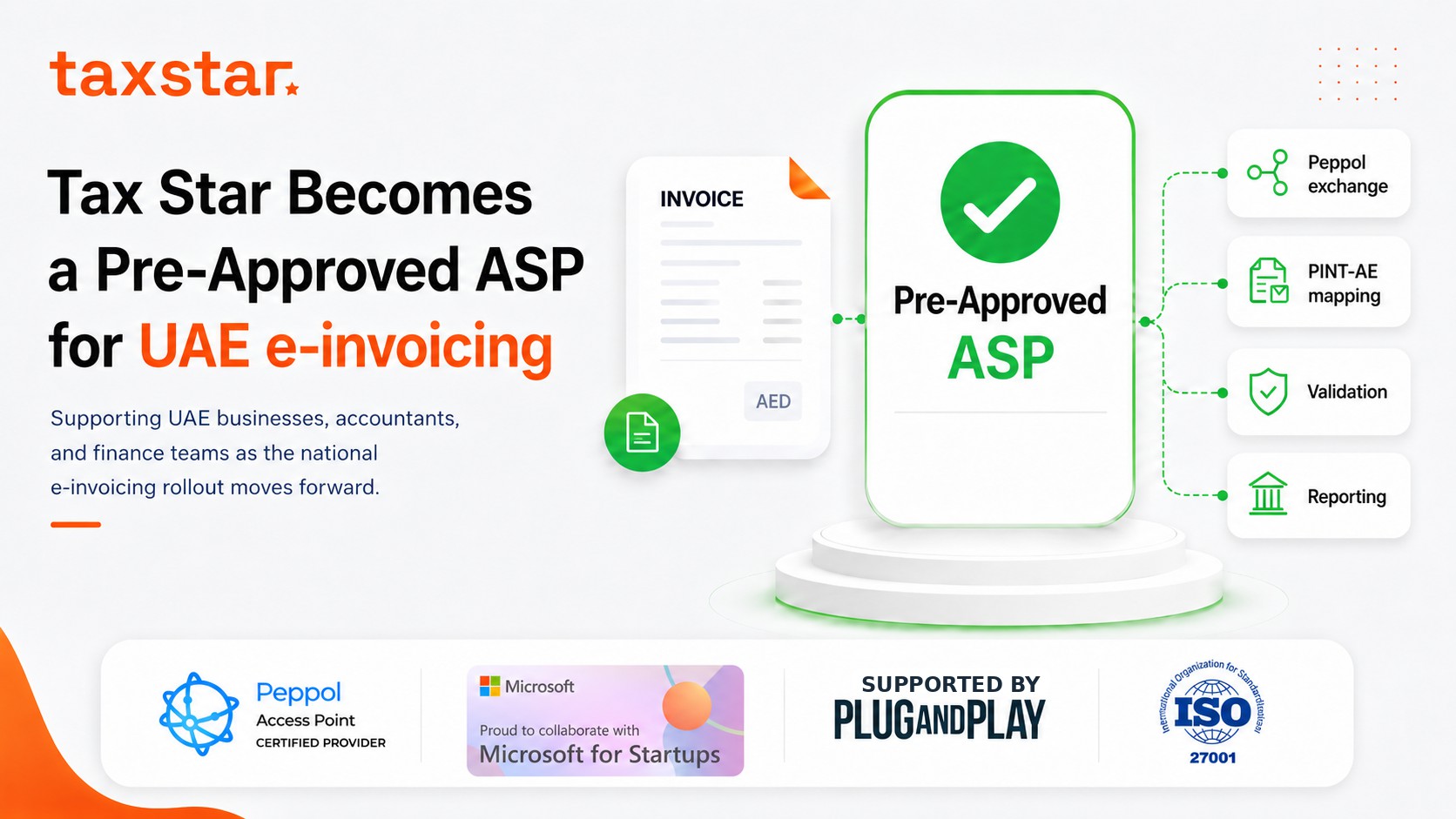
The milestone comes as the UAE moves forward with the first stage of its national e-invoicing rollout. The pilot programme and voluntary adoption phase started on 1 July 2026.
Tax Star supports businesses, finance teams and accounting firms preparing for structured e-invoices. The platform connects with existing accounting systems, checks invoice data and supports compliant e-invoice exchange through the UAE’s Peppol-based framework.
What Tax Star’s pre-approved ASP status means
Pre-approval is a formal stage within the UAE Ministry of Finance’s ASP accreditation process.
Before receiving pre-approval, a service provider must complete application reviews, Peppol interoperability testing, end-user verification testing and production trial runs.
A pre-approved ASP is authorised to provide e-invoicing services in the UAE during this stage. The provider must then complete the remaining tests for final accreditation within the timeline set by the Ministry of Finance.
For Tax Star, the status marks a key step in helping UAE businesses move from early e-invoicing planning to system connections, data reviews and practical testing.
Helping businesses keep their current accounting systems
Many UAE businesses already rely on accounting or Enterprise Resource Planning software for their daily finance work.
Moving to e-invoicing does not always mean replacing those systems.
Tax Star acts as the connection between a company’s existing accounting software and the UAE e-invoicing network. It integrates with platforms such as Xero, QuickBooks, Odoo and Zoho Books.
Invoice data can move from the accounting system into Tax Star for checking, mapping and processing. This gives finance teams a route to prepare for e-invoicing without rebuilding their full accounting setup.
For businesses managing several companies, Tax Star can bring invoice activity from multiple entities into one account. Accounting firms can use the same setup to manage e-invoicing work across several clients.
Why a PDF is not a UAE e-invoice
Many businesses already create invoices digitally and send them to customers by email.
A PDF invoice may look digital, but it does not meet the UAE definition of an e-invoice.
A UAE e-invoice must be issued, transmitted and received in a structured electronic format that supports automatic processing. The invoice data must follow the UAE PINT AE requirements and move through the approved Peppol-based e-invoicing model.
This shifts the focus from how the invoice looks to the quality of the data behind it.
Seller and buyer details, tax information, payment terms, invoice totals and invoice line data must be complete and mapped correctly. Missing or incorrect fields may lead to rejected invoices and more manual work for finance teams.
Supporting the e-invoicing process
Tax Star helps businesses prepare invoice data before it is exchanged through the network.
Invoice information can be mapped into the UAE PINT AE format and reviewed before transmission. Finance teams can identify missing data, correct validation errors and manage electronic credit notes within the same system.
Once the invoice is ready, Tax Star supports structured exchange through the Peppol network and the related tax data reporting flow.
Businesses can track invoice statuses, submission results and errors from one place. This gives finance teams a clearer view of what has been sent, received, accepted or rejected.
Batch upload options are available for businesses that do not yet use a direct accounting integration.
One platform for e-invoicing and Corporate Tax
Tax Star’s software covers UAE e-invoicing and Corporate Tax processes.
Its Corporate Tax tools support tax calculations, financial statement preparation, approval workflows and deadline tracking.
Keeping these processes in one platform can reduce the need for separate systems across finance and tax work.
This may suit accounting firms working across several clients, corporate groups managing multiple entities and in-house finance teams looking for one place to oversee UAE tax and e-invoicing tasks.
Security and business continuity
E-invoicing involves sensitive customer, supplier, transaction and tax data.
Tax Star’s Information Security Management System is certified under ISO/IEC 27001:2022. The company holds ISO 22301:2019 certification for business continuity management.
Tax Star accounts include multi-factor authentication, which adds a second verification step when users log in.
These controls support secure access, data protection, risk management and service continuity.
UAE e-invoicing deadlines businesses need to know
The UAE pilot programme and voluntary e-invoicing phase started on 1 July 2026.
Businesses with annual revenue of AED 50 million or more must appoint an ASP by 30 October 2026. Their mandatory e-invoicing go-live date remains 1 January 2027.
Businesses with annual revenue below AED 50 million must appoint an ASP by 31 March 2027 and implement e-invoicing by 1 July 2027.
Government entities must appoint an ASP by 31 March 2027 and implement e-invoicing by 1 October 2027.
The extended ASP appointment deadline gives larger businesses more time to review their provider options. The January 2027 implementation date has not moved, leaving a shorter period for system connections, invoice data checks and full testing.
What businesses should do next
Choosing an ASP is one part of e-invoicing preparation.
Businesses need to review the systems that create invoice data and identify which entities and transaction flows fall within scope.
Customer and supplier records should be checked for missing or outdated information. Finance teams should review addresses, Tax Identification Numbers, tax codes, payment details and invoice line data.
Current invoice fields should then be compared with the UAE PINT AE requirements. Any gaps may call for updates to the accounting system, master data or internal finance processes.
Businesses should agree how invoice data will move to their ASP and who will manage rejected invoices, corrections, electronic credit notes and system errors.
Starting this work early gives teams more time to test real invoice scenarios before the mandatory date.
Moving from awareness to action
Tax Star’s pre-approved ASP status gives UAE businesses another local option as they prepare for the new e-invoicing framework.
The next stage for many companies is practical testing.
Finance teams need to know whether their invoice data is complete, whether their accounting systems can connect to an ASP and whether their internal processes can deal with errors before go-live.
The deadlines are getting closer. Businesses that begin reviewing their systems and data now will be better placed to manage the move to UAE e-invoicing with less pressure.
About Tax Star
Tax Star is a pre-approved ASP (Accredited Service Provider) for UAE e-invoicing and a UAE-based tax and compliance software company supporting businesses, finance teams and accounting firms. The platform helps organisations prepare for the UAE’s e-invoicing requirements and manage Corporate Tax processes in one place. Tax Star holds ISO/IEC 27001:2022 certification for information security and ISO 22301:2019 certification for business continuity.
Events Calendar
Upcoming Events

BCCD Breakfast Networking
Wed, 21st Oct 2026
Reform Social & Grill
Kickstart your morning with valuable connections & conversations. This casual yet engaging... Read more

Quick Connect: Meet, Greet, Repeat!
Thu, 22nd Oct 2026
Pronto, Fairmont Dubai
Join us for an exciting evening of speed networking that’s all about making new connecti... Read more

Breast Cancer Awareness Morning
Tue, 27th Oct 2026
SEE Institute
October is Breast Cancer Awareness Month, a time to bring a difficult subject into the ope... Read more


