UAE Introduces New Administrative Penalties Under Cabinet Decision No. 129 of 2025
Date Posted:Fri, 19th Dec 2025

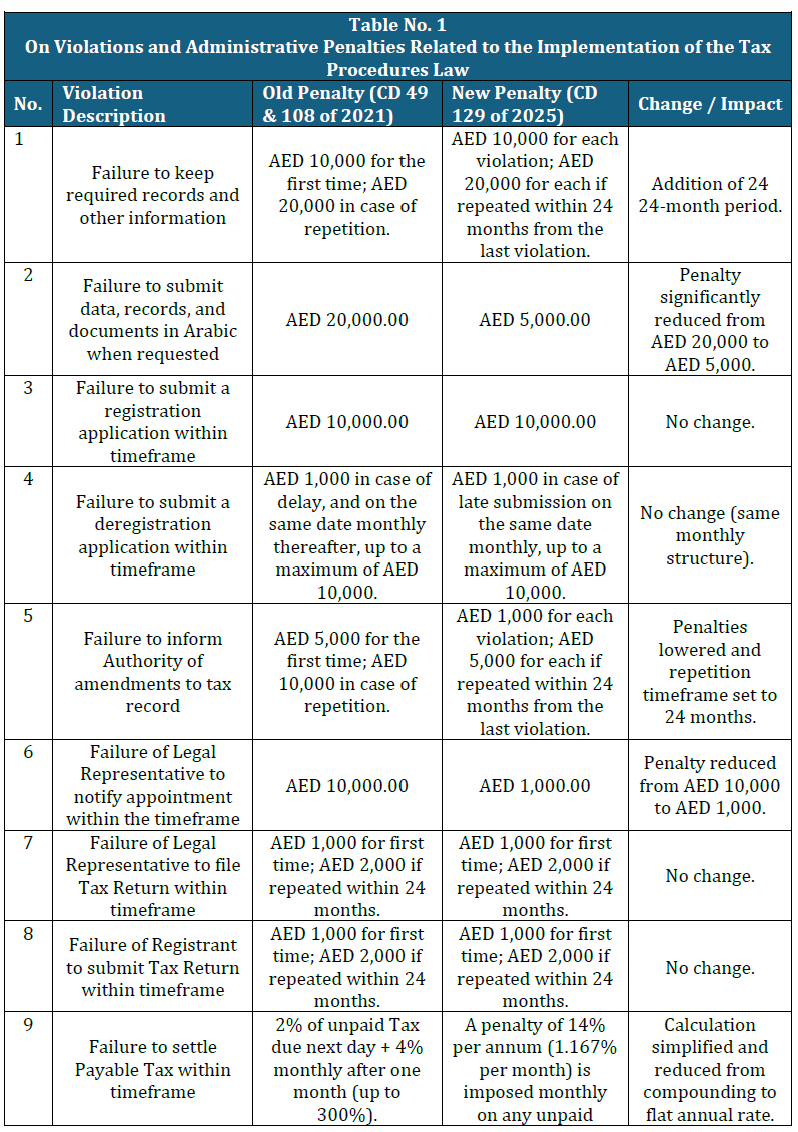
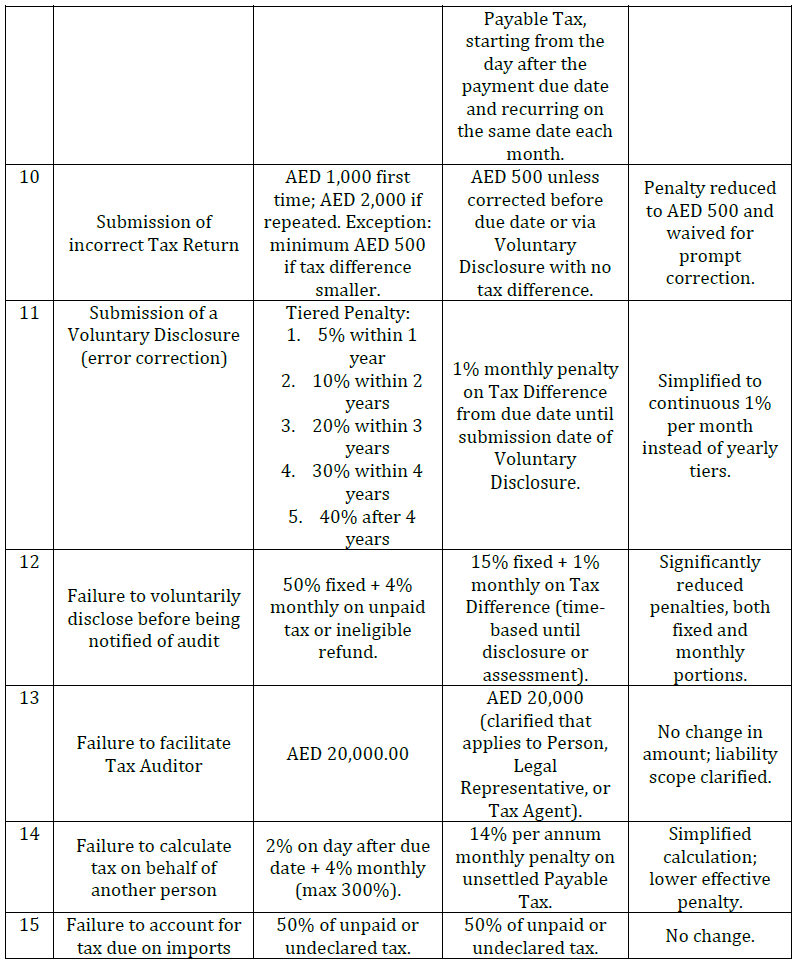
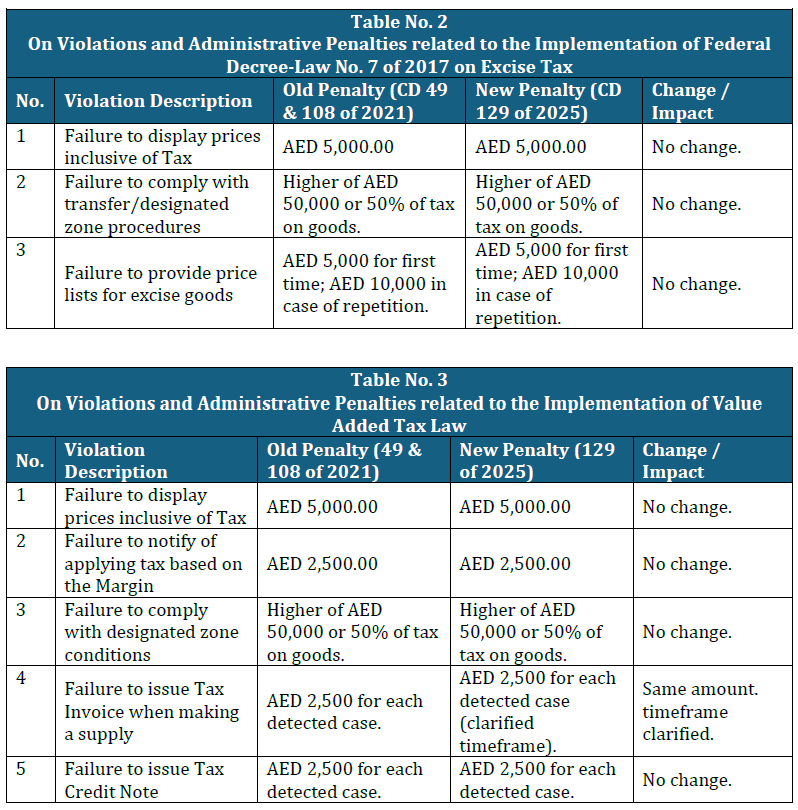
The Federal Tax Authority (FTA) has issued Cabinet Decision No. 129 of 2025, introducing significant amendments to the administrative penalties applicable under the UAE Tax Procedures Law, Excise Tax Law, and Value Added Tax (VAT) Law.
This Decision updates and replaces specific penalty provisions previously outlined in Cabinet Decision No. 40 of 2017, Cabinet Decision No. 49 of 2021, and Cabinet Decision No. 108 of 2021. The amendments aim to further refine the UAE’s tax compliance framework, enhance clarity for taxable persons, and strengthen the overall enforcement mechanism.
Key enhancements under the new Decision include:
- Revisions to penalty amounts for various non-compliance violations, including late tax return submission, delayed tax payment, and failures related to record-keeping and documentation.
- Clearer and more structured methodologies for calculating administrative penalties to ensure consistency and transparency.
- Updated provisions on penalty relief, including the conditions and procedures for reductions or waivers.
- Strengthened enforcement processes to support the effective and uniform application of tax regulations.
Cabinet Decision No. 129 of 2025 will come into effect on 14 April 2026, providing businesses with adequate time to review the amendments, assess their compliance processes, and implement the necessary internal controls.
These changes reaffirm the FTA’s commitment to maintaining a robust and transparent tax environment, in line with international best practices and the UAE’s evolving regulatory landscape.
This Decision shall come into effect on the date of its issuance, except for the following provisions:
- Table No. 2 – Violations and Administrative Penalties related to Federal Decree-Law No. 7 of 2017 on Excise Tax shall be effective from 1 October 2017.
- Table No. 3 – Violations and Administrative Penalties related to Federal Decree-Law No. 8 of 2017 on Value Added Tax shall be effective from 1 January 2018.
Overall Impact on Businesses
The 2025 amendments mark a significant step forward in modernizing the UAE’s tax compliance landscape. The revised framework provides businesses with several key advantages, including:
- Lower administrative complexity, supported by streamlined and more transparent penalty structures.
- Greater predictability through fixed, time-based penalty calculations that improve budgeting, forecasting, and financial reporting.
- Enhanced incentives for voluntary compliance, with proportionate monthly penalties encouraging timely corrections and disclosures.
- Improved legal certainty, achieved through clearer definitions, structured processes, and formal mechanisms for objections and reconsideration.
- Simplified compliance oversight, following the removal of earlier transitional relief schemes and legacy provisions.
Cabinet Decision No. 129 of 2025 significantly strengthens the UAE’s administrative penalty regime by promoting transparency, fairness, and proportionality. The updated methodology aligns closely with international tax standards and reinforces the UAE’s commitment to maintaining a robust, compliance-driven tax environment.
Businesses are advised to evaluate their existing tax compliance controls, update internal policies relating to voluntary disclosure, and prepare for the transition ahead of April 2026 to fully benefit from the revised framework.
Federal Decree-Law No. 16 of 2025:
The Federal Tax Authority has amended the Federal Decree-Law No. 8 of 2017 by issuing Federal Decree-Law No. 16 of 2025 on Oct 01, 2025, which is effective from January 01, 2026
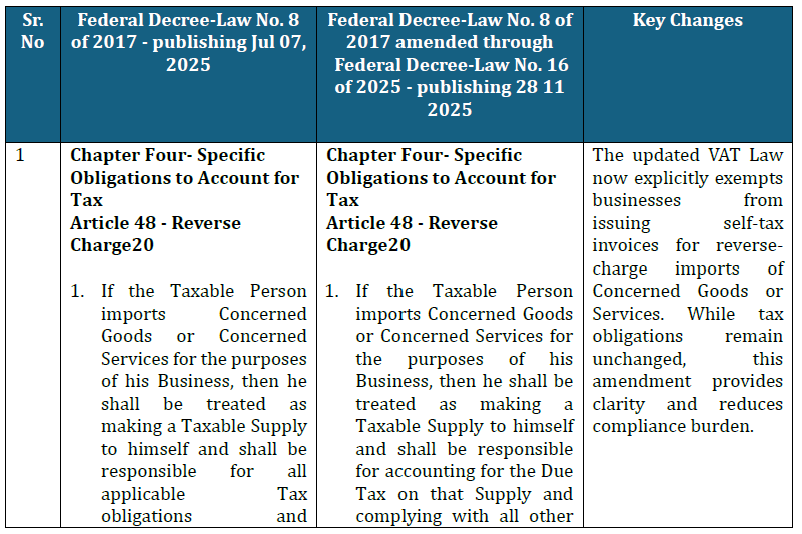
Federal Decree-Law No. 16 of 2025 introduces targeted and technical amendments to the UAE VAT Law (Federal Decree-Law No. 8 of 2017). Published on November 28, 2025, these changes are effective from January 1, 2026.
The amendments primarily focus on standardizing time limits, simplifying certain compliance procedures, and strengthening anti-tax evasion measures.
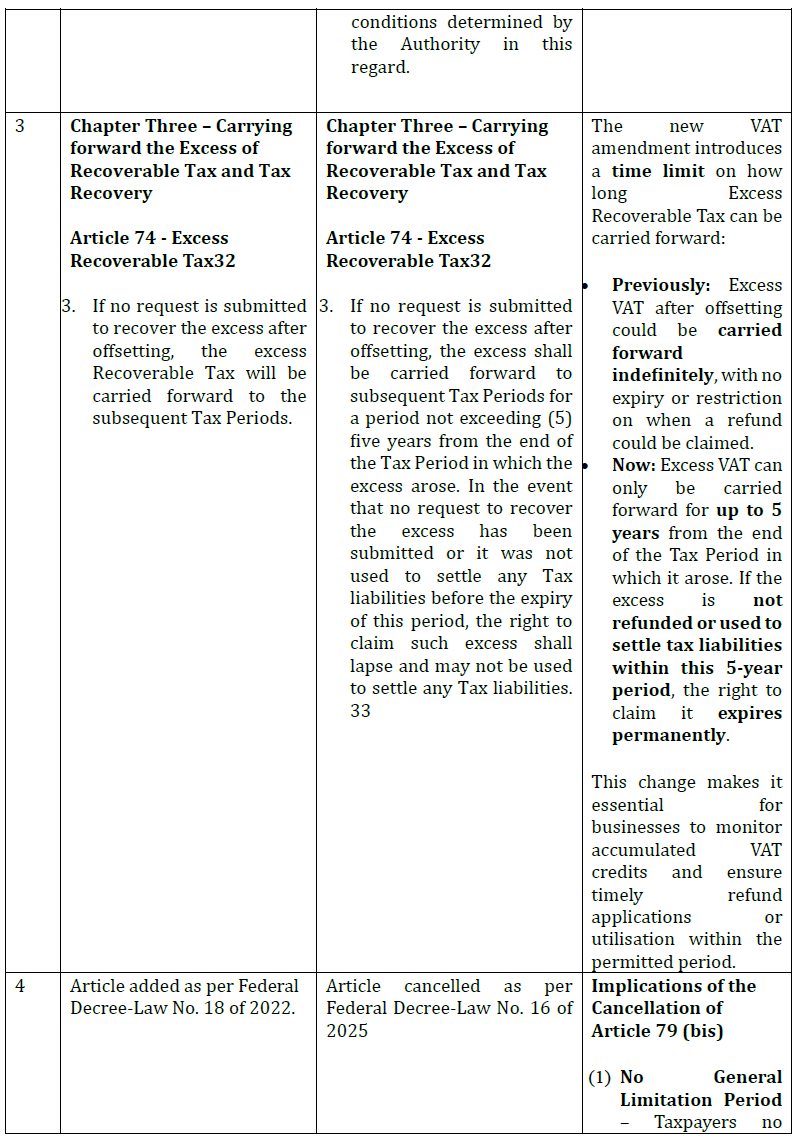
- Introduces a five-year time limit for claiming, utilizing, or carrying forward Excess Recoverable Input Tax (Article 74(3)). The right to the refund/credit lapses permanently after this period.
- Removes the requirement for taxable persons to issue a Self-Invoice for imports of goods and services used for business purposes under the RCM (Article 48(1)).
- Introduces new conditions for input tax recovery, allowing the FTA to deny Input Tax deduction if the supply is part of a tax evasion chain and the taxpayer knew or should have known of this connection (Article 54)
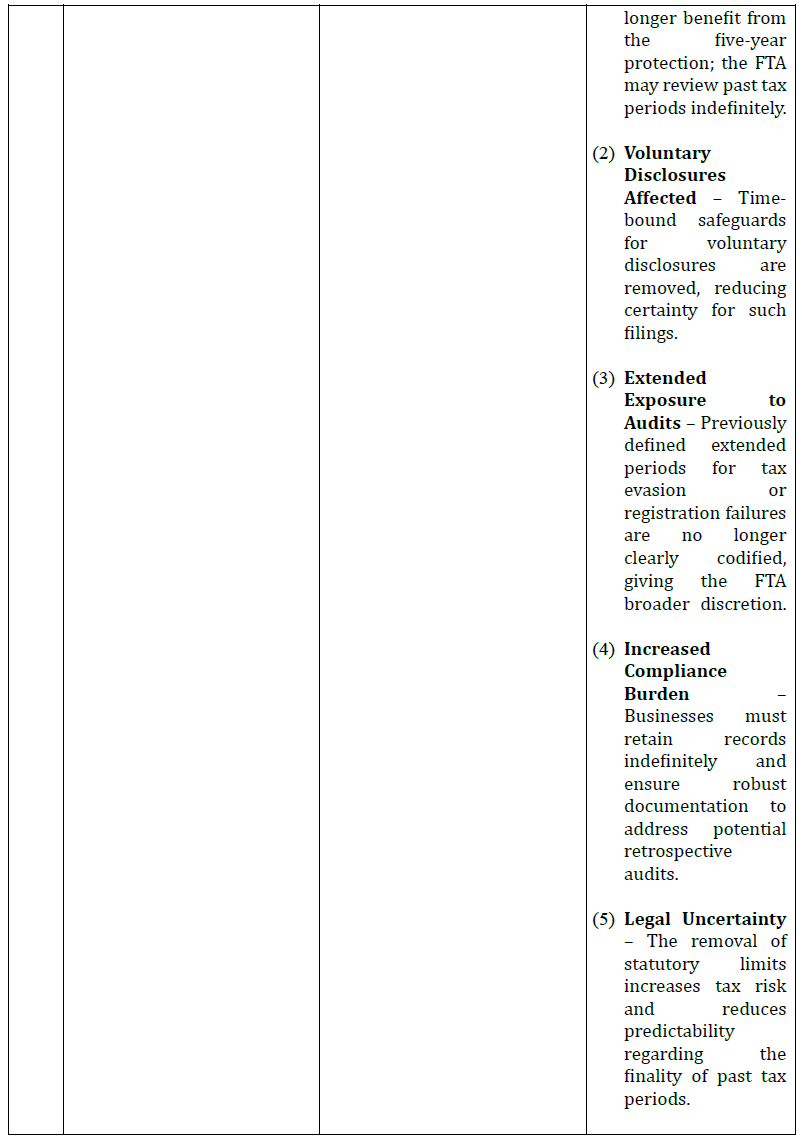
- Repeals the VAT-specific Statute of Limitation rules (Article 79 bis)
Key Impacts of UAE Federal Decree-Law No. 17 of 2025 on Businesses (Effective Jan 1, 2026)
Following the implementation of Federal Decree-Law No. 16 of 2025 UAE Taxpayers should consider the impact on their business and should follow the below points:
Proactive Management of Credits and Refunds:
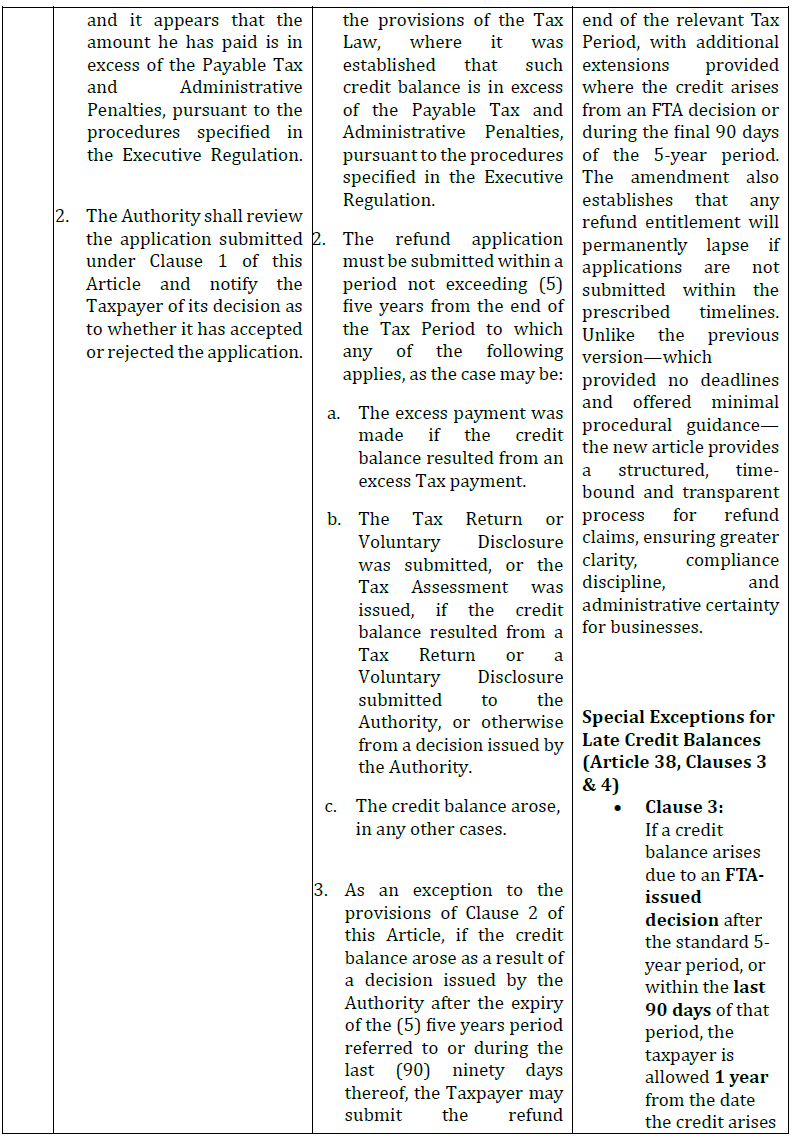
The most critical action is to address the new five-year statutory deadline for utilizing or claiming VAT credits and other tax overpayments (Article 74, VAT Law, and Article 38, Tax Procedures Law). Businesses must immediately conduct a comprehensive internal audit of all historical tax accounts to quantify and identify any Excess Recoverable Input Tax or credit balances nearing expiry. This is crucial because any unclaimed or unallocated amounts after the five-year window will be permanently forfeited. To remain tax-efficient, finance teams must implement a new routine financial control to actively monitor, reconcile, and submit refund requests well in advance of the five-year mark, treating this deadline as a high-priority risk.
Strengthening Due Diligence and Audit Preparedness:
Businesses must urgently bolster their internal controls to comply with the heightened anti-tax evasion standards (Article 54, VAT Law). This requires establishing formal, documented "Know-Your-Supplier" (KYS) policies to verify the legitimacy and integrity of all received supplies before recovering Input Tax. Failure to conduct adequate due diligence could result in the FTA denying the input tax deduction if the transaction is later linked to a tax evasion chain, even if the business did not have actual knowledge. Furthermore, given the expanded audit scope for late refund claims, businesses must ensure all documentation for older tax periods is meticulously maintained and readily accessible to handle potential audits triggered by final-year refund applications.
Updating Internal Tax Processes and Systems:
Administrative procedures require immediate updating to reflect the new legal mandates. Firstly, the procedure for correcting errors must be amended: errors that result in no change to the Tax Due should now be corrected directly in the subsequent Tax Return, eliminating the unnecessary burden of filing a Voluntary Disclosure in most minor cases (Article 10, Tax Procedures Law). Secondly, systems must be updated to reflect the removal of the requirement to issue a Self-Invoice for standard Reverse Charge Mechanism (RCM) imports, simplifying compliance for cross-border transactions (Article 48, VAT Law). Finally, internal compliance manuals must incorporate the binding nature of FTA directives to ensure all staff adhere to consistent, officially guided interpretations of tax legislation.
Federal Decree-Law No. 17 of 2025:
The Federal Tax Authority has amended the Federal Decree-Law No. 28 by issuing Federal Decree-Law No. 17 of 2025 on Oct 01, 2025 which is effective from Jan 01 2026 which focuses on introducing strict time limitations and procedural clarity across the UAE tax framework.
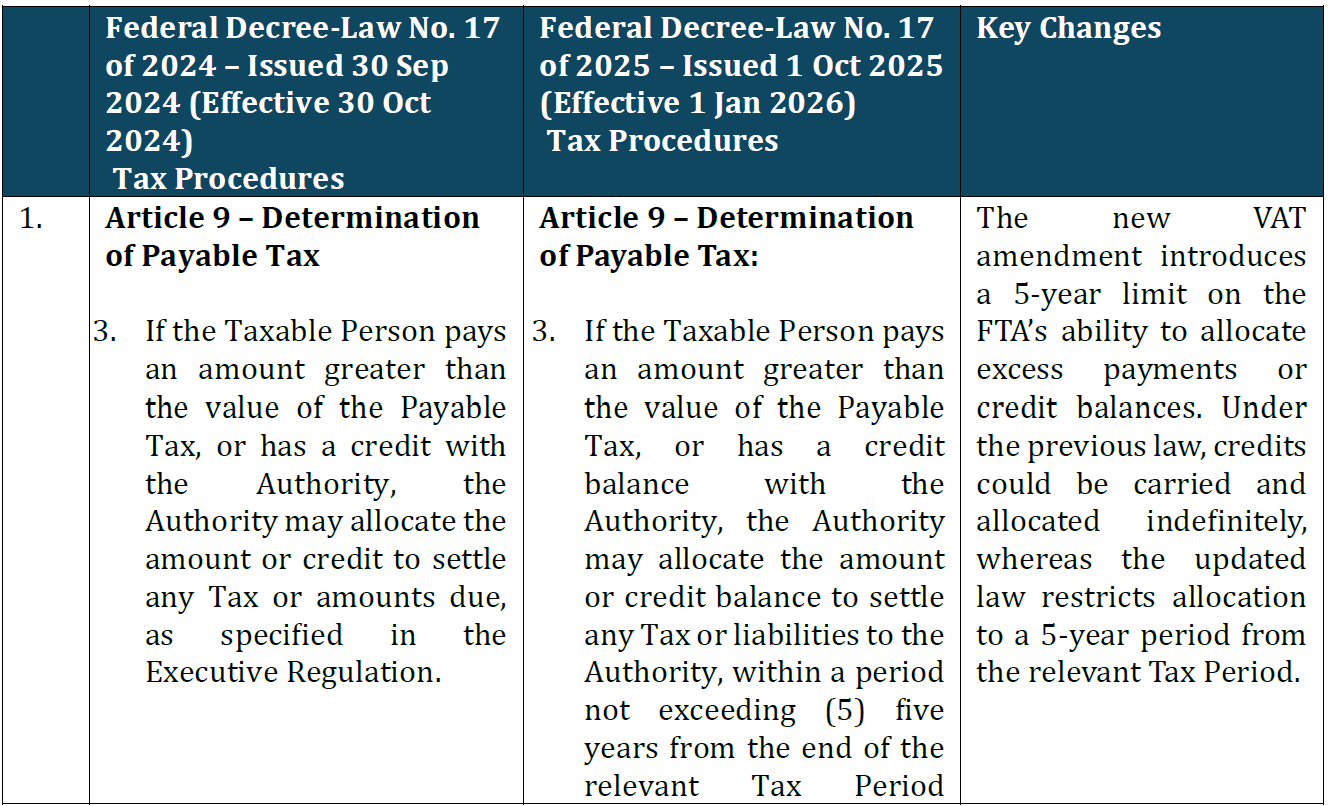
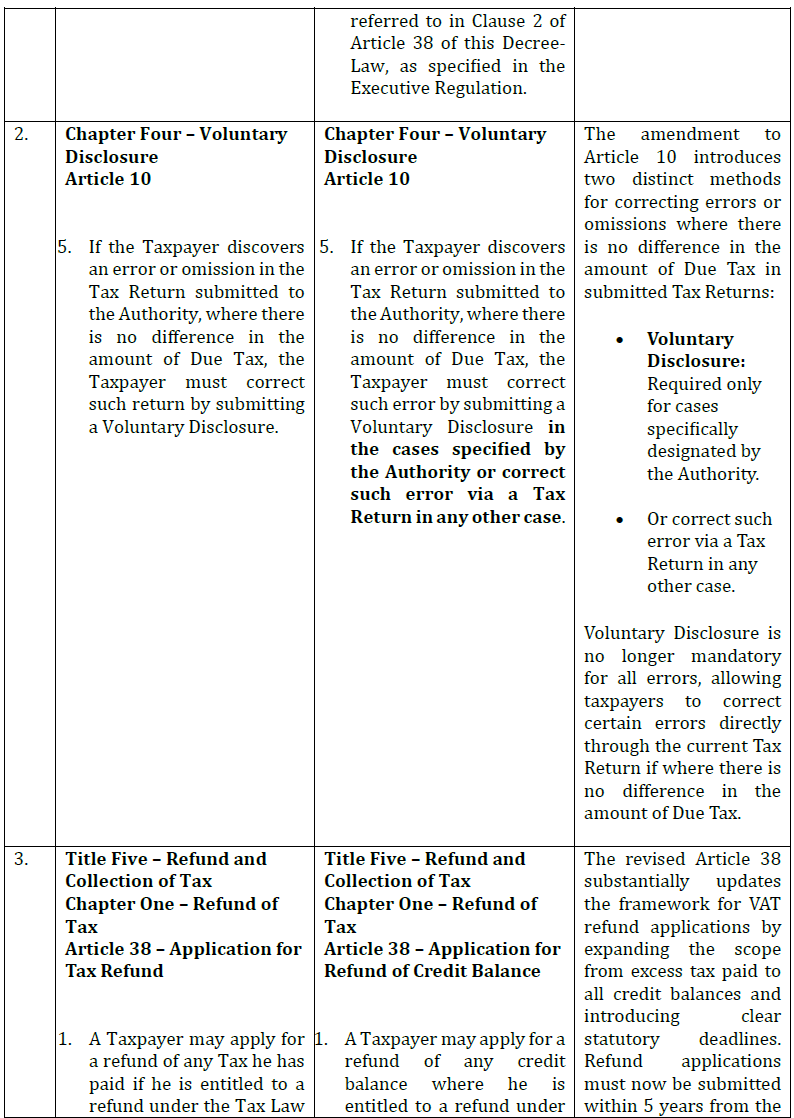
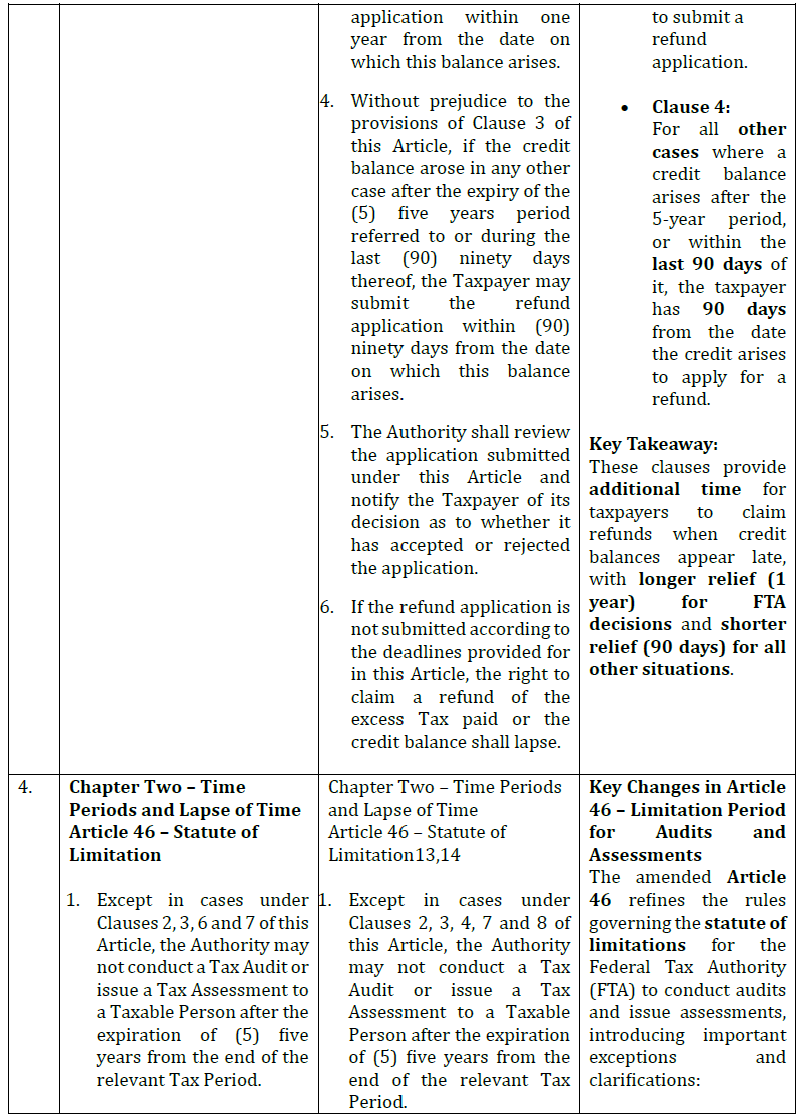
- Imposes a 5-year deadline for the FTA to allocate excess tax payments/credits (Article 9) and for taxpayers to apply for tax refunds (Article 38). After 5 years, the right to claim a refund lapses.
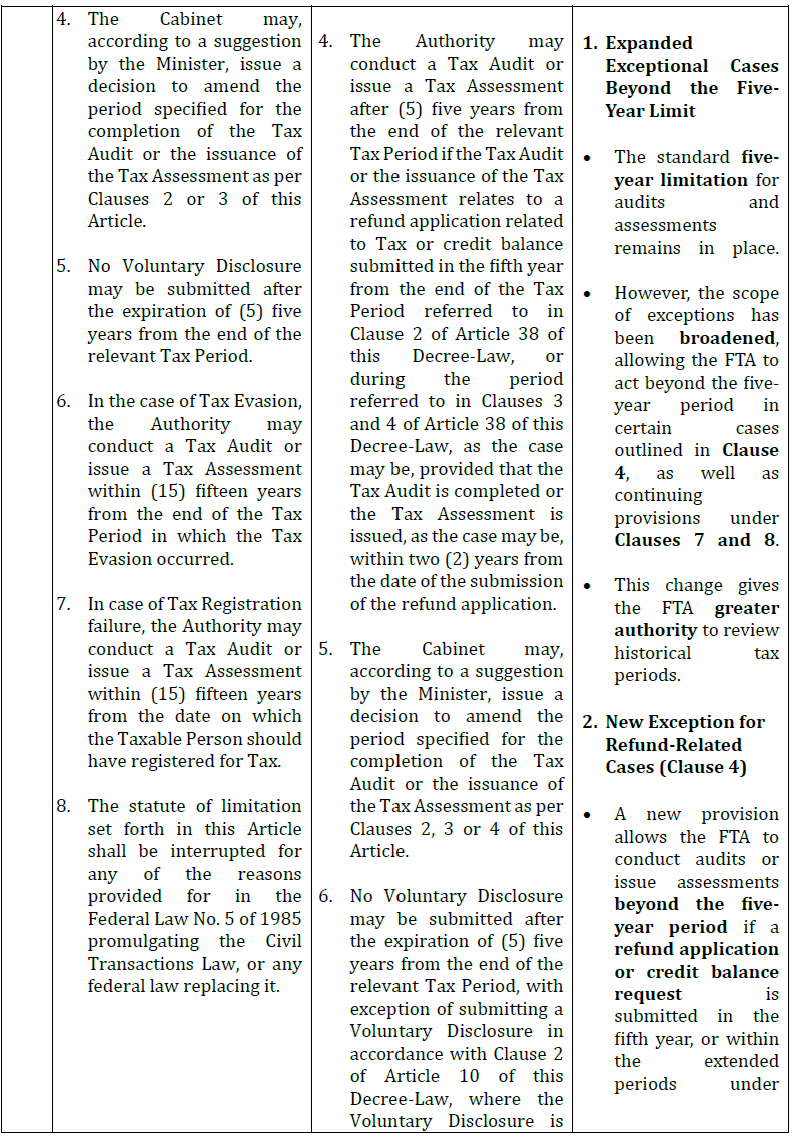
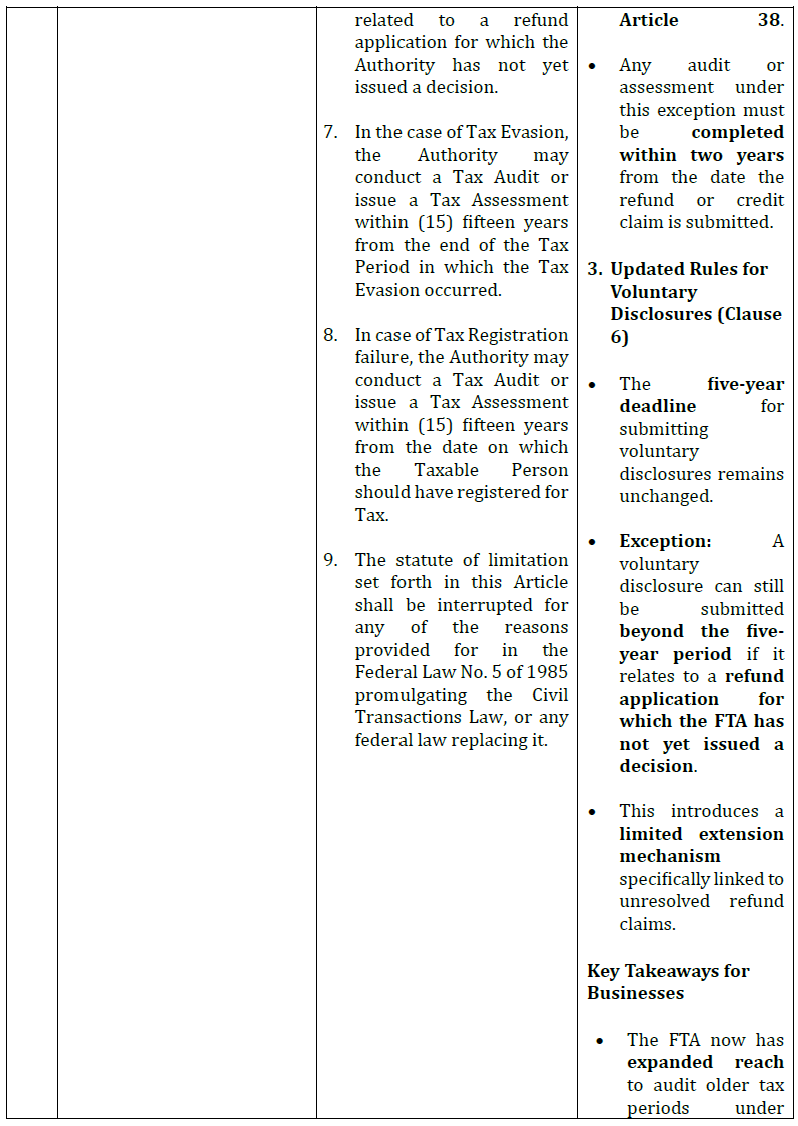
- Removes the mandatory Voluntary Disclosure requirement for errors/omissions that result in no change to the Due Tax. These can now be corrected directly via the subsequent Tax Return.
- Allows the FTA to conduct audits and issue assessments beyond the standard 5-year limit if the action relates to a refund application submitted in the fifth year, provided the audit is completed within 2 years of the application date.
- Provides special, time-limited extensions for taxpayers to claim refunds when the credit balance arises late (e.g., 1 year if due to an FTA decision, or 90 days in other late-arising cases).
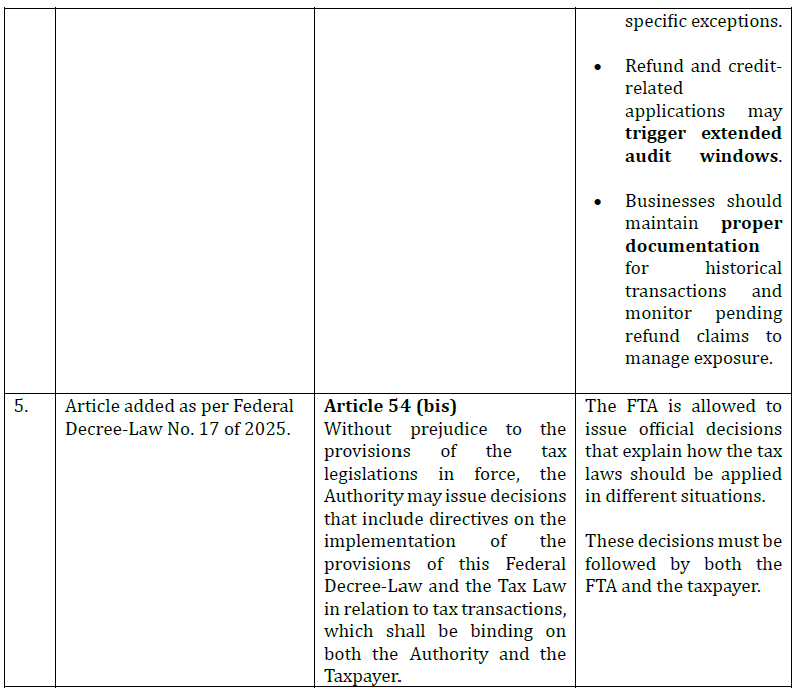
- Formally empowers the FTA to issue binding decisions and directives on the interpretation and implementation of tax laws, ensuring consistent application for both the Authority and taxpayers.
Key Impacts of UAE Federal Decree-Law No. 17 of 2025 on Businesses (Effective Jan 1, 2026)
The new amendments introduce strict time limits and enhanced procedural clarity, compelling UAE businesses to adopt more disciplined tax management practices.
- Risk of Credit Forfeiture:
- A strict 5-year deadline is now imposed for businesses to utilize tax credits or apply for refunds (Articles 9 & 38).
- Action Required: Businesses must urgently reconcile and process all outstanding credit balances to avoid the permanent forfeiture of recoverable tax amounts.
- Extended Audit Exposure:
- The standard 5-year Statute of Limitations for audits is preserved, but the FTA can now audit beyond this period (up to 2 additional years) if the action relates to a refund application filed in the fifth year.
- Implication: Filing late refund claims may trigger an extended audit, necessitating a risk assessment of the related tax period before submission.
-
Simplified Error Corrections:
The mandatory requirement to file a formal Voluntary Disclosure is removed for minor errors that result in no change to the Tax Due.
- Benefit: These nil-impact errors can now be corrected simply through the next Tax Return, significantly reducing administrative burden and complexity
-
Clarity via Binding Directives:
-
The FTA is formally authorized to issue binding decisions and directives (Article 54 bis).
-
Benefit: This provides greater administrative certainty and consistency in the interpretation and application of tax law for both the Authority and taxpayers.
-
-
Special Late Refund Extensions:
-
Specific exceptions are provided for credit balances that arise late, such as giving taxpayers up to 1 year to claim a refund if the credit results from an FTA decision, offering a final opportunity for recovery.
-
You may email us or can contact any of our team members relating to your queries on this subject:
Manan Chadha
Managing Director
+971-588942155
Mohammed Raza
Associate Director – Taxation
+971-553194065
Muhammad Sabir Hussain
Manager – Taxation
+971 54 350 5789
Events Calendar
Upcoming Events

Quick Connect: Meet, Greet, Repeat!
Thu, 22nd Oct 2026
Pronto, Fairmont Dubai
Join us for an exciting evening of speed networking that’s all about making new connecti... Read more

Breast Cancer Awareness Morning
Tue, 27th Oct 2026
SEE Institute
October is Breast Cancer Awareness Month, a time to bring a difficult subject into the ope... Read more

BCCD Business Briefing: Building Human Capital for Business Growth, Sponsored by Kaplan
Wed, 28th Oct 2026
Embassy Suites by Hilton Dubai Business Bay
People are fundamental to any business performance, but the skills organisations need and ... Read more


