The Pension That Cost £48,000 Before a Single Decision Was Made | By Mauro De Santis Bo, Senior Partner, GSB
Date Posted:Fri, 8th May 2026

How a UAE-based professional discovered his pension had been restructured without his knowledge, the adviser held no valid licence, and what it took to rebuild from the ground up.

Figures are illustrative, based on the specific client scenario. The 5-year return reflects GSB model portfolio benchmarks as at April 2026 and does not represent any individual client account.
How it started
It was not a scheduled meeting. It was a conversation over dinner following a family funeral, the kind of moment when people tend to talk more openly than usual. A guest mentioned, almost in passing, that his pension was being managed by an adviser in Dubai. The name he gave me was not one I recognised.
I offered to take a look. A week later, what arrived told a story I have unfortunately seen before.
First red flag
He had no online access to his pension and no recent valuation. When he asked his adviser directly, he was told the policy was ‘in the process of being transferred between firms’. There was no transparency about where his assets were held or how they were being managed.
Investigating the adviser
Before reviewing the pension itself, we looked into the regulatory status of the person managing it. The adviser was operating from a company registered in a UAE free zone. A trade licence alone does not constitute financial advisory authorisation. We could not identify any valid regulatory authorisation for this individual under the DFSA, SCA, FSRA, or any other relevant body.
To access and manage the client’s UK pension, the adviser was routing activity through a Mauritius-registered partnership, using a change of agency on the SIPP structure to gain access to the policy. Structures of this kind are frequently associated with commission-based remuneration that sits outside standard regulatory oversight.
Regulatory note
Any adviser providing financial advice to UAE residents is required to hold a valid licence from the relevant regulatory authority. Operating without one leaves clients with very limited recourse if things go wrong.
What was inside the pension
Peter (not his real name) had a pension worth approximately £600,000, consolidated from several UK workplace pensions into a single SIPP. The consolidation itself was sensible. The problems were entirely in the execution.
The most significant issue was an RL360 investment bond placed inside the SIPP wrapper. Offshore bonds are legitimate tools in the right context. But a SIPP is already a tax-efficient wrapper. Placing another tax wrapper inside it serves no planning purpose for a client in Peter’s position. What it did generate was a substantial upfront commission and ongoing costs the client was never made aware of.
The bond was set to run for ten years. Peter was already within pension minimum access age. If he needed to draw funds before maturity, he would face surrender penalties. His own money was, in effect, locked away from him.
Commission calculation
Based on standard RL360 commission structures, the upfront charge was approximately 8% of the transfer value, equating to around £48,000. Combined with ongoing costs across all layers, Peter was paying over 3.5% per year, before accounting for the £48,000 already taken on day one.
Five years of lost ground
The bond had been in place since 2021. Over that period, the portfolio returned 14.3%. During the same period, the GSB 100% equity benchmark returned over 70% (shown for illustrative comparison; different portfolios carry different risk profiles). The gap reflects the combined impact of high charges, poor construction, and a structure that was never designed around the client’s outcomes.
Rebuilding the portfolio
We carried out a full review: financial objectives, attitude to risk, capacity for loss, and a detailed cashflow model. From that foundation, we rebuilt from the ground up.
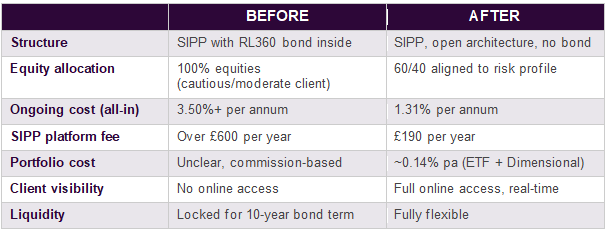
Cost breakdown (after): Platform 0.17% + portfolio funds 0.14% + GSB ongoing advice fee 1.00% = 1.31% per annum. On a £600,000 pension, the difference saves Peter over £13,000 every year, compounding forward.
*Figures are illustrative. Actual costs and outcomes will vary depending on individual circumstances, platform selection, and investment choices.
We recommended exiting the RL360 bond and accepting the surrender penalty in full. The ongoing drag of remaining in that structure would have cost significantly more than the exit fee. The portfolio was rebuilt using a globally diversified, evidence-based approach combining low-cost ETFs and Dimensional fund holdings, realigned to a 60/40 split that reflected Peter’s actual risk profile.
Why this still happens
The honest answer is that it happens because it can. Professionals moving to the UAE are often managing financial complexity across multiple jurisdictions. They trust people introduced through their network, and they are not always aware that the regulatory protections they relied upon in the UK do not automatically follow them here.
The commission-based model described here is banned in the UK under the Retail Distribution Review. A DFSA-licensed adviser would be required to disclose all charges and conflicts of interest. But a person operating without a licence is not bound by those rules. The cost ultimately falls on the client.
We see variations of this situation regularly. The structure changes, the products vary, but the pattern is consistent: a large upfront commission, a restrictive product designed to protect it, and a client who had no idea any of it had happened.
Is your pension working for you?
If you are a UAE-based professional with a UK pension managed by an adviser you have never formally verified, a no-obligation review could give you a clearer picture of what your pension is actually costing you.
Author: Mauro De Santis Bo, Senior Partner, GSB

Events Calendar
Upcoming Events

BCCD Breakfast Networking
Wed, 21st Oct 2026
Reform Social & Grill
Kickstart your morning with valuable connections & conversations. This casual yet engaging... Read more

Quick Connect: Meet, Greet, Repeat!
Thu, 22nd Oct 2026
Pronto, Fairmont Dubai
Join us for an exciting evening of speed networking that’s all about making new connecti... Read more

Breast Cancer Awareness Morning
Tue, 27th Oct 2026
SEE Institute
October is Breast Cancer Awareness Month, a time to bring a difficult subject into the ope... Read more


