The UAE E-Invoicing Mandate: Closer Than It Looks | By Haris Javaid, Managing Partner, ebs Chartered Accountants
Date Posted:Wed, 22nd Apr 2026

A practitioner's view of where UAE businesses actually stand — and where they should be by now.
I had a conversation recently with the CFO of a UAE trading group. Good business, AED 200 million in turnover, strong finance team. Somewhere in the middle of a wider discussion, I asked how his e-invoicing project was progressing. There was a pause, then an honest answer: "We've talked about it internally. We haven't started."
His company has roughly nine months until mandatory go live. In the world of enterprise change projects, that is not a runway. It is a rounding error.
I am writing this because I suspect his experience is closer to the norm than most business leaders would like to admit. The UAE's e-invoicing mandate is not a future problem. It is a live legal obligation, with fixed dates, a published penalty framework, and a timetable that is already under way. The only question left for leadership teams is whether the remaining time is being used well.
What the law actually says
The legal scaffolding is in place. It sits across four instruments, and it is worth knowing which does what, because conversations with the FTA are going to reference them by number.
Federal Decree-Law No. 16 of 2024 amended the UAE VAT Law. It introduced the legal definitions of "electronic invoice" and "electronic credit note," and extended the existing definitions of "tax invoice" and "tax credit note" to cover their digital equivalents.
Federal Decree-Law No. 17 of 2024 made the equivalent changes to the Tax Procedures Law, giving the Federal Tax Authority the procedural tools to enforce the regime.
Ministerial Decision No. 243 of 2025 sets out the substantive rules — who is in scope, what has to be issued, in what format, and within what window.
Ministerial Decision No. 244 of 2025 sets the phased timetable — when each category of taxpayer must appoint a service provider and when mandatory adoption takes effect.
The regime is technically a PEPPOL-based, decentralised five-corner model — what practitioners call the DCTCE approach. The details matter less than the consequence. From the mandatory date, every B2B and B2G invoice in scope must be issued in structured XML format, transmitted through a Federal Tax Authority-Accredited Service Provider, and reported in near real time. A PDF emailed to the client is not an e-invoice. A scanned document is not an e-invoice. From the relevant date, an invoice that does not go through the system is, legally speaking, not an invoice at all.
The timetable — and why it is tighter than it looks
Ministerial Decision No. 244 of 2025 runs in three overlapping waves. The headline dates are as follows.

Three observations on this timetable, based on what I am seeing across client conversations.
First, the voluntary window is genuinely a grace period. Under Cabinet Decision No. 106 of 2025, the penalty regime applies only once a business is within its mandatory phase. Businesses that adopt voluntarily before that date are not exposed to administrative fines during the voluntary period. This matters more than it sounds. Voluntary adoption is the only way to operate the system in a penalty-free environment before errors start to cost real money. The businesses that will have the smoothest transition are the ones that start running in parallel before they have to.
Second, the large-taxpayer runway is already short. If your business has revenue of AED 50 million or more, your service provider must be appointed by 31 July 2026. Between now and then you have to complete an impact assessment, a data audit, a vendor selection, and enough lead time for integration testing. That is not a seven-month project. That is a twelve-month project being squeezed into seven.
Third, the SME window is more generous on paper than in practice. Smaller businesses typically have less bandwidth, less IT budget, fewer internal compliance resources, and more legacy systems to replace. The six additional months do not change that equation. They delay it.
The penalties are specific, and they stack
Cabinet Decision No. 106 of 2025, issued on 24 November 2025, sets out the administrative penalty regime specifically for e-invoicing. These are defined, per-incident charges. They are narrower than the general VAT penalties, but they accumulate.
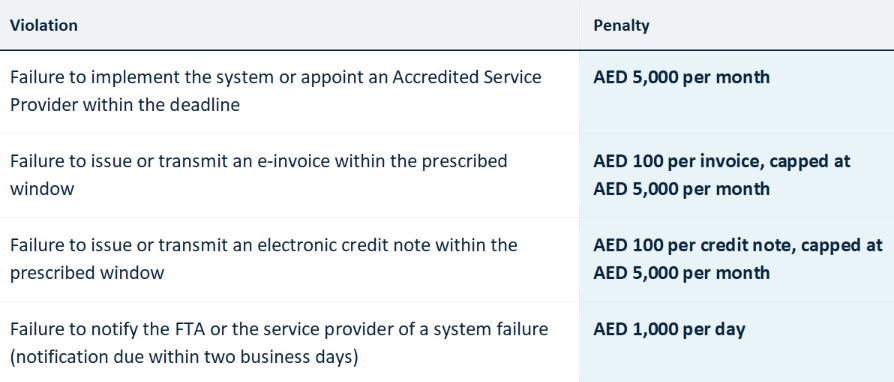
A separate point worth making: the general tax record-keeping penalties under Cabinet Decision No. 40 of 2017 — AED 10,000 for a first offence, AED 20,000 for a repeat within 24 months — continue to apply alongside this regime. The FTA has not replaced one with the other. They enforce both.
The structure matters. A business that misses its appointment deadline, then issues non-compliant invoices for a month, then experiences a system outage without timely notification, can find itself facing three separate penalty streams simultaneously. None of them is ruinous on its own. Stacked, they are not trivial either.
The businesses that will navigate this well are the ones treating it as a finance and operations project first, and an IT project second.
Why this is not an IT project
I have watched finance teams, faced with a digital compliance mandate, reach instinctively for their IT department or ERP vendor. It is an understandable instinct. It is also consistently wrong.
The e-invoicing mandate does not just change the format of an invoice. It changes the process architecture around invoicing. Every invoice must carry a precisely defined set of mandatory fields — buyer and seller electronic addresses tied to Tax Identification Numbers, transaction-type flags, correct tax categorisation at the line level, and the right XML structure. An invoice with a missing field, an incorrect TRN, or a mismatched buyer identifier does not produce a polite error message. It produces a compliance event. And every one of those carries a per-invoice penalty.
The businesses that will navigate this transition well are not the ones with the best ERP. They are the ones who do four unglamorous things before they configure anything:
- They audit their master data. Customer records, supplier records, TRN accuracy, TIN availability for counterparties that are not VAT-registered — all of it, before the system goes live.
- They review their internal approval workflows and document their exception-handling procedures, before the exceptions hit a live compliance environment.
- They select their service provider with enough lead time to onboard, integrate, and test — not the week before the deadline.
- They use the voluntary window deliberately, to run the system in parallel and surface integration issues before those issues carry a financial penalty.
The businesses that will struggle are the ones that leave any of these to the last quarter.
Where the scope is wider than most businesses assume
Two assumptions keep coming up in client conversations, and both are wrong.
"We're a free zone company, so we're exempt."
Free zone businesses are not automatically excluded. The mandate applies to all persons conducting business in the UAE in respect of their B2B and B2G transactions, regardless of VAT registration status, and regardless of location within a free zone or on the mainland. There is no free zone carve-out in the text of Ministerial Decision No. 243 of 2025.
"We're mostly B2C, so this doesn't really affect us."
B2C transactions are currently excluded, but the exclusion is explicitly temporary. A separate Ministerial Decision can switch B2C into scope at any point. Any business with a meaningful B2B tail to its revenue — and most B2C businesses have one — is already in scope for that portion of its transactions. Planning around a B2C-only reading of the mandate is a weak position to be in.
The actual statutory exclusions are narrower than often assumed: sovereign activities of government entities that do not compete with the private sector, certain international airline passenger and goods services (with transitional rules), and certain exempt or zero-rated financial services. If a business does not fall squarely into one of those categories, it is in scope.
What the right answer looks like right now
For large taxpayers, with a mandatory go-live on 1 January 2027, the realistic sequence is:
- Impact assessment and ERP gap analysis — by end of Q2 2026.
- Service provider appointed — by 31 July 2026 (statutory).
- Integration, master-data remediation, parallel running, staff training — July to December 2026.
- Mandatory go-live — 1 January 2027.
For businesses below the AED 50 million threshold, the same sequence applies, shifted six months later. The temptation to use the extra time by starting six months later should be resisted. The work is the same; the resource constraints are typically greater.
A closing thought
The UAE's e-invoicing mandate is not simply a regulatory milestone. It is a signal of how the country's tax infrastructure is evolving — toward near real-time reporting, structured data, and automated cross-border interoperability with other PEPPOL jurisdictions. The firms that recognise this early will not merely comply. They will operate in a system that is faster, more transparent, and more reliable than what they had before.
The firms that delay will find, as my CFO friend is probably finding right now, that compliance was never really the challenge. Readiness was.
Author: Haris Javaid — Managing Partner, ebs Chartered Accountants
I work with UAE-based businesses on VAT, corporate tax, and regulatory readiness. If this piece resonated with something on your own to-do list, I am happy to spend thirty minutes walking through where your organisation sits on the e-invoicing timeline and what the next three months should look like. No deck, no sales pitch — just a straightforward conversation.
[[email protected]] | [+971 52 500 5225] | ebs Chartered Accountants, Dubai

Events Calendar
Upcoming Events

BCCD Breakfast Networking
Wed, 21st Oct 2026
Reform Social & Grill
Kickstart your morning with valuable connections & conversations. This casual yet engaging... Read more

Quick Connect: Meet, Greet, Repeat!
Thu, 22nd Oct 2026
Pronto, Fairmont Dubai
Join us for an exciting evening of speed networking that’s all about making new connecti... Read more

Breast Cancer Awareness Morning
Tue, 27th Oct 2026
SEE Institute
October is Breast Cancer Awareness Month, a time to bring a difficult subject into the ope... Read more


