Decree-Law No. 11 – A Blueprint for a Sustainable Future in the UAE | By Georgina Bonney, Principal Sustainability Consultant at Turner & Townsend
Date Posted:Thu, 12th Jun 2025

A timely ESG-focused legal update by BCCD Member Turner & Townsend.
On 30th May, we saw the implementation of Federal Decree-Law No. (11) of 2024, On the Reduction of Climate Change Effects’ - a significant step in the UAE’s commitment to addressing climate change. This breakthrough legislation signals a national commitment to align with the Paris Agreement, demanding immediate and collective action from all UAE operating businesses.
Scope
Law No.11 is applicable to all public and private companies operating within the United Arab Emirates, including those in free zones. Organisations failing to comply with these regulations face penalties ranging from AED 50,000 to AED 2,000,000, with fines doubled for repeat violations. While the legislation does not currently specify the thresholds for enforcement, it is clear that no sector is exempt.
Objective
The Decree-Law mandates companies across the UAE measure and report on their carbon footprint, whilst implementing initiatives and technologies to reduce their impact. The law aims to:
- Align with the Paris Agreement and supporting the UAE’s Nationally Determined Contribution (NDC) of 40% emissions reduction by 2030.
- Accelerate the UAE’s Net Zero by 2050 transition to a low-carbon economy by mandating emissions reductions, whilst also strengthening the UAE’s position in supporting international climate initiatives.
- Mandate emissions measurement, monitoring, reporting and reduction in line with the UAE’s NDC.
- Guide the development of informed national and sectoral adaptation plans and reduction targets for infrastructure, energy, environment, health, and insurance sectors.
- Build resilience to climate impacts through the reporting of climate risks and opportunities across businesses and their supply chain.
- Encourage innovation through the adoption of and investment in renewable energy, energy efficiency measures, and emerging technologies like carbon capture, use, and storage (CCUS) to support in carbon reductions.
- Establish a National Carbon Credit Registry linked with international markets to support compliance.
- Standardise data reporting to provide real-time insights into national climate performance.
How to prepare
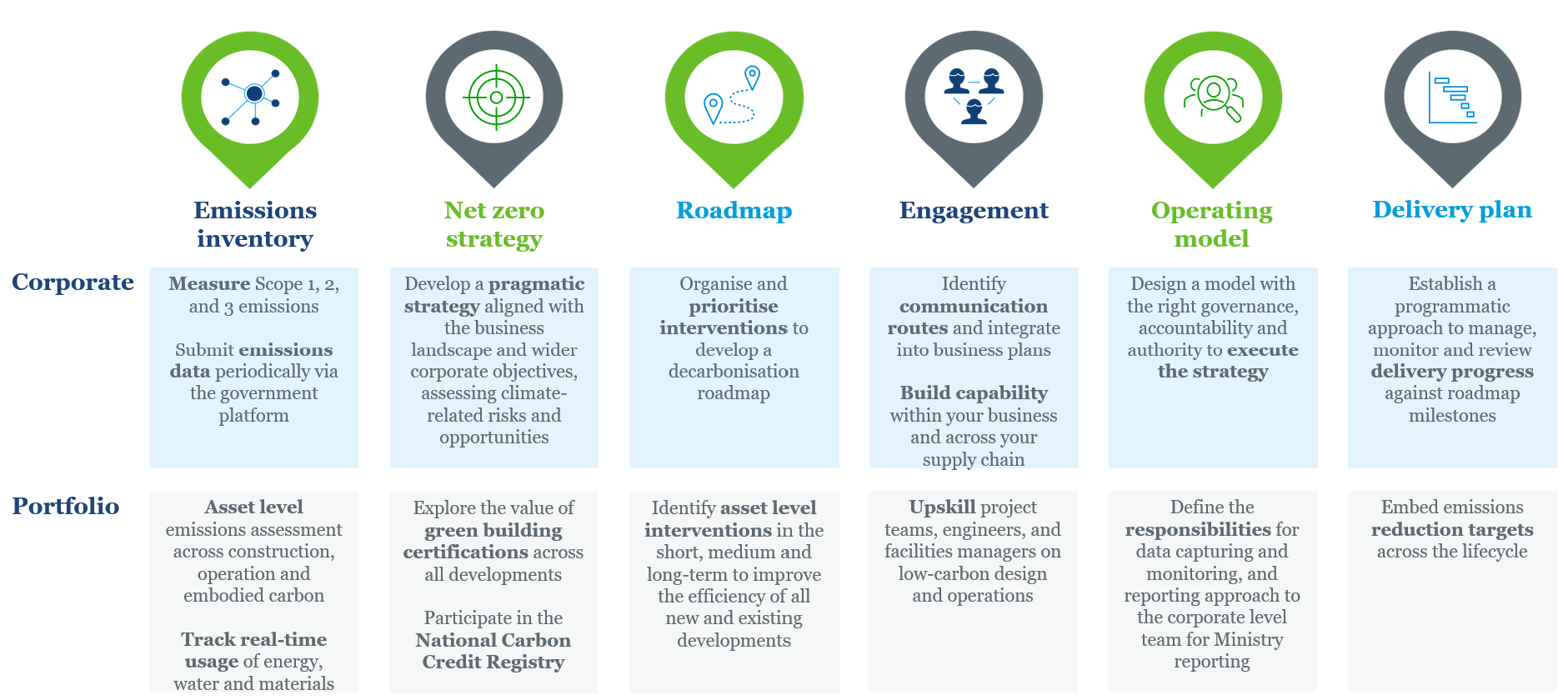
Under the Decree law, businesses are given only 12 months to prepare and transition. The following graphic highlights effective preparation tools to support in the implementation of the regulatory requirements:
What’s next
Evolving away from the traditionally oil and gas prominent market, this Decree-Law will incentivise innovation and transition towards clean energy and operational efficiency, driving economic diversification.
While compliance requires upfront investment, the long-term benefits are clear: operational cost savings, improved resilience, enhanced reputation, investor confidence, and global regulatory alignment. Furthermore, climate action failure and extreme weather were identified by the World Economic Forum as the two greatest risks over the next 5 to 10 years, posing significant impacts to business revenue, operations, and strategy. Identifying, mitigating and adapting to such risks can limit vulnerability to and extent of impact.
Sector specific targets, guidance and training programs will be shared by the Ministry of Climate Change and Environment in due course, to support companies with the transition as well as to facilitate knowledge-sharing and innovation. For those that are keen to get ahead and position themselves as a ‘Sustainability Leader’, consultancies like Turner & Townsend are well-positioned to support businesses on a corporate and development level – offering services such as:
- Accurate carbon footprint calculations,
- Asset audits and efficiency opportunities
- Tailored decarbonisation roadmaps,
- Climate risk integration within Enterprise Risk Management,
- Integration of climate strategy into governance, procurement, construction and operational practices.
Author: Georgina Bonney, Principal Sustainability Consultant at Turner & Townsend

Events Calendar
Upcoming Events

BCCD Breakfast Networking
Wed, 21st Oct 2026
Reform Social & Grill
Kickstart your morning with valuable connections & conversations. This casual yet engaging... Read more

Quick Connect: Meet, Greet, Repeat!
Thu, 22nd Oct 2026
Pronto, Fairmont Dubai
Join us for an exciting evening of speed networking that’s all about making new connecti... Read more

Breast Cancer Awareness Morning
Tue, 27th Oct 2026
SEE Institute
October is Breast Cancer Awareness Month, a time to bring a difficult subject into the ope... Read more


